

17: Art Between the Wars (WWI and WWII)
- Page ID
- 219620

\( \newcommand{\vecs}[1]{\overset { \scriptstyle \rightharpoonup} {\mathbf{#1}} } \)
\( \newcommand{\vecd}[1]{\overset{-\!-\!\rightharpoonup}{\vphantom{a}\smash {#1}}} \)
\( \newcommand{\dsum}{\displaystyle\sum\limits} \)
\( \newcommand{\dint}{\displaystyle\int\limits} \)
\( \newcommand{\dlim}{\displaystyle\lim\limits} \)
\( \newcommand{\id}{\mathrm{id}}\) \( \newcommand{\Span}{\mathrm{span}}\)
( \newcommand{\kernel}{\mathrm{null}\,}\) \( \newcommand{\range}{\mathrm{range}\,}\)
\( \newcommand{\RealPart}{\mathrm{Re}}\) \( \newcommand{\ImaginaryPart}{\mathrm{Im}}\)
\( \newcommand{\Argument}{\mathrm{Arg}}\) \( \newcommand{\norm}[1]{\| #1 \|}\)
\( \newcommand{\inner}[2]{\langle #1, #2 \rangle}\)
\( \newcommand{\Span}{\mathrm{span}}\)
\( \newcommand{\id}{\mathrm{id}}\)
\( \newcommand{\Span}{\mathrm{span}}\)
\( \newcommand{\kernel}{\mathrm{null}\,}\)
\( \newcommand{\range}{\mathrm{range}\,}\)
\( \newcommand{\RealPart}{\mathrm{Re}}\)
\( \newcommand{\ImaginaryPart}{\mathrm{Im}}\)
\( \newcommand{\Argument}{\mathrm{Arg}}\)
\( \newcommand{\norm}[1]{\| #1 \|}\)
\( \newcommand{\inner}[2]{\langle #1, #2 \rangle}\)
\( \newcommand{\Span}{\mathrm{span}}\) \( \newcommand{\AA}{\unicode[.8,0]{x212B}}\)
\( \newcommand{\vectorA}[1]{\vec{#1}} % arrow\)
\( \newcommand{\vectorAt}[1]{\vec{\text{#1}}} % arrow\)
\( \newcommand{\vectorB}[1]{\overset { \scriptstyle \rightharpoonup} {\mathbf{#1}} } \)
\( \newcommand{\vectorC}[1]{\textbf{#1}} \)
\( \newcommand{\vectorD}[1]{\overrightarrow{#1}} \)
\( \newcommand{\vectorDt}[1]{\overrightarrow{\text{#1}}} \)
\( \newcommand{\vectE}[1]{\overset{-\!-\!\rightharpoonup}{\vphantom{a}\smash{\mathbf {#1}}}} \)
\( \newcommand{\vecs}[1]{\overset { \scriptstyle \rightharpoonup} {\mathbf{#1}} } \)
\(\newcommand{\longvect}{\overrightarrow}\)
\( \newcommand{\vecd}[1]{\overset{-\!-\!\rightharpoonup}{\vphantom{a}\smash {#1}}} \)
\(\newcommand{\avec}{\mathbf a}\) \(\newcommand{\bvec}{\mathbf b}\) \(\newcommand{\cvec}{\mathbf c}\) \(\newcommand{\dvec}{\mathbf d}\) \(\newcommand{\dtil}{\widetilde{\mathbf d}}\) \(\newcommand{\evec}{\mathbf e}\) \(\newcommand{\fvec}{\mathbf f}\) \(\newcommand{\nvec}{\mathbf n}\) \(\newcommand{\pvec}{\mathbf p}\) \(\newcommand{\qvec}{\mathbf q}\) \(\newcommand{\svec}{\mathbf s}\) \(\newcommand{\tvec}{\mathbf t}\) \(\newcommand{\uvec}{\mathbf u}\) \(\newcommand{\vvec}{\mathbf v}\) \(\newcommand{\wvec}{\mathbf w}\) \(\newcommand{\xvec}{\mathbf x}\) \(\newcommand{\yvec}{\mathbf y}\) \(\newcommand{\zvec}{\mathbf z}\) \(\newcommand{\rvec}{\mathbf r}\) \(\newcommand{\mvec}{\mathbf m}\) \(\newcommand{\zerovec}{\mathbf 0}\) \(\newcommand{\onevec}{\mathbf 1}\) \(\newcommand{\real}{\mathbb R}\) \(\newcommand{\twovec}[2]{\left[\begin{array}{r}#1 \\ #2 \end{array}\right]}\) \(\newcommand{\ctwovec}[2]{\left[\begin{array}{c}#1 \\ #2 \end{array}\right]}\) \(\newcommand{\threevec}[3]{\left[\begin{array}{r}#1 \\ #2 \\ #3 \end{array}\right]}\) \(\newcommand{\cthreevec}[3]{\left[\begin{array}{c}#1 \\ #2 \\ #3 \end{array}\right]}\) \(\newcommand{\fourvec}[4]{\left[\begin{array}{r}#1 \\ #2 \\ #3 \\ #4 \end{array}\right]}\) \(\newcommand{\cfourvec}[4]{\left[\begin{array}{c}#1 \\ #2 \\ #3 \\ #4 \end{array}\right]}\) \(\newcommand{\fivevec}[5]{\left[\begin{array}{r}#1 \\ #2 \\ #3 \\ #4 \\ #5 \\ \end{array}\right]}\) \(\newcommand{\cfivevec}[5]{\left[\begin{array}{c}#1 \\ #2 \\ #3 \\ #4 \\ #5 \\ \end{array}\right]}\) \(\newcommand{\mattwo}[4]{\left[\begin{array}{rr}#1 \amp #2 \\ #3 \amp #4 \\ \end{array}\right]}\) \(\newcommand{\laspan}[1]{\text{Span}\{#1\}}\) \(\newcommand{\bcal}{\cal B}\) \(\newcommand{\ccal}{\cal C}\) \(\newcommand{\scal}{\cal S}\) \(\newcommand{\wcal}{\cal W}\) \(\newcommand{\ecal}{\cal E}\) \(\newcommand{\coords}[2]{\left\{#1\right\}_{#2}}\) \(\newcommand{\gray}[1]{\color{gray}{#1}}\) \(\newcommand{\lgray}[1]{\color{lightgray}{#1}}\) \(\newcommand{\rank}{\operatorname{rank}}\) \(\newcommand{\row}{\text{Row}}\) \(\newcommand{\col}{\text{Col}}\) \(\renewcommand{\row}{\text{Row}}\) \(\newcommand{\nul}{\text{Nul}}\) \(\newcommand{\var}{\text{Var}}\) \(\newcommand{\corr}{\text{corr}}\) \(\newcommand{\len}[1]{\left|#1\right|}\) \(\newcommand{\bbar}{\overline{\bvec}}\) \(\newcommand{\bhat}{\widehat{\bvec}}\) \(\newcommand{\bperp}{\bvec^\perp}\) \(\newcommand{\xhat}{\widehat{\xvec}}\) \(\newcommand{\vhat}{\widehat{\vvec}}\) \(\newcommand{\uhat}{\widehat{\uvec}}\) \(\newcommand{\what}{\widehat{\wvec}}\) \(\newcommand{\Sighat}{\widehat{\Sigma}}\) \(\newcommand{\lt}{<}\) \(\newcommand{\gt}{>}\) \(\newcommand{\amp}{&}\) \(\definecolor{fillinmathshade}{gray}{0.9}\)Introduction
World War I devastated Europe, and artists responded to the war by creating art that summed up the utter nonsensical nature of this brutality with the art movement called Dada. Dada and other visual arts at this time often used collage to visually communicate ideas. Modern art used for propaganda can be seen in the Russian Constructivist movement and similar art from the Dutch with the De Stijl movement. Exploration of the human psyche in the writings of Andre Breton is part of Surrealism, and several artists are invited into this group, including Salvador Dali and René Magritte. Picasso continues his influence on art by combining aspects of Cubism with recognizable imagery. North American art in the United States and in Mexico is also recognized for originality. Female artists and photographers find success in male-dominated fields and are also noted for their significant artistic contributions. Photography is now being recognized as both an art form and for its ability to document the world through popular publications like Life Magazine. Style comes into the American Industrial Age with the architectural style of Art Deco, which had originated in Paris in the 1910s. In Germany, the Bauhaus, or house for building, became the most influential modern art school in Europe, furthering the concepts of modern art, design, and manufacturing.
DADA: Anti Art (New York and Europe)

The Entombment of the Birds and Butterflies, Jean Arp 1916-17
https://www.youtube.com/watch?v=3wm0589mLbM
https://www.youtube.com/watch?v=dkqJmMECZCs


Fountain, 1917 Marcel Duchamp Mechanical Head, 1920 Raoul Hausmann
https://www.youtube.com/watch?v=ef5_PLKpEiE
https://www.youtube.com/watch?v=ABNwtDyx7T4


Dada Art Cut with the Kitchen Knife Dada Through the Last Weimar Beer Belly Cultural Epoch of Germany, 1919 Hannah Höch

Germany, A Winter's Tale, 1918 George Grosz


I Copper Plate I Zinc Plate I Rubber Cloth 2 Calipers I Drainpipe Telescope I Piping Man, 1920 Max Ernst Untitled, Man Ray 1922
https://www.youtube.com/watch?v=sWAzhHQKX5c
https://www.youtube.com/watch?v=26dRG-iAkWg
https://www.youtube.com/watch?v=2umyxWJslJY

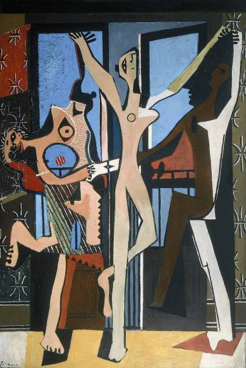
Three Musicians, 1921 Pablo Picasso Three Dancers, 1925 Pablo Picasso
https://www.youtube.com/watch?v=D_D4pwe7NSI
https://www.youtube.com/watch?v=kHcg9U25yV0


Head of a Woman, 1929-30 Pablo Picasso Head, 1935 Julio González
Surrealism:
Andre Breton Manifesto
Breton wrote the manifesto of 1924 that defines the purposes of the group. He included citations of the influences on Surrealism, examples of Surrealist works and discussion of Surrealist automatism.
Dictionary: Surrealism, n. Pure psychic automatism, by which one proposes to express, either verbally, in writing, or by any other manner, the real functioning of thought. Dictation of thought in the absence of all control exercised by reason, outside of all aesthetic and moral preoccupation.
Encyclopedia: Surrealism. Philosophy. Surrealism is based on the belief in the superior reality of certain forms of previously neglected associations, in the omnipotence of dream, in the disinterested play of thought. It tends to ruin once and for all other psychic mechanisms and to substitute itself for them in solving all the principal problems of life.
- The mind unbounded. Complete freedom of expression without societal, religious moral constraints.
- Technique still important to communicate visual ideas.
- Painting, film, photography and sculpture media are used. There is certainly exaggeration of forms in this art movement! The following slides show several examples.


Attirement of the Bride, Max Ernst (1940) The Elephants Celebes, 1921 Max Ernst
https://www.youtube.com/watch?v=8BkXjea4NBc

Salvador Dali
https://www.youtube.com/watch?v=gA0RAPh2ZgU
https://www.youtube.com/watch?v=BH7xxDLexvw

The Persistence of Memory (Melting Clocks), 1931 Salvador Dali
https://www.youtube.com/watch?v=dHY9mBvlRec
https://www.youtube.com/watch?v=6mp-fBJNQmU
https://www.britannica.com/video/240496/Salvador-Dali-Persistence-of-Memory

Dali

Dali

The False Mirror, 1928 René Magritte
https://www.youtube.com/watch?v=-bX9cFGKm1o
https://www.youtube.com/watch?v=NZCE3ot6lf8
https://www.youtube.com/watch?v=Jf3XhoVkRFI

Behind the Gare Saint-Lazare, Cartier-Bresson (1932)
https://www.youtube.com/watch?v=WsNnJLv1pkk

The Gift, Man Ray (1921)
https://www.youtube.com/watch?v=9vlyStRcxoQ
https://www.youtube.com/watch?v=vcPJWZcxqvM

Object (Luncheon in Fur), Méret Oppenheim (1936)
Sculpture


Lobster Trap and Fish Tail, 1939 Alexander Calder

Alexander Calder
https://www.youtube.com/watch?v=CIEqg-nSu7M
https://www.youtube.com/watch?v=FUchd9wwBoI

Recumbent Figure, 1938 Henry Moore

Sculpture with Color (Deep Blue and Red) [6] 1943 Barbara Hepworth
https://www.youtube.com/watch?v=8PPM8foaH_k
Russian Constructivism
https://www.youtube.com/watch?v=BuefUigp0Ws

Monument of the Third International (Tatlin's Tower), 1919-20 Vladimir Tatlin
https://www.youtube.com/watch?v=7KyWM9LrEcQ

Advertisement: "Books!", 1925 Alexander Rodchenko
De Stijl Movement

Composition No. II/Composition No. I//Composition en Rouge, Bleu et Jaune (Composition with Red, Blue, and Yellow), 1930 Piet Mondrian

Gerrit Rietveld, Interior of Schröder House, with "Red-Blue" chair, Utrecht, Holland 1924
Bauhaus
https://www.youtube.com/watch?v=lhXPQt8U3Zs

Walter Gropius, Werkbund housing development, Stuttgart, Germany (furniture by Marcel Breuer) 1927
https://www.youtube.com/watch?v=oqK5K6qFJuI

Walter Gropius, Shop Block of the Bauhaus , Dessau, Germany 1925-26

Ludwig Mies van der Rohe, German Pavilion 1929 (Guggenheim International Exposition, Barcelona)

Interior of the German Pavilion, 1929
Reinforced Concrete

Auguste Perret, Notre Dame, Le Raincy, France 1923-24

Françoise Hennebique, System for reinforced concrete, 1892 (After Curtis)
Art Deco

The Voice of the City (New York Interpreted), 1920-22 Joseph Stella (see below)


https://www.youtube.com/watch?v=B7MzNE66TlI

Wire Wheel, 1917 Paul Strand
https://www.youtube.com/watch?v=pm7CEt2okuc


Photography by Margaret Bourke-White 1930s
https://www.youtube.com/watch?v=FVzRbbCFeCA

My Egypt, 1927 Charles Demuth
https://www.youtube.com/watch?v=cDezhBHW4MM

William van Alen, Chrysler Building, New York, 1928-30
Painting and Photography in America

Black Iris III, 1926 Georgia O'Keefe
https://www.youtube.com/watch?v=83ggxS21mFM

Pepper, 1930 Edward Weston
Vintage film covering Weston available in the link below:
https://www.youtube.com/watch?v=yjSWgoRTn2Q

Photos by Edward Weston 1930s
https://www.sfmoma.org/watch/edward-weston-nature-is-the-great-stimulus/

American Gothic, 1930 Grant Wood
https://www.britannica.com/video/239225/interpretations-Grant-Wood-American-Gothic

In the North the Negro Had Better Educational Facilities, 1940-41 Jacob Lawrence
Frieda Kahlo and Diego Rivera

Man, Controller of the Universe, 1934 Diego Rivera
https://www.sfmoma.org/watch/how-diego-rivera-made-his-murals/
https://www.youtube.com/watch?v=mrT0uuZGxFU

The Two Fridas, 1939 Frida Kahlo
Edward Hopper

Early Sunday Morning, 1930 Edward Hopper
https://www.youtube.com/watch?v=lKIbT-4UFaE

Migrant Mother, California, 1936 Dorothea Lange
https://www.youtube.com/watch?v=Ae1n1JQ0wKc
https://www.youtube.com/watch?v=21nPEFybmtQ
