

3.3: Questions to Consider
- Page ID
- 376320

\( \newcommand{\vecs}[1]{\overset { \scriptstyle \rightharpoonup} {\mathbf{#1}} } \)
\( \newcommand{\vecd}[1]{\overset{-\!-\!\rightharpoonup}{\vphantom{a}\smash {#1}}} \)
\( \newcommand{\dsum}{\displaystyle\sum\limits} \)
\( \newcommand{\dint}{\displaystyle\int\limits} \)
\( \newcommand{\dlim}{\displaystyle\lim\limits} \)
\( \newcommand{\id}{\mathrm{id}}\) \( \newcommand{\Span}{\mathrm{span}}\)
( \newcommand{\kernel}{\mathrm{null}\,}\) \( \newcommand{\range}{\mathrm{range}\,}\)
\( \newcommand{\RealPart}{\mathrm{Re}}\) \( \newcommand{\ImaginaryPart}{\mathrm{Im}}\)
\( \newcommand{\Argument}{\mathrm{Arg}}\) \( \newcommand{\norm}[1]{\| #1 \|}\)
\( \newcommand{\inner}[2]{\langle #1, #2 \rangle}\)
\( \newcommand{\Span}{\mathrm{span}}\)
\( \newcommand{\id}{\mathrm{id}}\)
\( \newcommand{\Span}{\mathrm{span}}\)
\( \newcommand{\kernel}{\mathrm{null}\,}\)
\( \newcommand{\range}{\mathrm{range}\,}\)
\( \newcommand{\RealPart}{\mathrm{Re}}\)
\( \newcommand{\ImaginaryPart}{\mathrm{Im}}\)
\( \newcommand{\Argument}{\mathrm{Arg}}\)
\( \newcommand{\norm}[1]{\| #1 \|}\)
\( \newcommand{\inner}[2]{\langle #1, #2 \rangle}\)
\( \newcommand{\Span}{\mathrm{span}}\) \( \newcommand{\AA}{\unicode[.8,0]{x212B}}\)
\( \newcommand{\vectorA}[1]{\vec{#1}} % arrow\)
\( \newcommand{\vectorAt}[1]{\vec{\text{#1}}} % arrow\)
\( \newcommand{\vectorB}[1]{\overset { \scriptstyle \rightharpoonup} {\mathbf{#1}} } \)
\( \newcommand{\vectorC}[1]{\textbf{#1}} \)
\( \newcommand{\vectorD}[1]{\overrightarrow{#1}} \)
\( \newcommand{\vectorDt}[1]{\overrightarrow{\text{#1}}} \)
\( \newcommand{\vectE}[1]{\overset{-\!-\!\rightharpoonup}{\vphantom{a}\smash{\mathbf {#1}}}} \)
\( \newcommand{\vecs}[1]{\overset { \scriptstyle \rightharpoonup} {\mathbf{#1}} } \)
\(\newcommand{\longvect}{\overrightarrow}\)
\( \newcommand{\vecd}[1]{\overset{-\!-\!\rightharpoonup}{\vphantom{a}\smash {#1}}} \)
\(\newcommand{\ket}[1]{\left| #1 \right>}\)
\(\newcommand{\bra}[1]{\left< #1 \right|}\)
\(\newcommand{\braket}[2]{\left< #1 \vphantom{#2} \right| \left. #2 \vphantom{#1} \right>}\)
\(\newcommand{\braopket}[3]{\left< #1 \vphantom{#2}\vphantom{#3} \right| #2 \vphantom{#1}\vphantom{#3} \left| #3 \vphantom{#1}\vphantom{#2} \right>}\)
\(\newcommand{\qmvec}[1]{\mathbf{\vec{#1}}}\)
\(\newcommand{\op}[1]{\hat{\mathbf{#1}}}\)
\(\newcommand{\expect}[1]{\langle #1 \rangle}\)
\(\newcommand{\dfn}[1]{\emph{\textbf{#1}}}\)

Questions to Consider
Is there a difference between art and craft?
Difference between art and craft?
by TED-Ed
Was da Vinci an artistic genius? Sure, but he was also born in the right place at the right time — pre-Renaissance, Western artists got little individual credit for their work. And in many non-Western cultures, traditional forms have always been prized over innovation. So, where do we get our notions of art vs. craft? Laura Morelli traces the history of how we assign value to the visual arts. Lesson by Laura Morelli, animation by Sandro Katamashvili.
Citation: TED-Ed, "Is there a difference between art and craft?," in Smarthistory, December 20, 2015, accessed December 15, 2025, SmartHistory Art and Craft [smarthistory.org].
What does it mean to be an "old master" and to make a "masterpiece"?
What does it mean to be an “old master” and to make a “masterpiece”?
by Museum of Contemporary Art, Chicago
This video featuring Kerry James Marshall talking about his practice and the ideas driving it accompanied the exhibition Kerry James Marshall: Mastry, organized by the Museum of Contemporary Art Chicago, The Metropolitan Museum of Art, New York, and The Museum of Contemporary Art, Los Angeles. The exhibition is cocurated by Dieter Roelstraete, former Manilow Senior Curator at the MCA; Helen Molesworth, Chief Curator at MOCA; and Ian Alteveer, Associate Curator at The Met. At the MCA, the exhibition was realized with the assistance of former Curatorial Assistant Karsten Lund and former Research Associate Abigail Winograd.
This video featuring Kerry James Marshall talking about his practice and the ideas driving it accompanied the exhibition Kerry James Marshall: Mastry, organized by the Museum of Contemporary Art Chicago, The Metropolitan Museum of Art, New York, and The Museum of Contemporary Art, Los Angeles. The exhibition is cocurated by Dieter Roelstraete, former Manilow Senior Curator at the MCA; Helen Molesworth, Chief Curator at MOCA; and Ian Alteveer, Associate Curator at The Met. At the MCA, the exhibition was realized with the assistance of former Curatorial Assistant Karsten Lund and former Research Associate Abigail Winograd.
Citation: Museum of Contemporary Art, Chicago, "What does it mean to be an “old master” and to make a “masterpiece”?," in Smarthistory, May 21, 2021, accessed December 17, 2025, SmartHistory Mastry [smarthistory.org].
What's the point of realism?
What’s the point of making realistic paintings when photography can do the trick? We look at the history of artists recreating the world as we see it and ponder why it’s still happening.
Citation: The Art Assignment, "The case for Realism," in Smarthistory, March 4, 2019, accessed December 15, 2025, Realism [smarthistory.org].
What made art valuable, in the Middle Ages and Renaissance vs. now?
by Dr. Steven Zucker and Dr. Beth Harris
For artists working in the West in the period before the modern era(opens in new window) (before about 1800 or so), the process of selling art was different than it is now. In the Middle Ages(opens in new window) and in the Renaissance(opens in new window) works of art were commissioned, that is, they were ordered by a patron (the person paying for the work of art), and then made to order. A patron usually entered into a contract with an artist that specified how much he would be paid, what kinds of materials would be used, how long it would take to complete, and what the subject of the work would be.
Not what we would consider artistic freedom—but it did have its advantages. You didn’t paint something and then just hope it would sell, the way artists often do now.
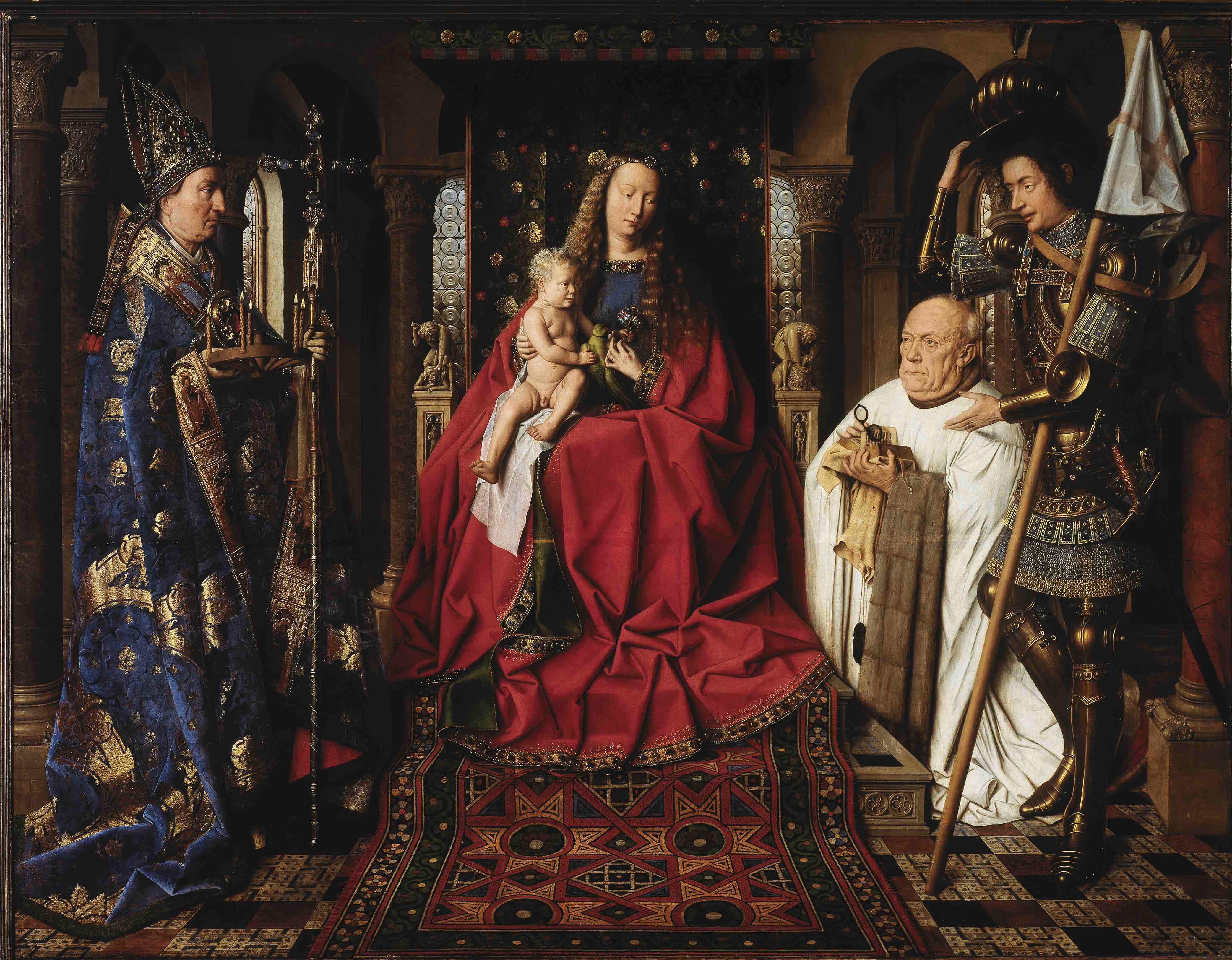
Patrons often asked to be included in the painting they commissioned. When patrons appear in a painting we usually refer to them as donors. In this painting, the donor is shown kneeling on the right before the Virgin Mary and the Christ Child. Jan van Eyck, The Virgin and Child with Canon van der Paele, 1436, oil on panel, 141 x 176.5 cm (including frame) (Groeningemuseum(opens in new window), Bruges)
What was the status of the artist before the modern era?
One way to understand this is to think about what you “order” to have made for you today. A pizza comes to mind—ordered from the cook at the local pizza parlor—”I’ll have a large pie with pepperoni,” or a birthday cake from a baker—”I’d like a chocolate cake with mocha icing and blue letters that say ‘Happy Birthday Jerry.'” Or perhaps you ordered a set of bookshelves from a carpenter, or a wedding dress from a seamstress?
Does our culture consider cooks and carpenters to be as high in their status as lawyers or doctors (remember we’re not asking what we think, but what value our culture generally gives to those professions)? Our culture creates a distinction that we sometimes refer to as “blue collar” work versus “white collar” work.
In the Middle Ages and even for much of the Renaissance, the artist was seen as someone who worked with his or her hands—they were considered skilled laborers, craftsmen, or artisans. This was something that Renaissance artists fought fiercely against. They wanted, understandably, to be considered as thinkers and innovators. And during the Renaissance the status of the artist does change dramatically, but it would take centuries for successful artists to gain the extremely high status we grant to “art stars” today (for example, Pablo Picasso(opens in new window), Andy Warhol(opens in new window), Jeff Koons(opens in new window), or Damien Hirst(opens in new window)).
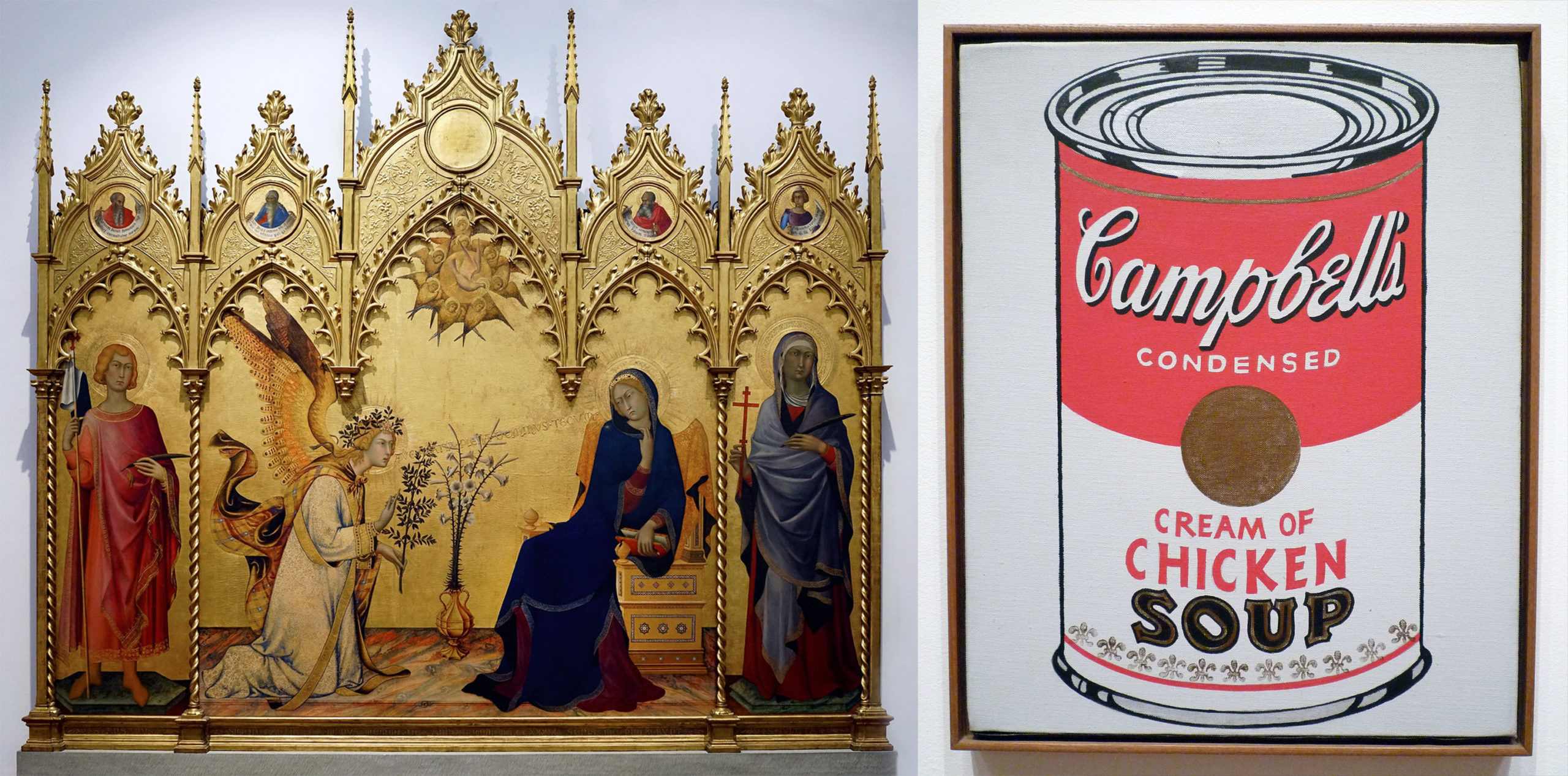
Left: Simone Martini, Annunciation, 1333, tempera on panel, 184 x 210 cm (Uffizi Gallery, Florence; photo: Steven Zucker(opens in new window), CC BY-NC-SA 2.0); right: soup can (detail), Andy Warhol, Campbell’s Soup Cans, 1962, synthetic polymer on thirty-two canvases, each canvas 20 x 16 inches (Museum of Modern Art, New York; photo: Steven Zucker(opens in new window), CC BY-NC-SA 2.0)
What we value has changed
Medieval paintings were often sumptuous objects made with gold(opens in new window) and other precious materials (like Simone Martini’s Annunciation(opens in new window)). What made these paintings valuable were these materials (blue, for example, was often made from the rare and expensive semi-precious stone, lapis lazuli(opens in new window)). These materials were lavished on objects to express religious devotion or to reflect the wealth and status of its patron. Today the value of a painting is often the result of something entirely different. Picasso could have painted on a napkin and it would have been incredibly valuable just because it was by Picasso—art is now an expression of the artist and materials often have little to do with the worth of the art.
Important fundamentals
Why commission artwork during the Renaissance?(opens in new window)
Learn about the role of the workshop in Italian Renaissance art(opens in new window)
Cite this page
Cite this page as: Dr. Steven Zucker and Dr. Beth Harris, "What made art valuable, in the Middle Ages and Renaissance vs. now," in Smarthistory, August 8, 2015, accessed December 17, 2025, Valuable Art then and now [smarthistory.org].
- 3.3.1: Using Cultural Theory to Investigate the Debate- Art vs. Craft
- This page explores the economic landscape of Renaissance Florence, focusing on the Medici family's influence on art and banking. It discusses the intersection of commerce and art through figures like Henry Hope, critiquing the separation of art and craft as a reflection of capitalist interests. The text highlights the impact of civic humanism and families like the Fuggers on wealth, power, and artistic patronage.
- 3.3.2: Medici Art
- This page explores the Medici family's impact on art and culture in Renaissance Florence, highlighting their wealth from banking and patronage of artists like Benozzo Gozzoli. The opulence of the Medici Chapel and its frescoes symbolizes their power and spiritual aspirations. Gozzoli's artworks uniquely depict the Medici as part of the Magi's journey, linking them to biblical wealth and generosity.
- 3.3.3: The Bauhaus Design
- This page explores the Bauhaus, a pivotal art and design school founded by Walter Gropius in 1919. It highlights the school's historical impact, merging art with industrial production and emphasizing a unified approach to art and craft. Key figures like Gropius and Marcel Breuer led significant design innovations, including Breuer's iconic B33 chair, which exemplifies minimalist aesthetics and ergonomic functionality.