

Humanities LibreTexts

2.4: Register Designation, The Octave, 8va, and 8vb

  • Page ID
    756
    • Anonymous
    • LibreTexts

    \( \newcommand{\vecs}[1]{\overset { \scriptstyle \rightharpoonup} {\mathbf{#1}} } \)

    \( \newcommand{\vecd}[1]{\overset{-\!-\!\rightharpoonup}{\vphantom{a}\smash {#1}}} \)

    \( \newcommand{\dsum}{\displaystyle\sum\limits} \)

    \( \newcommand{\dint}{\displaystyle\int\limits} \)

    \( \newcommand{\dlim}{\displaystyle\lim\limits} \)

    \( \newcommand{\id}{\mathrm{id}}\) \( \newcommand{\Span}{\mathrm{span}}\)

    ( \newcommand{\kernel}{\mathrm{null}\,}\) \( \newcommand{\range}{\mathrm{range}\,}\)

    \( \newcommand{\RealPart}{\mathrm{Re}}\) \( \newcommand{\ImaginaryPart}{\mathrm{Im}}\)

    \( \newcommand{\Argument}{\mathrm{Arg}}\) \( \newcommand{\norm}[1]{\| #1 \|}\)

    \( \newcommand{\inner}[2]{\langle #1, #2 \rangle}\)

    \( \newcommand{\Span}{\mathrm{span}}\)

    \( \newcommand{\id}{\mathrm{id}}\)

    \( \newcommand{\Span}{\mathrm{span}}\)

    \( \newcommand{\kernel}{\mathrm{null}\,}\)

    \( \newcommand{\range}{\mathrm{range}\,}\)

    \( \newcommand{\RealPart}{\mathrm{Re}}\)

    \( \newcommand{\ImaginaryPart}{\mathrm{Im}}\)

    \( \newcommand{\Argument}{\mathrm{Arg}}\)

    \( \newcommand{\norm}[1]{\| #1 \|}\)

    \( \newcommand{\inner}[2]{\langle #1, #2 \rangle}\)

    \( \newcommand{\Span}{\mathrm{span}}\) \( \newcommand{\AA}{\unicode[.8,0]{x212B}}\)

    \( \newcommand{\vectorA}[1]{\vec{#1}}      % arrow\)

    \( \newcommand{\vectorAt}[1]{\vec{\text{#1}}}      % arrow\)

    \( \newcommand{\vectorB}[1]{\overset { \scriptstyle \rightharpoonup} {\mathbf{#1}} } \)

    \( \newcommand{\vectorC}[1]{\textbf{#1}} \)

    \( \newcommand{\vectorD}[1]{\overrightarrow{#1}} \)

    \( \newcommand{\vectorDt}[1]{\overrightarrow{\text{#1}}} \)

    \( \newcommand{\vectE}[1]{\overset{-\!-\!\rightharpoonup}{\vphantom{a}\smash{\mathbf {#1}}}} \)

    \( \newcommand{\vecs}[1]{\overset { \scriptstyle \rightharpoonup} {\mathbf{#1}} } \)

    \(\newcommand{\longvect}{\overrightarrow}\)

    \( \newcommand{\vecd}[1]{\overset{-\!-\!\rightharpoonup}{\vphantom{a}\smash {#1}}} \)

    \(\newcommand{\avec}{\mathbf a}\) \(\newcommand{\bvec}{\mathbf b}\) \(\newcommand{\cvec}{\mathbf c}\) \(\newcommand{\dvec}{\mathbf d}\) \(\newcommand{\dtil}{\widetilde{\mathbf d}}\) \(\newcommand{\evec}{\mathbf e}\) \(\newcommand{\fvec}{\mathbf f}\) \(\newcommand{\nvec}{\mathbf n}\) \(\newcommand{\pvec}{\mathbf p}\) \(\newcommand{\qvec}{\mathbf q}\) \(\newcommand{\svec}{\mathbf s}\) \(\newcommand{\tvec}{\mathbf t}\) \(\newcommand{\uvec}{\mathbf u}\) \(\newcommand{\vvec}{\mathbf v}\) \(\newcommand{\wvec}{\mathbf w}\) \(\newcommand{\xvec}{\mathbf x}\) \(\newcommand{\yvec}{\mathbf y}\) \(\newcommand{\zvec}{\mathbf z}\) \(\newcommand{\rvec}{\mathbf r}\) \(\newcommand{\mvec}{\mathbf m}\) \(\newcommand{\zerovec}{\mathbf 0}\) \(\newcommand{\onevec}{\mathbf 1}\) \(\newcommand{\real}{\mathbb R}\) \(\newcommand{\twovec}[2]{\left[\begin{array}{r}#1 \\ #2 \end{array}\right]}\) \(\newcommand{\ctwovec}[2]{\left[\begin{array}{c}#1 \\ #2 \end{array}\right]}\) \(\newcommand{\threevec}[3]{\left[\begin{array}{r}#1 \\ #2 \\ #3 \end{array}\right]}\) \(\newcommand{\cthreevec}[3]{\left[\begin{array}{c}#1 \\ #2 \\ #3 \end{array}\right]}\) \(\newcommand{\fourvec}[4]{\left[\begin{array}{r}#1 \\ #2 \\ #3 \\ #4 \end{array}\right]}\) \(\newcommand{\cfourvec}[4]{\left[\begin{array}{c}#1 \\ #2 \\ #3 \\ #4 \end{array}\right]}\) \(\newcommand{\fivevec}[5]{\left[\begin{array}{r}#1 \\ #2 \\ #3 \\ #4 \\ #5 \\ \end{array}\right]}\) \(\newcommand{\cfivevec}[5]{\left[\begin{array}{c}#1 \\ #2 \\ #3 \\ #4 \\ #5 \\ \end{array}\right]}\) \(\newcommand{\mattwo}[4]{\left[\begin{array}{rr}#1 \amp #2 \\ #3 \amp #4 \\ \end{array}\right]}\) \(\newcommand{\laspan}[1]{\text{Span}\{#1\}}\) \(\newcommand{\bcal}{\cal B}\) \(\newcommand{\ccal}{\cal C}\) \(\newcommand{\scal}{\cal S}\) \(\newcommand{\wcal}{\cal W}\) \(\newcommand{\ecal}{\cal E}\) \(\newcommand{\coords}[2]{\left\{#1\right\}_{#2}}\) \(\newcommand{\gray}[1]{\color{gray}{#1}}\) \(\newcommand{\lgray}[1]{\color{lightgray}{#1}}\) \(\newcommand{\rank}{\operatorname{rank}}\) \(\newcommand{\row}{\text{Row}}\) \(\newcommand{\col}{\text{Col}}\) \(\renewcommand{\row}{\text{Row}}\) \(\newcommand{\nul}{\text{Nul}}\) \(\newcommand{\var}{\text{Var}}\) \(\newcommand{\corr}{\text{corr}}\) \(\newcommand{\len}[1]{\left|#1\right|}\) \(\newcommand{\bbar}{\overline{\bvec}}\) \(\newcommand{\bhat}{\widehat{\bvec}}\) \(\newcommand{\bperp}{\bvec^\perp}\) \(\newcommand{\xhat}{\widehat{\xvec}}\) \(\newcommand{\vhat}{\widehat{\vvec}}\) \(\newcommand{\uhat}{\widehat{\uvec}}\) \(\newcommand{\what}{\widehat{\wvec}}\) \(\newcommand{\Sighat}{\widehat{\Sigma}}\) \(\newcommand{\lt}{<}\) \(\newcommand{\gt}{>}\) \(\newcommand{\amp}{&}\) \(\definecolor{fillinmathshade}{gray}{0.9}\)
    Learning Objectives
    • Understanding the use of register designations and labeling specific pitches.
    • Understanding the term octave and its use.
    • Understanding 8va and 8vb as notation conventions.

    By using the Grand Staff, we can locate specific pitches from low to high. However it is necessary to assign more precise values to pitches according to their specific range in this spectrum. For this task we employ register designations.

    The Octave

    To do this, we first separate the entire span of pitches into discrete segments labeled octaves (Italian: ottava “eight”). In this context, an octave is a segment of pitches spanning the distance from one pitch to its pitch-class counterpart above or below. Further, it is customary to speak of pitches as residing in some particular “octave.”

    Sheet music excerpt featuring a treble clef, notes, and rests on a five-line staff.
    Figure 2.17 Octave

    Using the octave as a range-specific designator, pitches can be precisely located and identified by letter name as well as by register. Originally, a register designation system evolved that employed upper- and lower-case letter names. Multiple lower case letters (C, CC, CCC) denoted lower octaves while upper-case letter names followed by one or more apostrophes denoted higher octaves. While this system may still be encountered occasionally, it is gradually being abandoned in favor of a more malleable system.

    Register Designation

    In the 1970’s, the Acoustical Society of America instituted a register designation system based upon the layout of the piano keyboard. This system uses letter names to denote pitch. Each letter name is followed by a number denoting the octave within which that pitch resides. Each octave begins with the note “C” and extends to the “B” seven steps above.

    There are three pitches below the lowest C (C1) on the average piano keyboard. These notes are labeled in two ways: A0, Bb0, B0, or simply A, Bb, B. So, the entire piano keyboard spans the range from A0 to C8. Figure 2.18 shows this entire keyboard with each octave designation labeled.
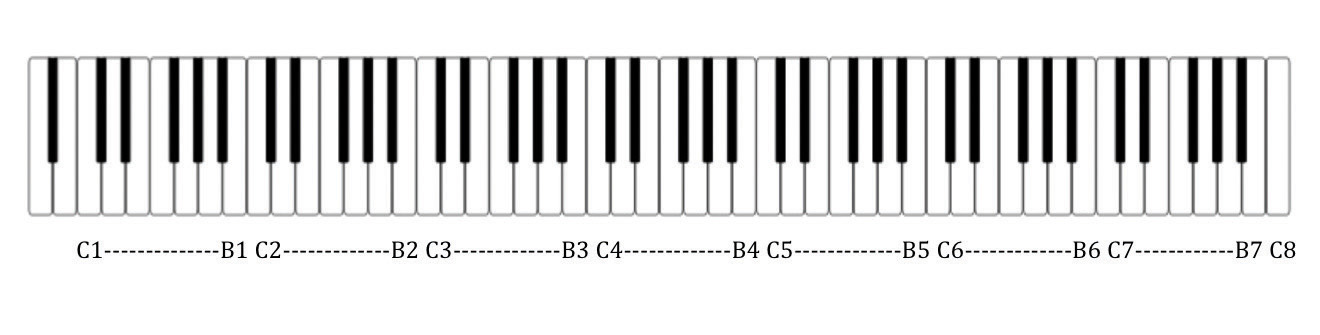
    A keyboard layout showing a series of black and white piano keys labeled with musical notes.
    Figure 2.18 Keyboard with Octave Designations

    © Wikicommons, Artur Jan Fijalkowski

    The use of register designations is coupled with, and reinforced by, the visual tool of the piano keyboard. This becomes an indispensable skill for every musician.

    Often the range of a particular segment of music will be written in extremes of register, high or low. This is notated using multiple ledger lines. Often, as a notational convenience and to make for ease of reading, composers may employ symbols denoting that a passage is played an octave higher than written (8va-ottava), or an octave lower than written (8vb-ottava bassa). In order to avoid using ledger lines, the passage is written in a lower octave, then labeled above the staff if 8va, below the staff if 8vb. A bracket extends from the ottava symbol to the end of the passage that is raised or lowered.
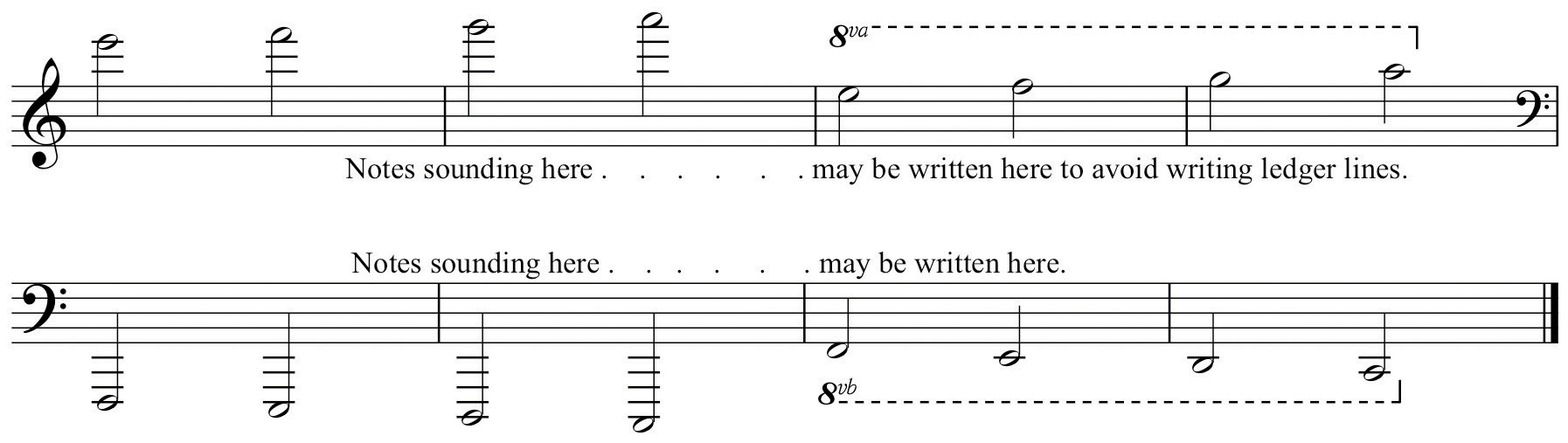
    Musical notation featuring notes on a staff with lyrics below, suggesting the melody and words of a song.
    Figure 2.19 8va, 8vb

    At times composers will use the symbols 15ma and 15mb to denote that the passage is to be played two octaves higher or lower. While uncommon, this is occasionally used, especially as a notational convenience. A composer may indicate that a passage is to be performed two octaves higher or lower by including this as an instruction.

    Sheet music fragment displaying notes on a treble clef staff, including rests and a key signature.
    Figure 2.20 15ma

    Conclusion

    • Understanding and employing register designations for locating pitch.
    • Use of the piano keyboard to support recognizing registral designations.
    • 8va and 8vb, 15ma and 15mb
    Exercise 1:
    1. Define octave. Define register designation.
    2. On the keyboard diagram provided, label octave designations.

      Figure 2.21 Octave Designations

      A close-up view of a piano keyboard featuring black and white keys in a standard layout.

      © Thinkstock

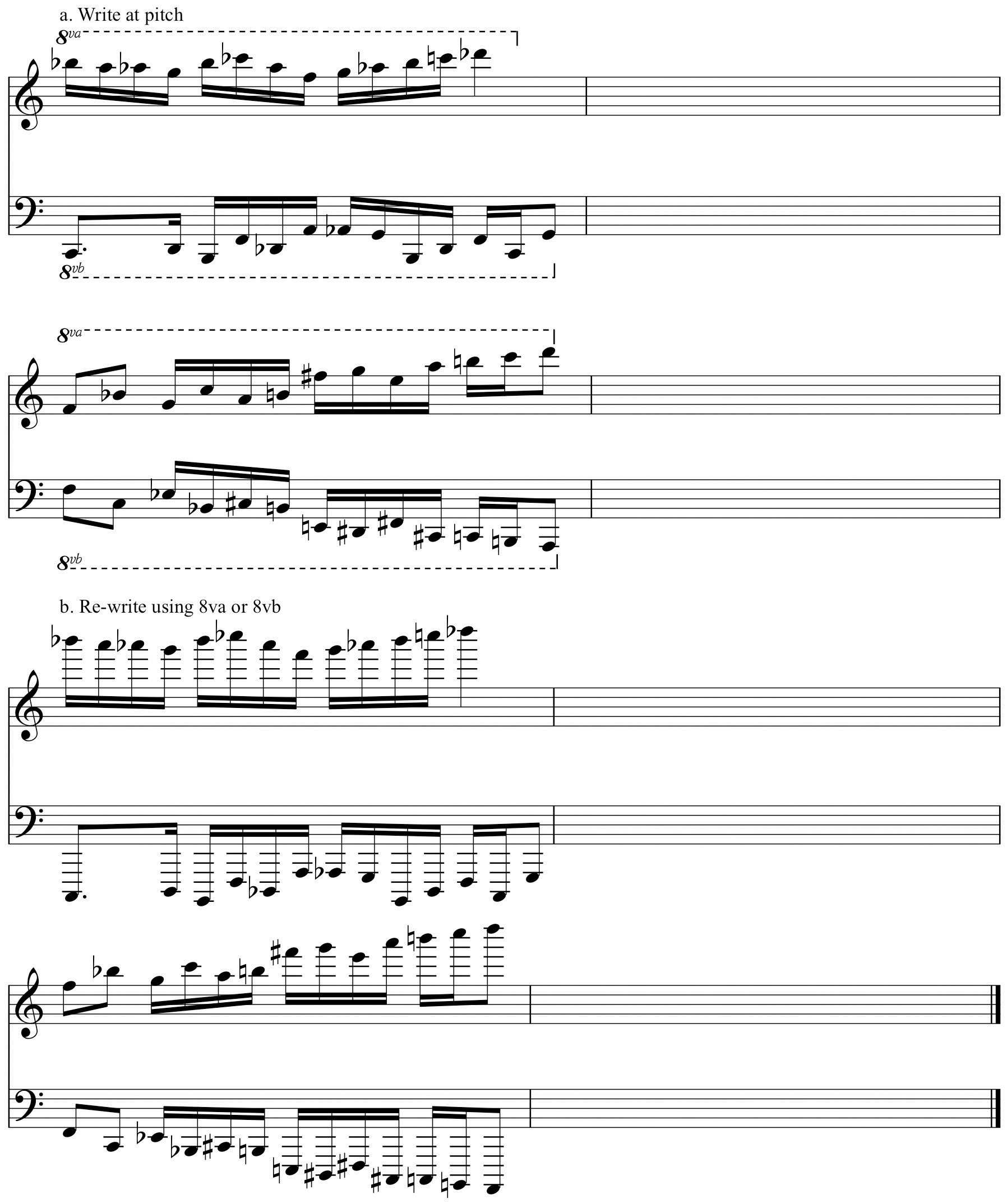
    3. On the example provided:
      1. Re-write 8va and 8vb segments at pitch.
      2. Re-write segments employing 8va and 8vb.

      Figure 2.22 8va, 8vb
      Sheet music featuring several staves with musical notes and symbols, arranged for a musical composition.

    This page titled 2.4: Register Designation, The Octave, 8va, and 8vb was last modified on Mon, 31 Aug 2026 07:16:56 GMT and is shared under a CC BY-NC-SA 3.0 license and was authored, remixed, and/or curated by Anonymous via source content that was edited to the style and standards of the LibreTexts platform.