

19.4: Peinture et sculpture
- Page ID
- 135065

\( \newcommand{\vecs}[1]{\overset { \scriptstyle \rightharpoonup} {\mathbf{#1}} } \)
\( \newcommand{\vecd}[1]{\overset{-\!-\!\rightharpoonup}{\vphantom{a}\smash {#1}}} \)
\( \newcommand{\dsum}{\displaystyle\sum\limits} \)
\( \newcommand{\dint}{\displaystyle\int\limits} \)
\( \newcommand{\dlim}{\displaystyle\lim\limits} \)
\( \newcommand{\id}{\mathrm{id}}\) \( \newcommand{\Span}{\mathrm{span}}\)
( \newcommand{\kernel}{\mathrm{null}\,}\) \( \newcommand{\range}{\mathrm{range}\,}\)
\( \newcommand{\RealPart}{\mathrm{Re}}\) \( \newcommand{\ImaginaryPart}{\mathrm{Im}}\)
\( \newcommand{\Argument}{\mathrm{Arg}}\) \( \newcommand{\norm}[1]{\| #1 \|}\)
\( \newcommand{\inner}[2]{\langle #1, #2 \rangle}\)
\( \newcommand{\Span}{\mathrm{span}}\)
\( \newcommand{\id}{\mathrm{id}}\)
\( \newcommand{\Span}{\mathrm{span}}\)
\( \newcommand{\kernel}{\mathrm{null}\,}\)
\( \newcommand{\range}{\mathrm{range}\,}\)
\( \newcommand{\RealPart}{\mathrm{Re}}\)
\( \newcommand{\ImaginaryPart}{\mathrm{Im}}\)
\( \newcommand{\Argument}{\mathrm{Arg}}\)
\( \newcommand{\norm}[1]{\| #1 \|}\)
\( \newcommand{\inner}[2]{\langle #1, #2 \rangle}\)
\( \newcommand{\Span}{\mathrm{span}}\) \( \newcommand{\AA}{\unicode[.8,0]{x212B}}\)
\( \newcommand{\vectorA}[1]{\vec{#1}} % arrow\)
\( \newcommand{\vectorAt}[1]{\vec{\text{#1}}} % arrow\)
\( \newcommand{\vectorB}[1]{\overset { \scriptstyle \rightharpoonup} {\mathbf{#1}} } \)
\( \newcommand{\vectorC}[1]{\textbf{#1}} \)
\( \newcommand{\vectorD}[1]{\overrightarrow{#1}} \)
\( \newcommand{\vectorDt}[1]{\overrightarrow{\text{#1}}} \)
\( \newcommand{\vectE}[1]{\overset{-\!-\!\rightharpoonup}{\vphantom{a}\smash{\mathbf {#1}}}} \)
\( \newcommand{\vecs}[1]{\overset { \scriptstyle \rightharpoonup} {\mathbf{#1}} } \)
\(\newcommand{\longvect}{\overrightarrow}\)
\( \newcommand{\vecd}[1]{\overset{-\!-\!\rightharpoonup}{\vphantom{a}\smash {#1}}} \)
\(\newcommand{\ket}[1]{\left| #1 \right>}\)
\(\newcommand{\bra}[1]{\left< #1 \right|}\)
\(\newcommand{\braket}[2]{\left< #1 \vphantom{#2} \right| \left. #2 \vphantom{#1} \right>}\)
\(\newcommand{\braopket}[3]{\left< #1 \vphantom{#2}\vphantom{#3} \right| #2 \vphantom{#1}\vphantom{#3} \left| #3 \vphantom{#1}\vphantom{#2} \right>}\)
\(\newcommand{\qmvec}[1]{\mathbf{\vec{#1}}}\)
\(\newcommand{\op}[1]{\hat{\mathbf{#1}}}\)
\(\newcommand{\expect}[1]{\langle #1 \rangle}\)
\(\newcommand{\dfn}[1]{\emph{\textbf{#1}}}\)
In this section, you will learn how to describe and appreciate paintings and sculptures
On étudie !

Rue de Paris, temps de pluie
Gustave Caillebotte | 1877

"2009-02-15 München 182 Neue Pinakothek, Camille Claudel - La valse" by Allie_Caulfield is licensed under CC BY 2.0
La Valse
Camille Claudel | 1904
La peinture
| Français | Anglais |
|---|---|
| un musée | museum |
| une exposition | exhibition |
| la peinture | painting |
| une peinture | a painting |
| un tableau | a painting (usually when framed) |
| une oeuvre d’art | a work of art |
| un dessin | a drawing |
| une toile | a canvas |
| une palette | a palette |
| un pinceau | a brush |
| un cadre | a frame |
| l’aquarelle | watercolor |
| dessiner | to draw |
| peindre | to paint |
| la peinture à l’huile | oil paint |
| l’acrylique | acrylic paint |
| un gobelet | water cup |
| un chevalet | easel |
| un croquis, une esquisse, une ébauche | a sketch |
| un carnet de croquis | a sketchbook |
| du papier | paper |
| un crayon à papier | a pencil |
| des crayons de couleurs | color pencils (prismacolor) |
| un pastel | a crayon |
| un stylo | a fountain pen |
| un fusain | charcoal |
| Français | Anglais |
|---|---|
| Comme c’est beau ! | How beautiful ! |
| Ça vous/te plaît ? | Do you like it ? |
| Qu’est-ce que vous en pensez / qu’est-ce que tu en penses ? | What do you think of it? |
| Vous avez vu cette exposition / visité ce musée ? | Did you see this art exhibit / visit this museum? |
| Je trouve ça pas mal… | I think it’s not bad (interesting) |
| C’est intéressant / remarquable / impressionnant | It’s interesting / remarkable / impressive |
| C’est affreux / sans aucun intérêt / atroce / du déja-vu | It’s awful / without any interest / atrocious / already seen |
| Je ne comprends pas trop le message | I don’t quite get the message |
| J’aime beaucoup ce genre de tableau | I love this kind of painting |
| C’est un chef d’oeuvre | It’s a masterpiece |
Explorez !
- Liste des Musées à Paris
- Quizlet Flashcards : Describing a museum
Explorez !
- Peindre une grenouille
- La petite histoire des grands tableaux
- Les types de peintures
- Une prescription pour aller au musée
- Les presciptions muséales
La Photographie


La sculpture


Explorez la sculpture.
Explorez !
- L’histoire de Camille Claudel et Auguste Rodin.
- Regardez Le film Camille Claudel
On pratique !
Activité A
Faites-nous visiter un musée à Paris !
Choisissez un musée et explorez-le sur Internet.. Puis, faites-nous visiter ce musée. Vous êtes notre guide.
Activité B
L’impressionisme en France
Choisisssez un tableau de chaque peintre (Dégas, Renoir et Cézanne).
Pour chaque œuvre répondez aux questions suivantes:
- Quel est le titre du tableau ? [Faites de la recherche en ligne]
- Qu’est-ce qui se passe dans le tableau ? Décrive ce qu’on voit et ce qui se passe dans le tableau.


Activité C
Deux toiles de Paul Gauguin.
|
Bonjour Monsieur Gauguin (II) 
|
Les potins 
|
Décrivez ces tableaux
- Qu’est-ce qu’on y voit ?
- Quelles couleurs et quels objets y observe-t-on ?
- Où sont ces personnes ?
- Que font les personnes ?
- Pouvez-vous décrire leur(s) setntiment(s) et leur(s) attitude(s) ? Ont-ils l’air heureux, etc. ? Pourquoi ?
- Qu’est-ce qu’ils diraient s’il pouvaient parler ?
Activité D
Choisissez un tableau. Le choix doit rester secret. Décrivez-le pour vos camarades de classe (1) ce qu’on trouve dans le tableau et (2) ce qu’y font les personnages. Les camarades de classe vont deviner de quel tableau vous parlez.
| Tableaux | Tableaux |
|---|---|
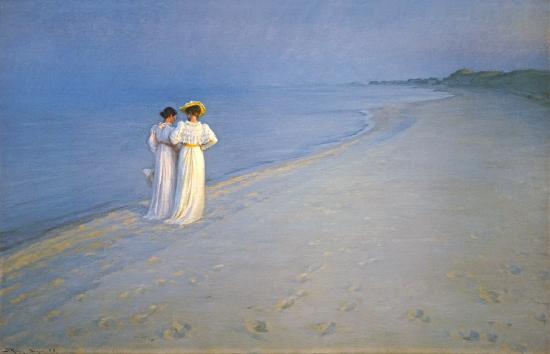
"Soirée calme sur la plage de Skagen" de P. S. Krøyer (musée Marmottan Monet, Paris)" by Jean-Pierre Dalbéra, Flickr is licensed under CC BY 2.0 |

"French painting and Sculpture circa 1900" by hannibal1107 is licensed under CC BY 2.0 |

|

"Pissaro" by Wikimedia is in the Public Domain, CC0 |
Activité E
Comparez ces œuvres d’art de la page Les inspirations dans l’art.. En quoi sont-elles différentes ? Similaires ?
Activité F
Visitez le Glossaire Sculpteur Pterus. Cliquez sur un terme et lisez tout ce qu’il vous montre. Présentez à la classe ce que vous avez appris.
Activité G
Quel sculpteur préférez-vous ? Camille Claudel ou Auguste Rodin ? Pourquoi. Comparez ces deux sculptures :
|
Camille Claudel 
"2009-02-15 München 182 Neue Pinakothek, Camille Claudel - La valse" by Allie_Caulfield is licensed under CC BY 2.0 |
Auguste Rodin 
"Rodin sculpture" by Agent Smith is licensed under CC BY 2.0 |
Activité H
Décrivez une œuvre d'art
| Français | Anglais |
|---|---|
| une œuvre | a work (of art) |
| intérêt interest | interest |
| une histoire | a story |
| raconter | to tell (a story) |
| Mots apparentés |
|---|
| la technique |
| une dimension |
| le titre |
| le contexte (historique artistique, social, etc.) |
| la description |
| l’interprétation |
| la perspective |
| un portrait |
Complétez ce formulaire:

On approfondit !
Use the following resources to type accents and/or search for words:
- Accents: ç, à, é, è, â, ê, î, ô, û, ù, ë, ï, ü
- Dictionnaire français-anglais