

2.08: Article: American Neoclassicism
- Page ID
- 174583

\( \newcommand{\vecs}[1]{\overset { \scriptstyle \rightharpoonup} {\mathbf{#1}} } \)
\( \newcommand{\vecd}[1]{\overset{-\!-\!\rightharpoonup}{\vphantom{a}\smash {#1}}} \)
\( \newcommand{\id}{\mathrm{id}}\) \( \newcommand{\Span}{\mathrm{span}}\)
( \newcommand{\kernel}{\mathrm{null}\,}\) \( \newcommand{\range}{\mathrm{range}\,}\)
\( \newcommand{\RealPart}{\mathrm{Re}}\) \( \newcommand{\ImaginaryPart}{\mathrm{Im}}\)
\( \newcommand{\Argument}{\mathrm{Arg}}\) \( \newcommand{\norm}[1]{\| #1 \|}\)
\( \newcommand{\inner}[2]{\langle #1, #2 \rangle}\)
\( \newcommand{\Span}{\mathrm{span}}\)
\( \newcommand{\id}{\mathrm{id}}\)
\( \newcommand{\Span}{\mathrm{span}}\)
\( \newcommand{\kernel}{\mathrm{null}\,}\)
\( \newcommand{\range}{\mathrm{range}\,}\)
\( \newcommand{\RealPart}{\mathrm{Re}}\)
\( \newcommand{\ImaginaryPart}{\mathrm{Im}}\)
\( \newcommand{\Argument}{\mathrm{Arg}}\)
\( \newcommand{\norm}[1]{\| #1 \|}\)
\( \newcommand{\inner}[2]{\langle #1, #2 \rangle}\)
\( \newcommand{\Span}{\mathrm{span}}\) \( \newcommand{\AA}{\unicode[.8,0]{x212B}}\)
\( \newcommand{\vectorA}[1]{\vec{#1}} % arrow\)
\( \newcommand{\vectorAt}[1]{\vec{\text{#1}}} % arrow\)
\( \newcommand{\vectorB}[1]{\overset { \scriptstyle \rightharpoonup} {\mathbf{#1}} } \)
\( \newcommand{\vectorC}[1]{\textbf{#1}} \)
\( \newcommand{\vectorD}[1]{\overrightarrow{#1}} \)
\( \newcommand{\vectorDt}[1]{\overrightarrow{\text{#1}}} \)
\( \newcommand{\vectE}[1]{\overset{-\!-\!\rightharpoonup}{\vphantom{a}\smash{\mathbf {#1}}}} \)
\( \newcommand{\vecs}[1]{\overset { \scriptstyle \rightharpoonup} {\mathbf{#1}} } \)
\( \newcommand{\vecd}[1]{\overset{-\!-\!\rightharpoonup}{\vphantom{a}\smash {#1}}} \)
13
Charity Davenport

Before You Read
Answer the following questions with a partner. Compare your answers.
- How have ancient or historical cultures, either in your country or from another country, influenced your country in the following ways?
- Political
- Art and architecture
- Religion/philosophy
- Literature
- Science
- Skim the next reading. What do you think is the author’s purpose of the text: to inform, entertain, or to persuade? How will that affect the way you take notes on the reading?
This chart will help you with the next reading. It has some architectural vocabulary that can help you identify common features found in both Classical and Neoclassical architecture.


Here is a link with more information on Greek architecture, from Lumen Learning.
Vocabulary in Context
Guess the vocabulary in bold using the context of the sentence.
- At certain times in Western history, the ideas of the ancient Greeks and Romans resurfaced to change the culture of the times.
- Using logic and learning by empirical evidence helped some of the most famous scientists of the time, like Copernicus and Galileo Galilei, make great discoveries.
- The Age of Enlightenment is another time of Neoclassicism, which is when ancient Greek and Roman influence appear again in Western history. This era started in France in the mid-1700s…
- Many people did not like this and took the opportunity to find a new home in a new land across the Atlantic Ocean. However, England still wanted control over the settlers.
- This was around the time that Thomas Jefferson incorporated Classical ideas into the creation of the Declaration of Independence in 1776.
- The New World needed a new government, and thus the founding fathers of the United States wanted to combine what they loathed of the British monarchy with the successes of, and the lesson learned from the Greco-Roman democracies of the past.
American Neoclassicism
by Charity Davenport
What is Neoclassicism?

Even though ancient Greek and Roman culture and society ended around 476 CE with the fall of the Roman Empire, more than a thousand years later, the language, art, architecture, philosophy, and political and scientific thought have continued to live on. At certain times in Western history, the ideas of the ancient Greeks and Romans resurfaced to change the culture of the times. This happened in Italy in the 1500s in their Renaissance, which spread to England, inspiring writers like Shakespeare, and to France and the rest of Europe. Many of the paintings you will see throughout this book have come from this period. This is known as “Renaissance Classicism”. “Renaissance” is French for “rebirth”, and Classicism refers to the study of Classics, which for people in the Western world refers to knowledge about the ancient Greeks and Romans.
One of the philosophies that was popular during the Italian Renaissance came from Greek philosophy and thought. Using logic and learning by empirical evidence helped some of the most famous scientists of the time, like Copernicus and Galileo Galilei, make great discoveries.
The Age of Enlightenment was another period when ancient Greek and Roman influence appeared again in Western history. This era started in France in the mid-1700s, again showing Greek and Roman influence in art and architecture, but also helping influence advancements in philosophy, politics, and scientific discoveries. This was around the time that Thomas Jefferson, one of the seven founding fathers of America along with George Washington, America’s first president, incorporated Classical ideas into the creation of the Declaration of Independence in 1776.
Neoclassicism in Early America
English settlers fled to the New World in the early 1600s to escape religious persecution. In the 1500s much of Europe was Roman Catholic, but England decided to make its own church, called the Church of England, and people were required to change to this new church. Many people did not like this and took the opportunity to find a new home in a new land, North America, across the Atlantic Ocean. However, England still wanted control over the settlers. Eventually the settlers went to war against Britain and won their freedom. In 1776, America was born, and the architects of the new government took inspiration from ancient Greek and Roman ideas.
Neoclassicism Inspires a New Government
The New World needed a new government, and thus the founding fathers of the United States wanted to combine what they loathed of the British monarchy with the successes of and the lesson learned from the Greco-Roman democracies of the past. In the late 18th century, the founding fathers created a republican government modeled on Greek and Roman ideals – liberty, room for debate and reform as laws need to be changed or added at times, and a system built to limit tyranny, as well as a system that allows power to be held by many, not by a few at the top. One interesting topic borrowed from the ancient Romans was the power to pardon, written in the US Constitution. This idea may have come from Julius Caesar, who had his senate build temples to Clementia, the Roman goddess of clemency, to show how forgiving he was to his enemies, pardoning those who had done crimes against the state in order to turn them into his supporters. The founding fathers also looked at the mistakes the Roman Empire had made and studied the reasons for its fall to help make sure the same would not happen to the US.
Neoclassicism in American Art
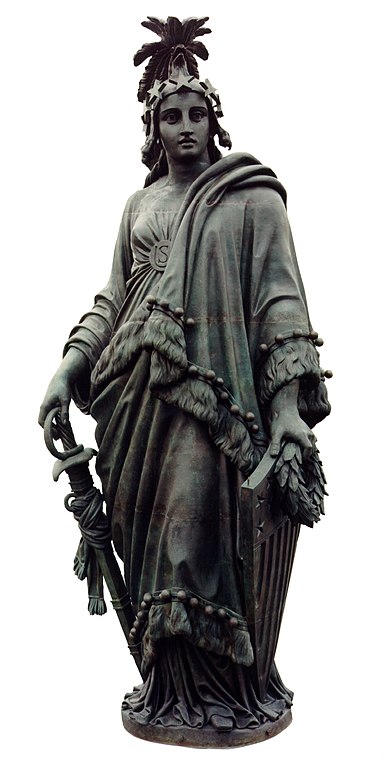
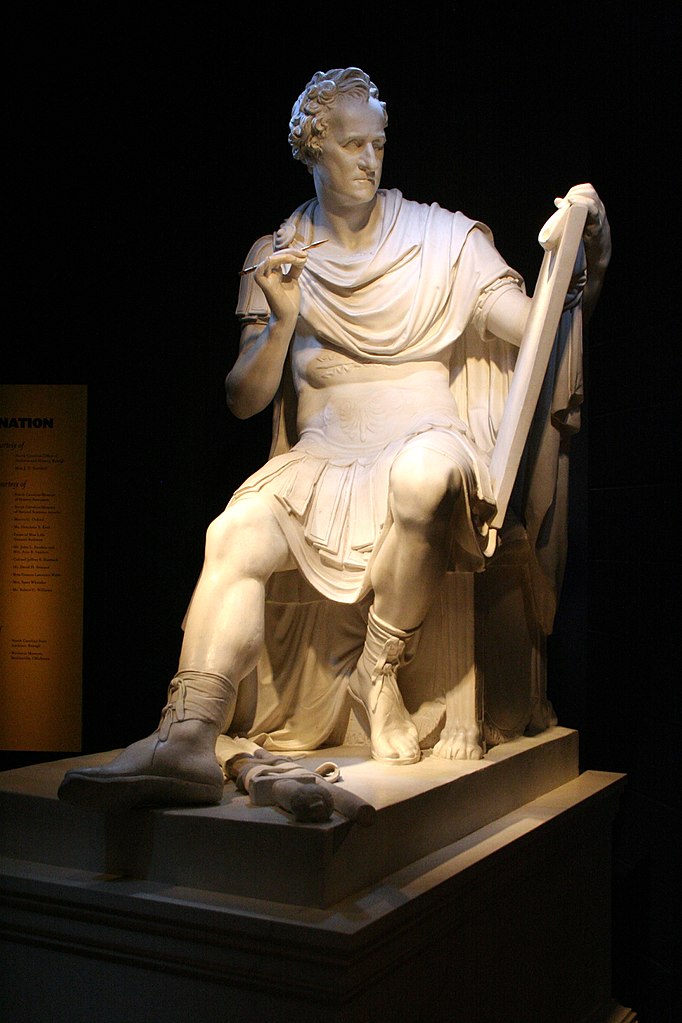
Images of freedom, such as Athena, the Greek goddess of wisdom in battle, can be seen in art from early America, as well as the usual red, white, and blue with stars that are now made popular in the American flag. Even before there was Uncle Sam, there was Columbia, the goddess-like personification of the spirit of early America, who can be found often in early American art and sculptures. There are statues of George Washington, who fought in the Revolutionary War against Britain, becoming America’s first president and founding father, dressed as a Roman emperor. The bald eagle is the national animal of the US and was also used in early American art. Early Americans loved how majestic the bald eagle looked, flying high with long, spread out wings, free as they were, free from the British. But the Romans had also used the eagle as a symbol of strength, since it was a symbol of Zeus.

|

|

|
Greek and Roman influence can also be seen in early American architecture. Thomas Jefferson himself designed his house, Monticello, inspired by Neoclassical art from Italy at the time. Later, the Statue of Liberty, also known as Lady Liberty, a gift from France in 1886, was built by Gustave Eiffel in the image of Libertas, the Roman goddess of Liberty. Many famous buildings and statues in the US from the 1700s and 1800s show how much Greek and Roman history and culture influenced early Americans and the Americans of today.
In both American art and architecture, the important idea of democratic justice is conveyed on and around courthouses around the nation. Most courthouses are built in the neoclassical style with tall columns and with statues representing justice and liberty nearby. A popular image in statues across the country is Lady Justice. She is often seen blindfolded, holding a set of balances in one hand and a sword in the other. We often say in English that “justice is blind”–the truth has no prejudices. Lady Justice is the personification of justice and comes from the Titaness Themis.

|

|

|

|

|

|

Comprehension and Critical Thinking Questions
Discuss the following questions with a classmate.
- How was the early American government influenced by the ancient Greeks and Romans?
- What is the difference between a republic and a democracy?
- What are other types of government mentioned here? How do they govern?
- What kind of government does your country have?
- Click on each of the five examples above of American neoclassical architecture. What do you notice that is similar in each image of the building? What features would you identify as possible features of Greek and Roman architecture that was borrowed by Americans in the 1800s? Use the chart at the top of this page for help.
- Go back to the “before you read” questions. After reading, would you change your answers?
- Click here or go to this website: http://web.sbu.edu/theology/bychkov/cole.html Look at this set of paintings by Thomas Cole. What is happening in each painting? What do you think is the purpose of this set of paintings?
- The following paintings are part of a fresco painted in 1865 by Greek-Italian artist Constantino Brumidi inside the dome of the US Capitol Building in Washington, DC. It is called “The Apotheosis of Washington”, featuring George Washington sitting on a throne in heaven as if he had become a Greek god. This work shows a lot of Greek influence. How many Greek figures can you recognize? Some are from the previous reading. How does each section represent a part of America? Could they represent your country as well? Use the title of the work to help you.

|

|

|

|

|

|
You can check your answers at this link.
All images for this exercise are $\ccpd$.
CEFR Level: CEF Level B2