

6.8: Lab Activities
- Page ID
- 270111

\( \newcommand{\vecs}[1]{\overset { \scriptstyle \rightharpoonup} {\mathbf{#1}} } \)
\( \newcommand{\vecd}[1]{\overset{-\!-\!\rightharpoonup}{\vphantom{a}\smash {#1}}} \)
\( \newcommand{\dsum}{\displaystyle\sum\limits} \)
\( \newcommand{\dint}{\displaystyle\int\limits} \)
\( \newcommand{\dlim}{\displaystyle\lim\limits} \)
\( \newcommand{\id}{\mathrm{id}}\) \( \newcommand{\Span}{\mathrm{span}}\)
( \newcommand{\kernel}{\mathrm{null}\,}\) \( \newcommand{\range}{\mathrm{range}\,}\)
\( \newcommand{\RealPart}{\mathrm{Re}}\) \( \newcommand{\ImaginaryPart}{\mathrm{Im}}\)
\( \newcommand{\Argument}{\mathrm{Arg}}\) \( \newcommand{\norm}[1]{\| #1 \|}\)
\( \newcommand{\inner}[2]{\langle #1, #2 \rangle}\)
\( \newcommand{\Span}{\mathrm{span}}\)
\( \newcommand{\id}{\mathrm{id}}\)
\( \newcommand{\Span}{\mathrm{span}}\)
\( \newcommand{\kernel}{\mathrm{null}\,}\)
\( \newcommand{\range}{\mathrm{range}\,}\)
\( \newcommand{\RealPart}{\mathrm{Re}}\)
\( \newcommand{\ImaginaryPart}{\mathrm{Im}}\)
\( \newcommand{\Argument}{\mathrm{Arg}}\)
\( \newcommand{\norm}[1]{\| #1 \|}\)
\( \newcommand{\inner}[2]{\langle #1, #2 \rangle}\)
\( \newcommand{\Span}{\mathrm{span}}\) \( \newcommand{\AA}{\unicode[.8,0]{x212B}}\)
\( \newcommand{\vectorA}[1]{\vec{#1}} % arrow\)
\( \newcommand{\vectorAt}[1]{\vec{\text{#1}}} % arrow\)
\( \newcommand{\vectorB}[1]{\overset { \scriptstyle \rightharpoonup} {\mathbf{#1}} } \)
\( \newcommand{\vectorC}[1]{\textbf{#1}} \)
\( \newcommand{\vectorD}[1]{\overrightarrow{#1}} \)
\( \newcommand{\vectorDt}[1]{\overrightarrow{\text{#1}}} \)
\( \newcommand{\vectE}[1]{\overset{-\!-\!\rightharpoonup}{\vphantom{a}\smash{\mathbf {#1}}}} \)
\( \newcommand{\vecs}[1]{\overset { \scriptstyle \rightharpoonup} {\mathbf{#1}} } \)
\(\newcommand{\longvect}{\overrightarrow}\)
\( \newcommand{\vecd}[1]{\overset{-\!-\!\rightharpoonup}{\vphantom{a}\smash {#1}}} \)
\(\newcommand{\ket}[1]{\left| #1 \right>}\)
\(\newcommand{\bra}[1]{\left< #1 \right|}\)
\(\newcommand{\braket}[2]{\left< #1 \vphantom{#2} \right| \left. #2 \vphantom{#1} \right>}\)
\(\newcommand{\braopket}[3]{\left< #1 \vphantom{#2}\vphantom{#3} \right| #2 \vphantom{#1}\vphantom{#3} \left| #3 \vphantom{#1}\vphantom{#2} \right>}\)
\(\newcommand{\qmvec}[1]{\mathbf{\vec{#1}}}\)
\(\newcommand{\op}[1]{\hat{\mathbf{#1}}}\)
\(\newcommand{\expect}[1]{\langle #1 \rangle}\)
\(\newcommand{\dfn}[1]{\emph{\textbf{#1}}}\)
Warm Ups
These warm ups can be used for personal practice or in-class activities.
Activity 1

Activity 2
Thirds
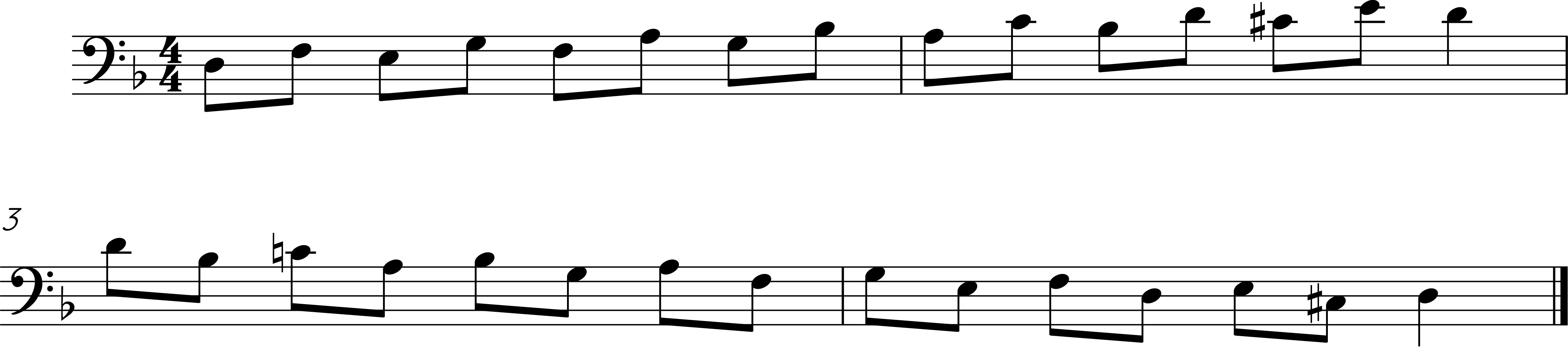
Fourths

Fifths

Listening
Intervals
This listening section focuses on recognizing ascending and descending intervals. Your instructor will play a number of examples for you.
- Example 1: (a) ascending P5 (b) ascending m6 (c) ascending P4 (d) ascending M6
- Example 2: (a) ascending P5 (b) ascending m6 (c) ascending P4 (d) ascending M6
- Example 3: (a) ascending P5 (b) ascending m6 (c) ascending P4 (d) ascending M6
- Example 4: (a) descending P4 (b) descending P5 (c) descending M3 (d) descending m6
- Example 5: (a) descending P4 (b) descending P5 (c) descending M3 (d) descending m6
- Example 6: (a) descending P4 (b) descending P5 (c) descending M3 (d) descending m6
- Example 7: (a) descending P4 (b) descending P5 (c) descending M3 (d) descending m6
- Example 8: (a) ascending m7 (b) ascending M6 (c) ascending M7 (d) ascending m6
- Example 9: (a) ascending m7 (b) ascending M6 (c) ascending M7 (d) ascending m6
- Example 10: (a) ascending m7 (b) ascending M6 (c) ascending M7 (d) ascending m6
Additional Intervals
Sight Singing
Use these melodies to practice sight singing. True sight singing is your attempt the very first time you sing the melody. Our goal is to sing it perfectly the first time through. However, this is a new skill for many. As with any new skill, practicing is the key to improvement. If the melody is not perfect the first time through, discuss as a class or with your group and determine where errors were made. Why do you think that particular area was challenging? Practice a few parts and then attempt the melody again.
Melody 1
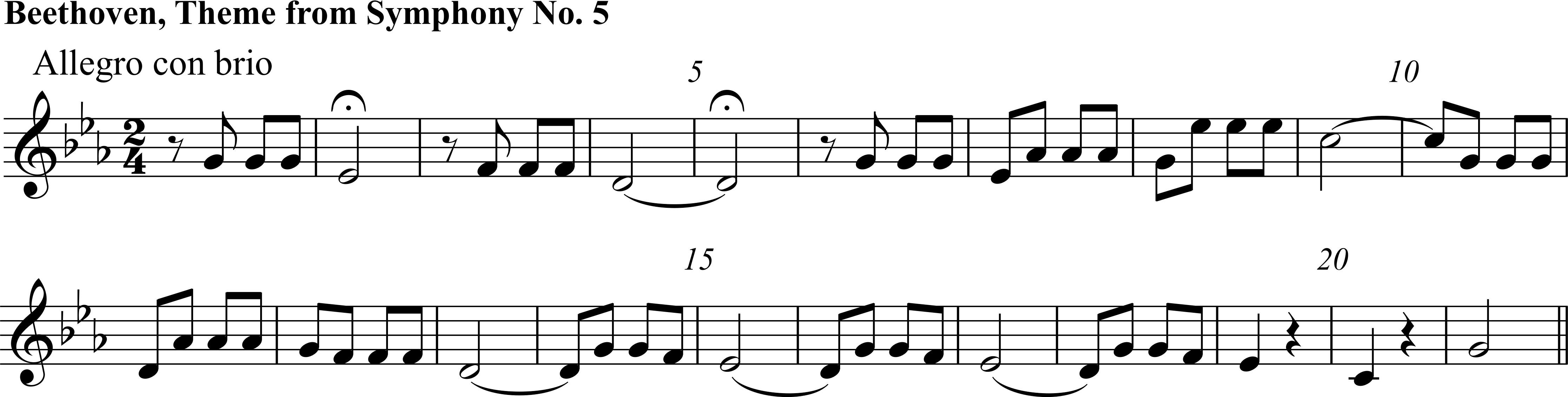
Melody 2

Rhythm Practice
Use these rhythm exercises to practice reading and performing rhythms.
Rhythm 1

Rhythm 2

Rhythm 3

Melodic Dictation
Use these staves to practice short melodic dictations provided by your instructor. Listen the first time through for the rhythm and then focus on the pitches.


Discuss
What other methods do you have for hearing intervals? Additional song ideas? Spend some time discussing how you hear different intervals, both ascending and descending.