

1.3: Drawing Mechanics
- Page ID
- 439816
\( \newcommand{\vecs}[1]{\overset { \scriptstyle \rightharpoonup} {\mathbf{#1}} } \)
\( \newcommand{\vecd}[1]{\overset{-\!-\!\rightharpoonup}{\vphantom{a}\smash {#1}}} \)
\( \newcommand{\dsum}{\displaystyle\sum\limits} \)
\( \newcommand{\dint}{\displaystyle\int\limits} \)
\( \newcommand{\dlim}{\displaystyle\lim\limits} \)
\( \newcommand{\id}{\mathrm{id}}\) \( \newcommand{\Span}{\mathrm{span}}\)
( \newcommand{\kernel}{\mathrm{null}\,}\) \( \newcommand{\range}{\mathrm{range}\,}\)
\( \newcommand{\RealPart}{\mathrm{Re}}\) \( \newcommand{\ImaginaryPart}{\mathrm{Im}}\)
\( \newcommand{\Argument}{\mathrm{Arg}}\) \( \newcommand{\norm}[1]{\| #1 \|}\)
\( \newcommand{\inner}[2]{\langle #1, #2 \rangle}\)
\( \newcommand{\Span}{\mathrm{span}}\)
\( \newcommand{\id}{\mathrm{id}}\)
\( \newcommand{\Span}{\mathrm{span}}\)
\( \newcommand{\kernel}{\mathrm{null}\,}\)
\( \newcommand{\range}{\mathrm{range}\,}\)
\( \newcommand{\RealPart}{\mathrm{Re}}\)
\( \newcommand{\ImaginaryPart}{\mathrm{Im}}\)
\( \newcommand{\Argument}{\mathrm{Arg}}\)
\( \newcommand{\norm}[1]{\| #1 \|}\)
\( \newcommand{\inner}[2]{\langle #1, #2 \rangle}\)
\( \newcommand{\Span}{\mathrm{span}}\) \( \newcommand{\AA}{\unicode[.8,0]{x212B}}\)
\( \newcommand{\vectorA}[1]{\vec{#1}} % arrow\)
\( \newcommand{\vectorAt}[1]{\vec{\text{#1}}} % arrow\)
\( \newcommand{\vectorB}[1]{\overset { \scriptstyle \rightharpoonup} {\mathbf{#1}} } \)
\( \newcommand{\vectorC}[1]{\textbf{#1}} \)
\( \newcommand{\vectorD}[1]{\overrightarrow{#1}} \)
\( \newcommand{\vectorDt}[1]{\overrightarrow{\text{#1}}} \)
\( \newcommand{\vectE}[1]{\overset{-\!-\!\rightharpoonup}{\vphantom{a}\smash{\mathbf {#1}}}} \)
\( \newcommand{\vecs}[1]{\overset { \scriptstyle \rightharpoonup} {\mathbf{#1}} } \)
\(\newcommand{\longvect}{\overrightarrow}\)
\( \newcommand{\vecd}[1]{\overset{-\!-\!\rightharpoonup}{\vphantom{a}\smash {#1}}} \)
\(\newcommand{\ket}[1]{\left| #1 \right>}\)
\(\newcommand{\bra}[1]{\left< #1 \right|}\)
\(\newcommand{\braket}[2]{\left< #1 \vphantom{#2} \right| \left. #2 \vphantom{#1} \right>}\)
\(\newcommand{\braopket}[3]{\left< #1 \vphantom{#2}\vphantom{#3} \right| #2 \vphantom{#1}\vphantom{#3} \left| #3 \vphantom{#1}\vphantom{#2} \right>}\)
\(\newcommand{\qmvec}[1]{\mathbf{\vec{#1}}}\)
\(\newcommand{\op}[1]{\hat{\mathbf{#1}}}\)
\(\newcommand{\expect}[1]{\langle #1 \rangle}\)
\(\newcommand{\dfn}[1]{\emph{\textbf{#1}}}\)
Overview
Aesthetic drawing is both an intuitive and cerebral exercise. The cerebral aspects of drawing include logical decisions born out of knowledge gained by generations of artists working in drawing studios and creating finished drawings with a level of success and aesthetics. In this chapter, recommendations are made to facilitate drawing. These recommendations include best practices for holding drawing tools, and for positioning your drawing support and your body to best view both your drawing surface (support) and your subject.
How to Hold a Pencil
• Early in life you learned to hold a spoon, crayon, and pencil
• If your grip is awkward, you can retrain your grip
Index Finger and Thumb
• Using your index finger and thumb, pick up your pencil, and then support it with your other fingers
• Your grip should be relaxed
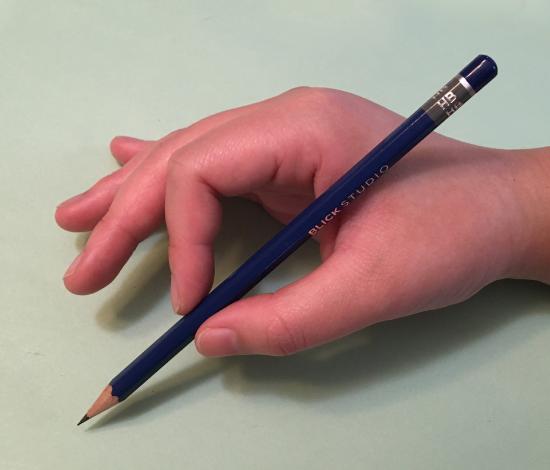
Index Finger and Thumb
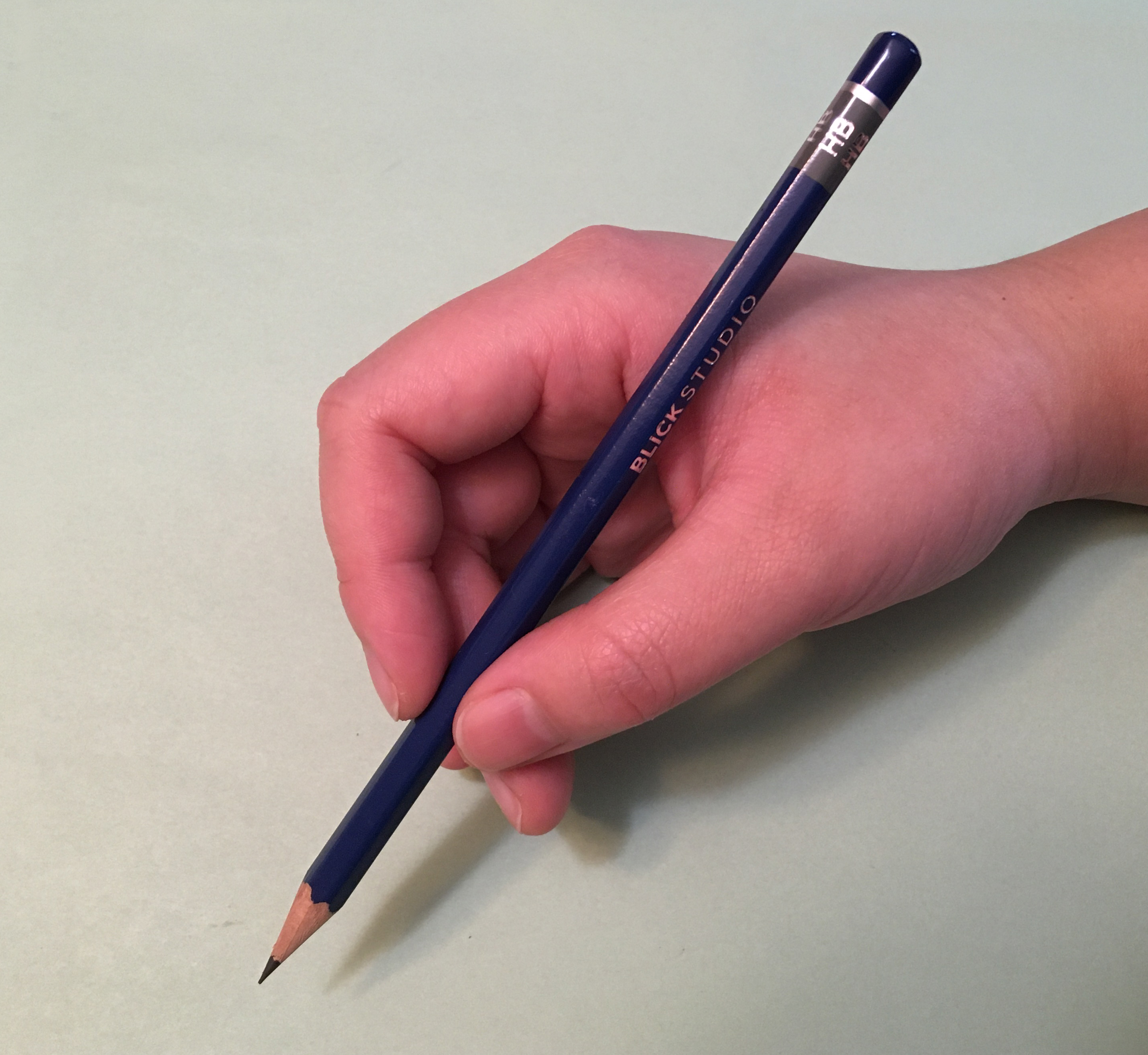
Add Support
Sketching Grip
• Most drawing for fine art is actually done with a second type of pencil grip
• This grip may be awkward at first
• The pencil is held loosely and allows for a wide variety of mark-making
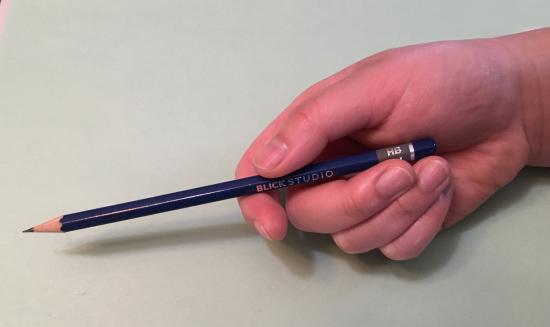
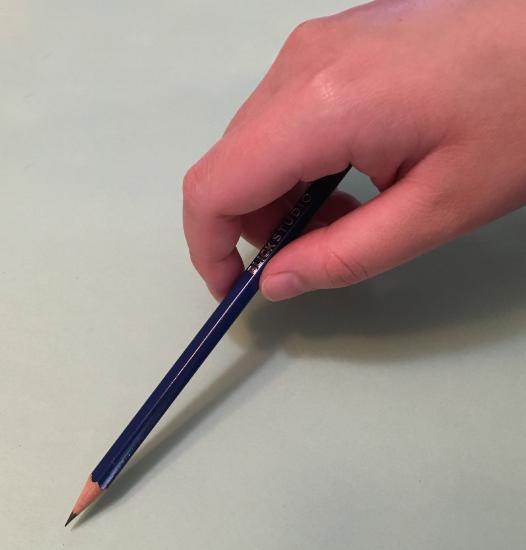
Sketching Grip
Types of Drawing Movements
• Finger Drawing (precise)
• Hand Drawing (good for sketching)
• Arm Drawing Movements (used for large drawings and sweeping marks)
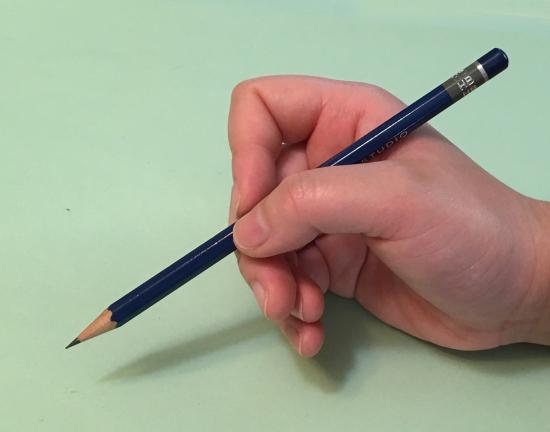
Finger Movements
Use fingers for precise detail and close-up drawing
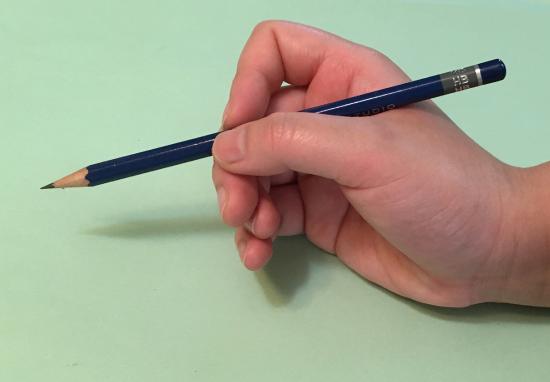
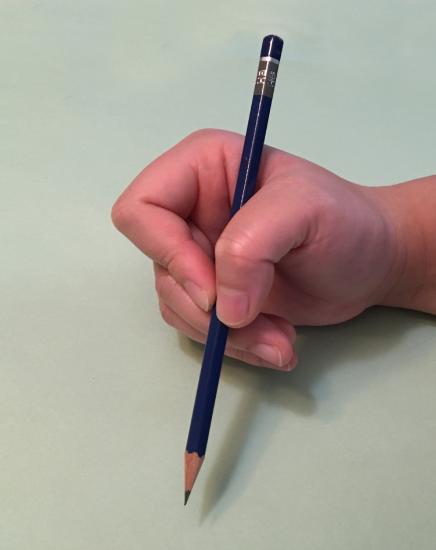
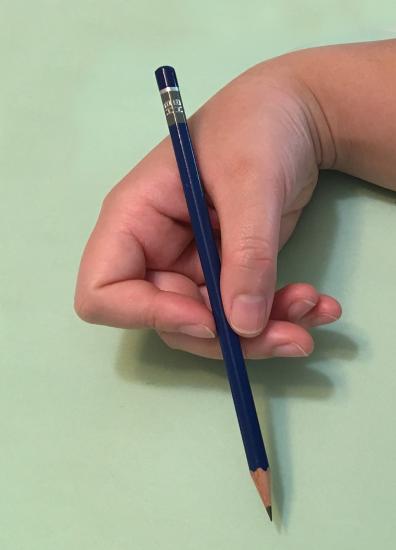
Hand Movements
Use hand and wrist for sketching and mark-making
Index Finger and Thumb
This is like using chopsticks – first grasp one chopstick
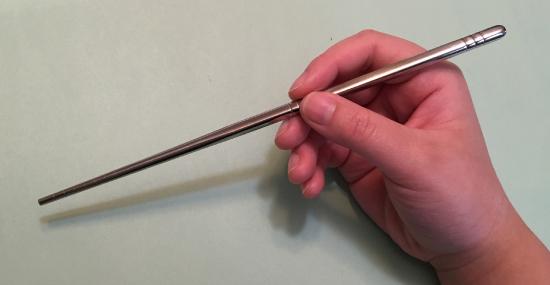
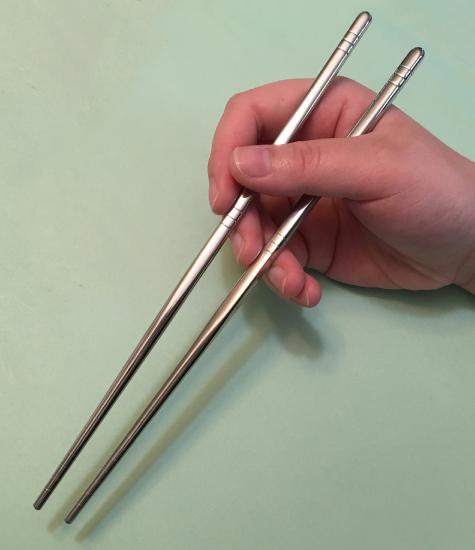
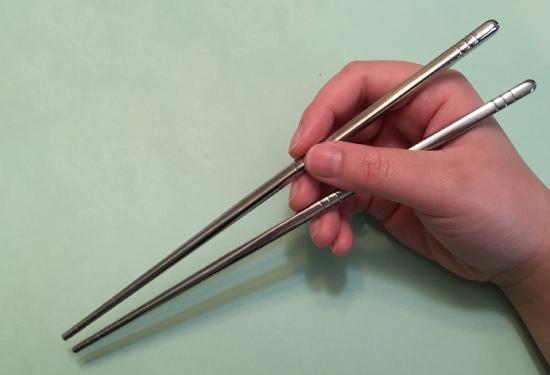
Chopsticks Grip
Then cradle the second chopstick between your thumb and palm – OK, you don’t need to worry about this second step when drawing
Body Positioning
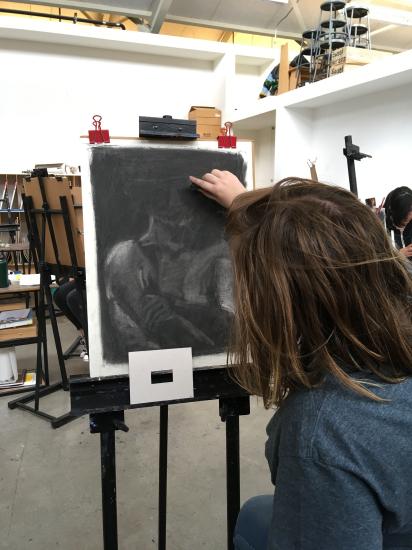
When working from an easel, whether standing or sitting, keep the easel on the side of your drawing hand. If you are right handed, the easel is placed on the right side; if left handed, the easel is placed on the left. When drawing a portrait, have the easel the same height as your subject so you may view your subject and easily compare this visual information with your drawing (this will also be covered in the Sighting chapter). Avoid uncomfortable ergonomics when drawing.
Using Drawings Tools
There are many tools and materials that can be used to create drawings. For this course, you will only need a pencil, a pen, and paper. While additional supplies can help expand your understanding of drawing, limited materials can still be used to create strong and meaningful artwork. At times, working with fewer supplies helps you better understand and master the tools you already have.
Below are examples of drawing tools and materials that you may already have or may choose to use. Please remember that you are welcome to add additional materials to your projects if they support your creative ideas, but extra supplies are not required and will not automatically improve your grade.
Your grade will be based on how well you follow the assignment directions, apply the drawing concepts, show effort, and demonstrate growth in your work. The focus of this course is not on having the most materials, but on learning how to use the tools you have with skill and intention.
Unless for intended visual effects, do no harm to the paper when drawing. Choose the correct pencil for the desired effect, such as a 6B for dark values, or an HB for lighter tones. Common errors include forcing an HB pencil to create really dark values and having the paper damaged in the process. Less effort is needed for a 4B or 6B pencil to create rich, dark values while also not damaging the paper with unnecessary pressed indentations. This takes practice, but having a light touch and "feeling" the tooth of the paper while drawing is an art unto itself.
White plastic erasers work well removing specific areas of a drawing and sometimes can remove marks nearly completely from the surface. Erasers may also be used as a drawing tool, rather than a drawing correction tool, by creating intentionally erased areas for visual effect. A disadvantage of the white plastic eraser is the left over plastic "eraser dust" created in the process of erasing on paper.
Kneaded erasers also can be shaped to suit the needs of the task. They can be formed into pointed ends for detailed erasing, or flattened out to erase larger areas. This latter technique is quite unique to the kneaded eraser. When flattened out, varying the pressure of the eraser can control how much of the drawing is removed. When practiced, this is quite useful and a technique unique to this eraser. This can technique can be used for graphite on paper.
Blending Stumps can be held with the index finger and thumb, or in the sketching position. They are made of paper and of various sizes and used for blending graphite. I often also say to use your finger, tissue, or cloth all of which helps blend in a different way. These are also often easily accessible,
Viewfinders are another tool used to visually "frame" your subject as you close one eye and look through the opening to help create a drawing Composition. Viewfinders can be purchased or made by hand by cutting the opening out of mat board or other flat material. A 3:5 ratio for the cutout is similar to the Golden Ratio and an aesthetic choice that comes close to the ratio of most drawing pads. I also think of a view finder in a camera, these are the same concept.


