

1.10: Chile
- Page ID
- 320454

\( \newcommand{\vecs}[1]{\overset { \scriptstyle \rightharpoonup} {\mathbf{#1}} } \)
\( \newcommand{\vecd}[1]{\overset{-\!-\!\rightharpoonup}{\vphantom{a}\smash {#1}}} \)
\( \newcommand{\dsum}{\displaystyle\sum\limits} \)
\( \newcommand{\dint}{\displaystyle\int\limits} \)
\( \newcommand{\dlim}{\displaystyle\lim\limits} \)
\( \newcommand{\id}{\mathrm{id}}\) \( \newcommand{\Span}{\mathrm{span}}\)
( \newcommand{\kernel}{\mathrm{null}\,}\) \( \newcommand{\range}{\mathrm{range}\,}\)
\( \newcommand{\RealPart}{\mathrm{Re}}\) \( \newcommand{\ImaginaryPart}{\mathrm{Im}}\)
\( \newcommand{\Argument}{\mathrm{Arg}}\) \( \newcommand{\norm}[1]{\| #1 \|}\)
\( \newcommand{\inner}[2]{\langle #1, #2 \rangle}\)
\( \newcommand{\Span}{\mathrm{span}}\)
\( \newcommand{\id}{\mathrm{id}}\)
\( \newcommand{\Span}{\mathrm{span}}\)
\( \newcommand{\kernel}{\mathrm{null}\,}\)
\( \newcommand{\range}{\mathrm{range}\,}\)
\( \newcommand{\RealPart}{\mathrm{Re}}\)
\( \newcommand{\ImaginaryPart}{\mathrm{Im}}\)
\( \newcommand{\Argument}{\mathrm{Arg}}\)
\( \newcommand{\norm}[1]{\| #1 \|}\)
\( \newcommand{\inner}[2]{\langle #1, #2 \rangle}\)
\( \newcommand{\Span}{\mathrm{span}}\) \( \newcommand{\AA}{\unicode[.8,0]{x212B}}\)
\( \newcommand{\vectorA}[1]{\vec{#1}} % arrow\)
\( \newcommand{\vectorAt}[1]{\vec{\text{#1}}} % arrow\)
\( \newcommand{\vectorB}[1]{\overset { \scriptstyle \rightharpoonup} {\mathbf{#1}} } \)
\( \newcommand{\vectorC}[1]{\textbf{#1}} \)
\( \newcommand{\vectorD}[1]{\overrightarrow{#1}} \)
\( \newcommand{\vectorDt}[1]{\overrightarrow{\text{#1}}} \)
\( \newcommand{\vectE}[1]{\overset{-\!-\!\rightharpoonup}{\vphantom{a}\smash{\mathbf {#1}}}} \)
\( \newcommand{\vecs}[1]{\overset { \scriptstyle \rightharpoonup} {\mathbf{#1}} } \)
\(\newcommand{\longvect}{\overrightarrow}\)
\( \newcommand{\vecd}[1]{\overset{-\!-\!\rightharpoonup}{\vphantom{a}\smash {#1}}} \)
\(\newcommand{\ket}[1]{\left| #1 \right>}\)
\(\newcommand{\bra}[1]{\left< #1 \right|}\)
\(\newcommand{\braket}[2]{\left< #1 \vphantom{#2} \right| \left. #2 \vphantom{#1} \right>}\)
\(\newcommand{\braopket}[3]{\left< #1 \vphantom{#2}\vphantom{#3} \right| #2 \vphantom{#1}\vphantom{#3} \left| #3 \vphantom{#1}\vphantom{#2} \right>}\)
\(\newcommand{\qmvec}[1]{\mathbf{\vec{#1}}}\)
\(\newcommand{\op}[1]{\hat{\mathbf{#1}}}\)
\(\newcommand{\expect}[1]{\langle #1 \rangle}\)
\(\newcommand{\dfn}[1]{\emph{\textbf{#1}}}\)
Chile
Map

"South America Location CHI", by David Liuzzo, Wikimedia Commons is licensed under CC0 1.0
General Information
Capital: Santiago de Chile
Ubicación: Sudamérica
Idiomas: El español y el mapuche (lengua indígena)
Moneda: El peso chileno
Economía: La minería, la agricultura y recursos marinos (sea resources)
Clima: El clima en Chile es muy variado. Hace mucho frío en los Andes y en el sur de Chile y hace mucho calor en el desierto del norte (Desierto de Atacama) En Santiago, la capital y el centro del país, hace calor en verano y llueve en invierno.
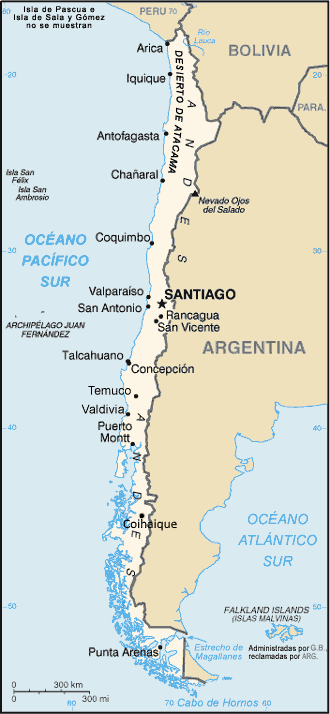
"Ci-map-es", by CIA World Factbook, Wikimedia Commons is licensed under CC0 1.0
Interesting Facts
Chile is the longest and most narrow country in the world.
The oldest mummies in the world were found in Chile. These mummies were found in the Atacama Desert and have been dated to be from 5050 and 3000 BC, People from this tribe were mummifying their dead up to two thousand years before the Egyptians.
Parque Nacional Torres del Paine. Torres del Paine National Park is a popular tourist destination where visitors can admire its glaciers, lakes, and rivers in southern Chilean Patagonia. The Cordillera Paine is the centerpiece of the park. Visitors hike in the high mountains, kayak the Grey Glacier, camp, and take amazing pictures of the breathtaking natural panorama.
La Isla de Pascua. Easter Island is a special territory of Chile in the southeastern Pacific Ocean, at the southeasternmost point of the Polynesian. Easter Island is famous for its nearly 900 monumental statues called “Moai”.
Chile is known as El país de los poetas (the country of poets). There are two Nobel Prize winners in Literature from Chile: Gabriela Mistral and the famous poet Pablo Neruda.
Actividad
La Isla de Pascua (Easter Island)
Watch the video below (or read its summary(opens in new window)) to answer the questions below.
Actividad
La Patagonia: Torres del Paine Solo Travel Guide
Welcome to Patagonia, this South American site is known for its mountains, glaciers, and forest. The guide is at Torres del Paine, and will be doing some of the most popular hikes and exploring the best sites. There is one site that stands head and shoulder above the rest of the attraction in the park, Los Cuernos (The Horns). One of these spots is called Mirador Condor where you could get unrivaled views of The Horns. Here is the highest mountain in the entire Torres del Paine National Park as well. The very top of the mountains is a glacier. Another ideal spot to get that perfect shot of The Horns is in Mirador Los Cuernos. The hike begins at the largest waterfall in the park called Salto Grande. The rest of the park also offers you terrific views of The Horn. The Grey Glacier is part of the southern Patagonia icefield. It is not every day that you could see a glacier this up close. It is really one of the most spectacular sights in the entire park. You will be impressed by its striking blue color. Unfortunately, this glacier is slowly dissolving which is tragic. The guide stays at Hosteria Pehoe. The hotel lies in the most unique and probably the neatest location of any hotel in any part of this national park, or maybe any national park. The hotel is located just in the middle of Pehoe Lake. One of the most beautiful lakes in the entire park. The hotel gives you beautiful views of Los Cuernos. Paine Towers (Torres del Paine) is the most popular attraction in the park. This mountain range is a UNESCO biosphere reserve. If you want to view these impressive sites, click to watch the video(opens in new window).