

1.10: Italy – L’Italia
- Page ID
- 171180
\( \newcommand{\vecs}[1]{\overset { \scriptstyle \rightharpoonup} {\mathbf{#1}} } \)
\( \newcommand{\vecd}[1]{\overset{-\!-\!\rightharpoonup}{\vphantom{a}\smash {#1}}} \)
\( \newcommand{\dsum}{\displaystyle\sum\limits} \)
\( \newcommand{\dint}{\displaystyle\int\limits} \)
\( \newcommand{\dlim}{\displaystyle\lim\limits} \)
\( \newcommand{\id}{\mathrm{id}}\) \( \newcommand{\Span}{\mathrm{span}}\)
( \newcommand{\kernel}{\mathrm{null}\,}\) \( \newcommand{\range}{\mathrm{range}\,}\)
\( \newcommand{\RealPart}{\mathrm{Re}}\) \( \newcommand{\ImaginaryPart}{\mathrm{Im}}\)
\( \newcommand{\Argument}{\mathrm{Arg}}\) \( \newcommand{\norm}[1]{\| #1 \|}\)
\( \newcommand{\inner}[2]{\langle #1, #2 \rangle}\)
\( \newcommand{\Span}{\mathrm{span}}\)
\( \newcommand{\id}{\mathrm{id}}\)
\( \newcommand{\Span}{\mathrm{span}}\)
\( \newcommand{\kernel}{\mathrm{null}\,}\)
\( \newcommand{\range}{\mathrm{range}\,}\)
\( \newcommand{\RealPart}{\mathrm{Re}}\)
\( \newcommand{\ImaginaryPart}{\mathrm{Im}}\)
\( \newcommand{\Argument}{\mathrm{Arg}}\)
\( \newcommand{\norm}[1]{\| #1 \|}\)
\( \newcommand{\inner}[2]{\langle #1, #2 \rangle}\)
\( \newcommand{\Span}{\mathrm{span}}\) \( \newcommand{\AA}{\unicode[.8,0]{x212B}}\)
\( \newcommand{\vectorA}[1]{\vec{#1}} % arrow\)
\( \newcommand{\vectorAt}[1]{\vec{\text{#1}}} % arrow\)
\( \newcommand{\vectorB}[1]{\overset { \scriptstyle \rightharpoonup} {\mathbf{#1}} } \)
\( \newcommand{\vectorC}[1]{\textbf{#1}} \)
\( \newcommand{\vectorD}[1]{\overrightarrow{#1}} \)
\( \newcommand{\vectorDt}[1]{\overrightarrow{\text{#1}}} \)
\( \newcommand{\vectE}[1]{\overset{-\!-\!\rightharpoonup}{\vphantom{a}\smash{\mathbf {#1}}}} \)
\( \newcommand{\vecs}[1]{\overset { \scriptstyle \rightharpoonup} {\mathbf{#1}} } \)
\(\newcommand{\longvect}{\overrightarrow}\)
\( \newcommand{\vecd}[1]{\overset{-\!-\!\rightharpoonup}{\vphantom{a}\smash {#1}}} \)
\(\newcommand{\ket}[1]{\left| #1 \right>}\)
\(\newcommand{\bra}[1]{\left< #1 \right|}\)
\(\newcommand{\braket}[2]{\left< #1 \vphantom{#2} \right| \left. #2 \vphantom{#1} \right>}\)
\(\newcommand{\braopket}[3]{\left< #1 \vphantom{#2}\vphantom{#3} \right| #2 \vphantom{#1}\vphantom{#3} \left| #3 \vphantom{#1}\vphantom{#2} \right>}\)
\(\newcommand{\qmvec}[1]{\mathbf{\vec{#1}}}\)
\(\newcommand{\op}[1]{\hat{\mathbf{#1}}}\)
\(\newcommand{\expect}[1]{\langle #1 \rangle}\)
\(\newcommand{\dfn}[1]{\emph{\textbf{#1}}}\)
- Understand some basic aspects of Italian geography and general characteristics.
- Become familiar with the Italian national anthem, its meaning and history.
- Recognize some famous Italian cities.
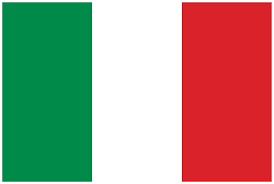
L’Italia è una repubblica parlamentare situata nell’Europa meridionale, con una popolazione di circa 60 milioni di abitanti e Roma come capitale.
Ha una superficie di 302 072 km² (116 630 mi2)
La moneta è l’Euro. 1€ = 1,15$ circa.
YouTube: 10 Best Places to Visit in Italy
Visita la mappa.
Esercizio 21
Riconosci queste città italiane? Abbina il nome all’immagine:
Roma, Firenze, Lago di Como, Venezia, Pisa, Amalfi, Pompei, Milano, Città del Vaticano

Benvenuti in Italia!
Vocabolario utile:
diviso = divided insieme = together, with
settentrionale = northern proprio = own
meridionale = southern lingua = language
insulare = of the islands anche = also
L’Italia è divisa geograficamente in Italia settentrionale, Italia centrale, Italia meridionale e Italia insulare. Politicamente l’Italia è divisa in venti regioni. Le regioni sono, insieme ai comuni, alle province, alle città metropolitane e allo Stato, uno dei cinque elementi costitutivi della Repubblica Italiana. Ogni regione è un ente territoriale con propri statuti, poteri e funzioni secondo i principi fissati dalla Costituzione. La città più importante della regione è il capoluogo.
Nel territorio italiano ci sono due stati indipendenti: la Repubblica di San Marino (33.000 abitanti) e la Città del Vaticano (605 abitanti). La lingua ufficiale di questi piccoli stati è l’italiano, ma nella Città del Vaticano si parla e si scrive anche in latino.
La capitale d’Italia è Roma, che ha quasi tre milioni di abitanti. Fu fondata nel 753 a.C. ed è la prima grande metropoli dell’umanità. Roma è anche il capoluogo della regione Lazio e si trova nell’Italia centrale.
Domande di comprensione
- In quante parti è divisa geograficamente l’Italia?
- Che cos’è una regione?
- Come si chiama la città più importante di una regione?
- Quante persone abitano a San Marino?
- Quali lingue si parlano nella Città del Vaticano?
- Secondo te, è più (more) grande l’Italia o il Michigan?