

1.12: On analyse en contexte - les voyages
- Page ID
- 258425

\( \newcommand{\vecs}[1]{\overset { \scriptstyle \rightharpoonup} {\mathbf{#1}} } \)
\( \newcommand{\vecd}[1]{\overset{-\!-\!\rightharpoonup}{\vphantom{a}\smash {#1}}} \)
\( \newcommand{\dsum}{\displaystyle\sum\limits} \)
\( \newcommand{\dint}{\displaystyle\int\limits} \)
\( \newcommand{\dlim}{\displaystyle\lim\limits} \)
\( \newcommand{\id}{\mathrm{id}}\) \( \newcommand{\Span}{\mathrm{span}}\)
( \newcommand{\kernel}{\mathrm{null}\,}\) \( \newcommand{\range}{\mathrm{range}\,}\)
\( \newcommand{\RealPart}{\mathrm{Re}}\) \( \newcommand{\ImaginaryPart}{\mathrm{Im}}\)
\( \newcommand{\Argument}{\mathrm{Arg}}\) \( \newcommand{\norm}[1]{\| #1 \|}\)
\( \newcommand{\inner}[2]{\langle #1, #2 \rangle}\)
\( \newcommand{\Span}{\mathrm{span}}\)
\( \newcommand{\id}{\mathrm{id}}\)
\( \newcommand{\Span}{\mathrm{span}}\)
\( \newcommand{\kernel}{\mathrm{null}\,}\)
\( \newcommand{\range}{\mathrm{range}\,}\)
\( \newcommand{\RealPart}{\mathrm{Re}}\)
\( \newcommand{\ImaginaryPart}{\mathrm{Im}}\)
\( \newcommand{\Argument}{\mathrm{Arg}}\)
\( \newcommand{\norm}[1]{\| #1 \|}\)
\( \newcommand{\inner}[2]{\langle #1, #2 \rangle}\)
\( \newcommand{\Span}{\mathrm{span}}\) \( \newcommand{\AA}{\unicode[.8,0]{x212B}}\)
\( \newcommand{\vectorA}[1]{\vec{#1}} % arrow\)
\( \newcommand{\vectorAt}[1]{\vec{\text{#1}}} % arrow\)
\( \newcommand{\vectorB}[1]{\overset { \scriptstyle \rightharpoonup} {\mathbf{#1}} } \)
\( \newcommand{\vectorC}[1]{\textbf{#1}} \)
\( \newcommand{\vectorD}[1]{\overrightarrow{#1}} \)
\( \newcommand{\vectorDt}[1]{\overrightarrow{\text{#1}}} \)
\( \newcommand{\vectE}[1]{\overset{-\!-\!\rightharpoonup}{\vphantom{a}\smash{\mathbf {#1}}}} \)
\( \newcommand{\vecs}[1]{\overset { \scriptstyle \rightharpoonup} {\mathbf{#1}} } \)
\(\newcommand{\longvect}{\overrightarrow}\)
\( \newcommand{\vecd}[1]{\overset{-\!-\!\rightharpoonup}{\vphantom{a}\smash {#1}}} \)
\(\newcommand{\ket}[1]{\left| #1 \right>}\)
\(\newcommand{\bra}[1]{\left< #1 \right|}\)
\(\newcommand{\braket}[2]{\left< #1 \vphantom{#2} \right| \left. #2 \vphantom{#1} \right>}\)
\(\newcommand{\braopket}[3]{\left< #1 \vphantom{#2}\vphantom{#3} \right| #2 \vphantom{#1}\vphantom{#3} \left| #3 \vphantom{#1}\vphantom{#2} \right>}\)
\(\newcommand{\qmvec}[1]{\mathbf{\vec{#1}}}\)
\(\newcommand{\op}[1]{\hat{\mathbf{#1}}}\)
\(\newcommand{\expect}[1]{\langle #1 \rangle}\)
\(\newcommand{\dfn}[1]{\emph{\textbf{#1}}}\)
1. On voyage en train: Le TER
** Potential ADAPT/H5P problem

Répondez aux questions :
- Comment s’appelle la gare (=train station) du départ ?
- Comment s’appelle la gare d’arrivée ?
- Combien de personnes voyagent (=travel) ?
- Le(s) nom(s) de la / des personne(s) ?
- Quelle est la date du départ et la date du retour ?
- Combien coûte le billet de train (€) ?
- Que veut dire SNCF ?
- Que veut dire TER ?
- What word(s) in French do you see on the ticket that you have not learned yet but you can guess their meaning?
To hear a live SNCF announcement, visit: France: SNCF Jingle and station announcement at Lyon-Part-Dieu station
2. On voyage en train: Le TGV
** Potential ADAPT/H5P problem

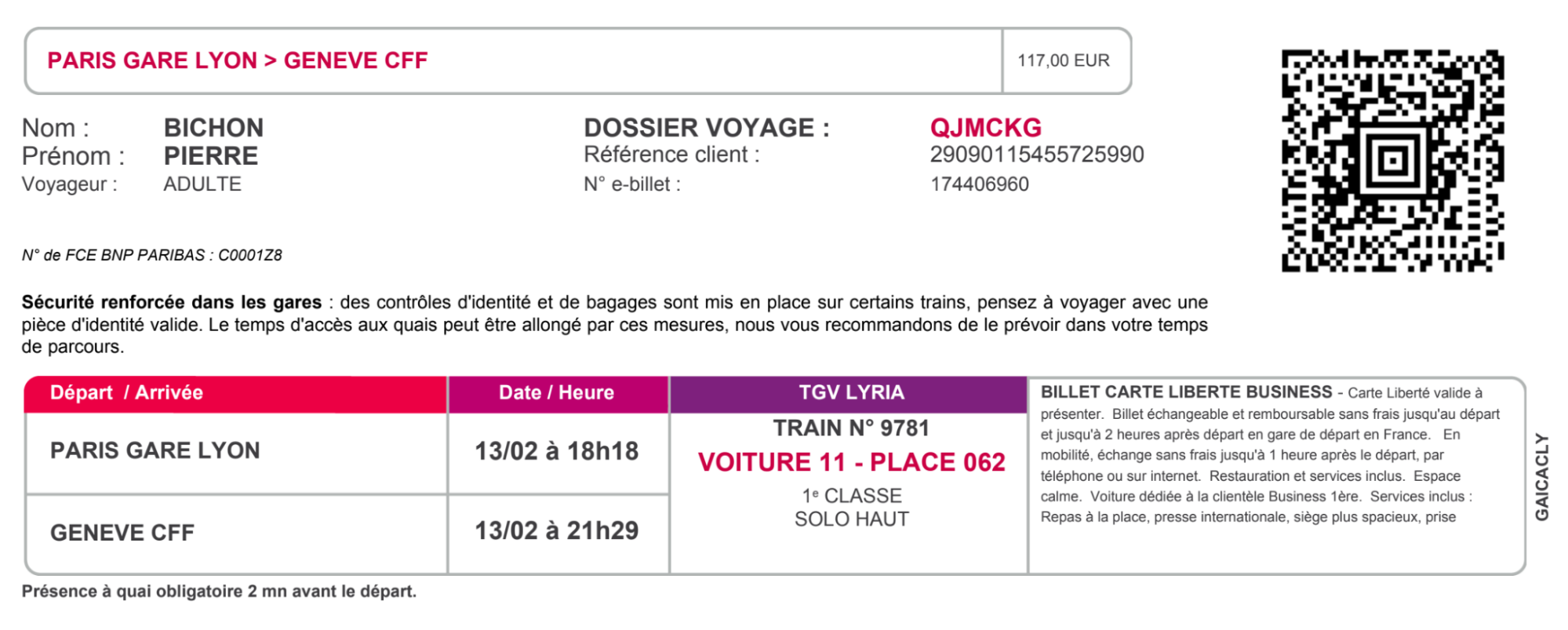

- Comment s’appelle la gare du départ ?
- Comment s’appelle la gare d’arrivée ?
- Il y a combien de voyageurs ?
- Le(s) nom(s) du/des voyageur(s) ?
- Quelle est la date du départ ?
- Quel est le numéro du train du départ ?
- Combien coûte le billet de train (€) ?
- Que veut dire TGV ?
- Que veut dire CFF ?
- What word(s) in French do you not know but can guess their meaning?
To hear a live SNCF announcement, visit:
3. On voyage en avion
** Potential ADAPT/H5P problem


- Comment s’appelle l’aéroport de départ ?
- Comment s’appelle l’aéroport d’arrivée ?
- Il y a combien de voyageurs ?
- Le(s) nom(s) du/des voyageur(s) ?
- Quelle est la date du départ ?
- Quel est le numéro du vol du départ (=flight) ?
- What word(s) in French do you not know but can guess their meaning?
