

9.01: Unit 1 Additional Materials
- Page ID
- 174639

\( \newcommand{\vecs}[1]{\overset { \scriptstyle \rightharpoonup} {\mathbf{#1}} } \)
\( \newcommand{\vecd}[1]{\overset{-\!-\!\rightharpoonup}{\vphantom{a}\smash {#1}}} \)
\( \newcommand{\id}{\mathrm{id}}\) \( \newcommand{\Span}{\mathrm{span}}\)
( \newcommand{\kernel}{\mathrm{null}\,}\) \( \newcommand{\range}{\mathrm{range}\,}\)
\( \newcommand{\RealPart}{\mathrm{Re}}\) \( \newcommand{\ImaginaryPart}{\mathrm{Im}}\)
\( \newcommand{\Argument}{\mathrm{Arg}}\) \( \newcommand{\norm}[1]{\| #1 \|}\)
\( \newcommand{\inner}[2]{\langle #1, #2 \rangle}\)
\( \newcommand{\Span}{\mathrm{span}}\)
\( \newcommand{\id}{\mathrm{id}}\)
\( \newcommand{\Span}{\mathrm{span}}\)
\( \newcommand{\kernel}{\mathrm{null}\,}\)
\( \newcommand{\range}{\mathrm{range}\,}\)
\( \newcommand{\RealPart}{\mathrm{Re}}\)
\( \newcommand{\ImaginaryPart}{\mathrm{Im}}\)
\( \newcommand{\Argument}{\mathrm{Arg}}\)
\( \newcommand{\norm}[1]{\| #1 \|}\)
\( \newcommand{\inner}[2]{\langle #1, #2 \rangle}\)
\( \newcommand{\Span}{\mathrm{span}}\) \( \newcommand{\AA}{\unicode[.8,0]{x212B}}\)
\( \newcommand{\vectorA}[1]{\vec{#1}} % arrow\)
\( \newcommand{\vectorAt}[1]{\vec{\text{#1}}} % arrow\)
\( \newcommand{\vectorB}[1]{\overset { \scriptstyle \rightharpoonup} {\mathbf{#1}} } \)
\( \newcommand{\vectorC}[1]{\textbf{#1}} \)
\( \newcommand{\vectorD}[1]{\overrightarrow{#1}} \)
\( \newcommand{\vectorDt}[1]{\overrightarrow{\text{#1}}} \)
\( \newcommand{\vectE}[1]{\overset{-\!-\!\rightharpoonup}{\vphantom{a}\smash{\mathbf {#1}}}} \)
\( \newcommand{\vecs}[1]{\overset { \scriptstyle \rightharpoonup} {\mathbf{#1}} } \)
\( \newcommand{\vecd}[1]{\overset{-\!-\!\rightharpoonup}{\vphantom{a}\smash {#1}}} \)
61
Charity Davenport
Select from the Unit 1 readings below for more reading and listening resources.
You can also use the search bar at the top right to look for keywords from this unit!
- Why Study Greek Mythology?
- Part 1: The Creation Story
- Part 2: The War of the Titans
- Part 3: The Olympian Pantheon
- The Olympics: Then and Now
- LEGOS in Space
- Greek Influence in US World’s Fairs
- American Neoclassicism
unit 1: Why Study Greek Mythology?
why study greek mythology
Additional Reading Materials
-
- Article about JK Rowling and Greek Mythology in Harry Potter
- Great open resource about ancient history in general
- Article about 11 Greek Influences and Contributions to Today’s Society
- General: Ancient Greek Cures for Depression and Anxiety
- Great resource for all of Greek Mythology
- CC-BY-NC comic for many stories from Greek mythology
- Look at this adorable monster poster by macrovector!
- Not reading, but might be a good overall resource for videos (depends on the video)
Additional Audio / Video Materials
Before starting, it’s a good idea to learn about how to take notes using the Cornell Method. This is useful not only for this course, but all courses you have. Watch the video below about how to take notes using the Cornell method.

A YouTube element has been excluded from this version of the text. You can view it online here: https://pb.libretexts.org/greek/?p=187
Here you can download a template of how your notes should look when using the Cornell Method. You can print this out or make your own notebook paper look like this.

A YouTube element has been excluded from this version of the text. You can view it online here: https://pb.libretexts.org/greek/?p=187

A YouTube element has been excluded from this version of the text. You can view it online here: https://pb.libretexts.org/greek/?p=187
Here is an example of Cornell Method notes you should have after watching this video.
Part 1: The Creation Story
Additional Reading Materials
Additional Audio / Video Materials
Part 2: The war of the titans
Additional Reading Materials
Additional Audio / Video Materials
- A long but thorough podcast about the Titanomachy (War of the Titans): 47 mins has an interesting analysis.
- NPR audio references cornucopia
Part 3: the Olympian pantheon
Additional Reading Materials
Additional Audio / Video Materials
A YouTube element has been excluded from this version of the text. You can view it online here: https://pb.libretexts.org/greek/?p=187

A YouTube element has been excluded from this version of the text. You can view it online here: https://pb.libretexts.org/greek/?p=187

A YouTube element has been excluded from this version of the text. You can view it online here: https://pb.libretexts.org/greek/?p=187

A YouTube element has been excluded from this version of the text. You can view it online here: https://pb.libretexts.org/greek/?p=187

A YouTube element has been excluded from this version of the text. You can view it online here: https://pb.libretexts.org/greek/?p=187
- NPR audio references aphrodisiac
- VOA Special English audio references “muse”, “hermes”, and “terra”!
- Podcast about Athena’s origins
- East pediment of Parthenon showed imagery from this story–this image is from the east pediment at the Parthenon in Nashville, TN
- How Athens became Athena’s city (about 18:30 in)
- West pediment of Parthenon showed imagery from this story–this image is from the west pediment at the Parthenon in Nashville, TN
The Olympics: then and now
Additional Reading Materials
Additional Audio / Video Materials
- LONG video about the Olympics then and now (requires UT net ID log in)

A YouTube element has been excluded from this version of the text. You can view it online here: https://pb.libretexts.org/greek/?p=187
legos in space
Additional Reading Materials
Additional Audio / Video Materials
A YouTube element has been excluded from this version of the text. You can view it online here: https://pb.libretexts.org/greek/?p=187
A YouTube element has been excluded from this version of the text. You can view it online here: https://pb.libretexts.org/greek/?p=187
American neoclassicism
Additional Reading Materials
Additional Audio / Video Materials
- 360 View of the US Capitol
- 360 View of the US Supreme Court
- VR Tours of Neoclassical Architecture in the US
- Compare above with VR tours of ancient temples in Greece
- Good site with intro videos to classical architecture, VR building comparisons, and Slideshow of Greek mythology found in the Library of Congress!

A YouTube element has been excluded from this version of the text. You can view it online here: https://pb.libretexts.org/greek/?p=187

A YouTube element has been excluded from this version of the text. You can view it online here: https://pb.libretexts.org/greek/?p=187
- Podcast discussing the current meaning of the Statue of Liberty–references the Phrygian cap and Trojan Horse (which might be a spoiler?)
Greek influence in us world’s fairs
Additional Reading Materials
Additional Audio / Video Materials
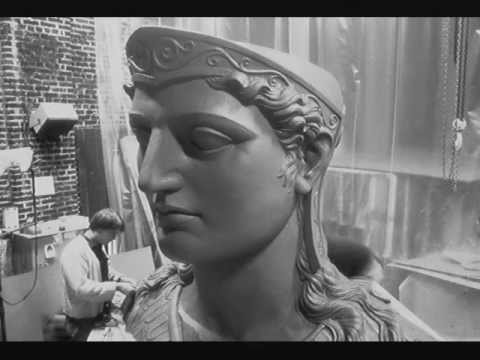
A YouTube element has been excluded from this version of the text. You can view it online here: https://pb.libretexts.org/greek/?p=187

A YouTube element has been excluded from this version of the text. You can view it online here: https://pb.libretexts.org/greek/?p=187
(Information about the Vulcan Statue from 3:30 to 8:30)

A YouTube element has been excluded from this version of the text. You can view it online here: https://pb.libretexts.org/greek/?p=187

A YouTube element has been excluded from this version of the text. You can view it online here: https://pb.libretexts.org/greek/?p=187