

2.04: Story: Part 3: The Olympian Pantheon
- Page ID
- 174579

\( \newcommand{\vecs}[1]{\overset { \scriptstyle \rightharpoonup} {\mathbf{#1}} } \)
\( \newcommand{\vecd}[1]{\overset{-\!-\!\rightharpoonup}{\vphantom{a}\smash {#1}}} \)
\( \newcommand{\id}{\mathrm{id}}\) \( \newcommand{\Span}{\mathrm{span}}\)
( \newcommand{\kernel}{\mathrm{null}\,}\) \( \newcommand{\range}{\mathrm{range}\,}\)
\( \newcommand{\RealPart}{\mathrm{Re}}\) \( \newcommand{\ImaginaryPart}{\mathrm{Im}}\)
\( \newcommand{\Argument}{\mathrm{Arg}}\) \( \newcommand{\norm}[1]{\| #1 \|}\)
\( \newcommand{\inner}[2]{\langle #1, #2 \rangle}\)
\( \newcommand{\Span}{\mathrm{span}}\)
\( \newcommand{\id}{\mathrm{id}}\)
\( \newcommand{\Span}{\mathrm{span}}\)
\( \newcommand{\kernel}{\mathrm{null}\,}\)
\( \newcommand{\range}{\mathrm{range}\,}\)
\( \newcommand{\RealPart}{\mathrm{Re}}\)
\( \newcommand{\ImaginaryPart}{\mathrm{Im}}\)
\( \newcommand{\Argument}{\mathrm{Arg}}\)
\( \newcommand{\norm}[1]{\| #1 \|}\)
\( \newcommand{\inner}[2]{\langle #1, #2 \rangle}\)
\( \newcommand{\Span}{\mathrm{span}}\) \( \newcommand{\AA}{\unicode[.8,0]{x212B}}\)
\( \newcommand{\vectorA}[1]{\vec{#1}} % arrow\)
\( \newcommand{\vectorAt}[1]{\vec{\text{#1}}} % arrow\)
\( \newcommand{\vectorB}[1]{\overset { \scriptstyle \rightharpoonup} {\mathbf{#1}} } \)
\( \newcommand{\vectorC}[1]{\textbf{#1}} \)
\( \newcommand{\vectorD}[1]{\overrightarrow{#1}} \)
\( \newcommand{\vectorDt}[1]{\overrightarrow{\text{#1}}} \)
\( \newcommand{\vectE}[1]{\overset{-\!-\!\rightharpoonup}{\vphantom{a}\smash{\mathbf {#1}}}} \)
\( \newcommand{\vecs}[1]{\overset { \scriptstyle \rightharpoonup} {\mathbf{#1}} } \)
\( \newcommand{\vecd}[1]{\overset{-\!-\!\rightharpoonup}{\vphantom{a}\smash {#1}}} \)
9
Charity Davenport

Vocabulary Building
Find the word in the paragraph given. Use the synonyms and definition to help. (Definitions from Merriam-Webster Learner’s Dictionary.)
- P1: to be made up of (something) : to include or consist of (something) (v.) _________________
- P2: control of something (n.) ____________________________________________________________
- P3: challenging or opposing someone especially in an angry way (adj.) _____________________
- P4: having a feeling of anger or displeasure about someone or something unfair (adj.) ________________________________________
- P6: a field where grapes are grown (n.) __________________________________________________
- P6: to tell (something that is secret or private) to someone you trust (v.) ___________________
- P6: that happened afterward (adj.) ______________________________________________________
- P14: a very sad, unfortunate, or upsetting situation (n.) ___________________________________
Part 3: The Olympian Pantheon

Adapted from The Gods of Greece: Stories of the Ancient Greeks by Charles D. Shaw $\ccpd$
The Greeks thought there were many gods, twelve of whom lived above the clouds on top of Olympus, a mountain in Thessaly, Greece. These gods and all of their children are part of the Pantheon. They had bodies like men and women, but they were larger, stronger, and usually more handsome than human beings. They comprised of Zeus, Hera, Poseidon, Demeter, Athena, Apollo, Artemis, Ares, Aphrodite, Hephaestus, Hermes, and Dionysus.
The king of all the gods, and the father of many of them, was called Zeus. The Latin name for this god is Jupiter. He was the ruler of the weather. At his command the clouds gathered, rain or snow fell, gentle winds blew, or storms roared. He threw lightning across the sky and thunderbolts upon the world. The tallest trees and highest mountain peaks were sacred to him. He is often seen with an eagle, and once turned himself into an eagle to find a new cupbearer named Ganymede.

His wife was Hera, who in Latin is called Juno. She was very beautiful and distinguished. She was the goddess of marriage and childbirth, and that’s why even to this day it is good luck to have a wedding in June, the month named after Juno. Her eyes were so large and dark, that one poet called her “ox-eyed.” She was proud and confrontational, and ready to harm those who made her angry. She is often seen with her guard, a peacock.
This couple had several children. One of them, Hephæstus, the Latin Vulcan, was born deformed. Others say that Hera thought he was so ugly that she threw him down, out of Olympus. He fell for a long summer day, and when he reached the island of Lemnos he had little life remaining in him and limped forever after. The ocean nymphs and the goddess Thetis found him on the shore of the island and took care of him. This is where he learned about his talent with metal. He made jewelry so beautiful that even Hera learned about it and asked him to make some for her, being his mother and all. Hephaestus was rightfully resentful and thus sent a golden throne to Hera that trapped her as soon as she sat down in it. Zeus sent Hephestus’ half-brother Dionysus, who had a

mortal mother, to convince Hephaestus to free Hera. Dionysus got them both drunk, and after sympathizing with each others’ pain, since both of them were hated by Hera, Dionysus persuaded Hephaestus to come back to Olympus to set Hera’s free from his throne. Zeus felt sorry for both of his sons and let them come back to Mount Olympus. There Hephaestus became the blacksmith god, who built houses for the other gods and made the staff of Zeus, the arrows used by Apollo and Artemis, and other wonderful things. Volcanoes were called his earthly workshops.
As consolation for how horribly Hephaestus was treated, he was given Aphrodite for his wife. Aphrodite, the Latin Venus, the loveliest of all the goddesses, who was said to have been born from the blood of Uranus falling into the sea when Cronos slashed his father with his scythe. She was the ruler of love and beauty. She is often seen with doves and even has her chariot pulled by doves. At weddings, a new bride and groom may release doves into the air as a symbol of their love. Hephæstus often made her beautiful gold jewelry. She made some people happy, but for others, she caused much grief and trouble. She was married to the lame Hephæstus, but had an affair with Ares and gave him two sons named Phobos and Deimos.
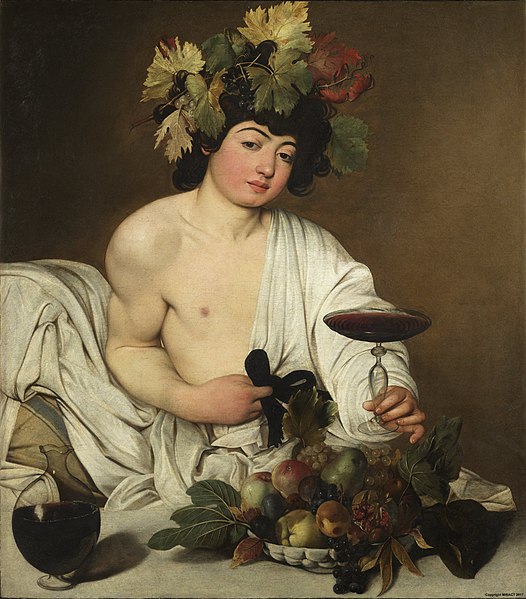
Dionysus, or Bacchus, was the god of vineyards, wine and theatre, and was particularly admired by the Greeks. He had an interesting birth, and was not originally accepted as one of the twelve Olympians. Zeus often had many affairs with other goddesses and mortals, one being with Semele. Hera found out, as she usually does, and was furious. Hera befriended Semele, who confided in her that Zeus was the father of her baby. Hera pretended not to believe her and planted seeds of doubt in Semele’s mind. Curious, Semele demanded that Zeus reveal himself in all his glory as proof that he was indeed a god. Though Zeus begged her not to ask this, she persisted, and he agreed. He came to her wrapped in bolts of lightning; mortals, however, could not look upon an undisguised god without dying, and she was killed in the ensuing blaze. Zeus rescued the unborn Dionysus, however, and after he sewed the infant into his thigh, Dionysus emerged fully-grown a few months later. Hera, of course, hated Dionysus and did not accept him on Mount Olympus until after he helped convince Hephaestus to free her from his trap.
One day Zeus had a terrible headache. It felt like something inside his head was pounding. Zeus asked Hephæstus, with his ax, to split open his father’s aching head. He had forgotten that he had turned his previous wife Metis into a fly and swallowed her to avoid a prophecy. At the time, Metis was with child, and to pass the time, she was crafting armor for her baby girl, pounding the metal flat with a mallet. When Hephaestus cracked open Zeus’ skull, the goddess Athena, the Latin Minerva, sprang out, fully grown and dressed in armor. She became the goddess of wisdom and military strategy, and also took care of cities. Athena is often associated with owls, which have become a symbol of intelligence, and that’s why owl designs are often seen at schools.
Phœbus, the Latin Apollo, was the god who ruled the sun. He loved music and poetry. Artemis, the Latin Diana, was his twin sister. She was in charge of the moon and was the friend of the hunters. They were the children of Leto and Zeus.
Hermes, the Latin Mercury, was handsome and swift, the messenger of the gods and the patron of commerce and communication. Under his care were merchants, travelers, and public speakers. He wore a hat with wings, and wings grew from his ankles. In his hand, he carried a wand around which snakes twist. He was very clever and full of tricks. He was the son of Zeus and a daughter of the Titan Atlas named Maia, from whom we get the month of May.

|

|

|
Ares, the Latin Mars, was the god of war, finding pleasure in battle and death. He was often accompanied by his two young sons, Phobos, the god of fear, and Deimos, the god of terror.
The ruler of the sea was Zeus’ brother Poseidon, whose Latin name was Neptune. Under the waves he had a shining palace, the work of Hephæstus.

|

|
Zeus’ sister Demeter, the Latin Ceres, was goddess of the earth, especially of harvests of grain. It was up to her whether or not farmers had a good harvest or not.
Lastly, there is Hades, also known as Pluto, god of the dead and ruler of the Underworld, not to be confused with Thanatos, the god of death. Hades is also associated with riches found underground and mining materials such as gold and gemstones. Although like his brother Poseidon he does not reside on Mount Olympus, he is considered one of the twelve Olympians.
These twelve gods formed the “Great Council” of Olympus. They lived in their own houses of brass built by Hephæstus, but every day they went to the palace of Zeus and feasted on ambrosia and nectar. At the feasts, Apollo played on his lyre and the Muses sang. The Muses were nine sisters who lived on Mount Parnassus. They were in charge of poetry, history, music, tragedy, comedy, dancing, love-songs, hymns, and astronomy. Their mother was Mnemosyne, the goddess of memory.
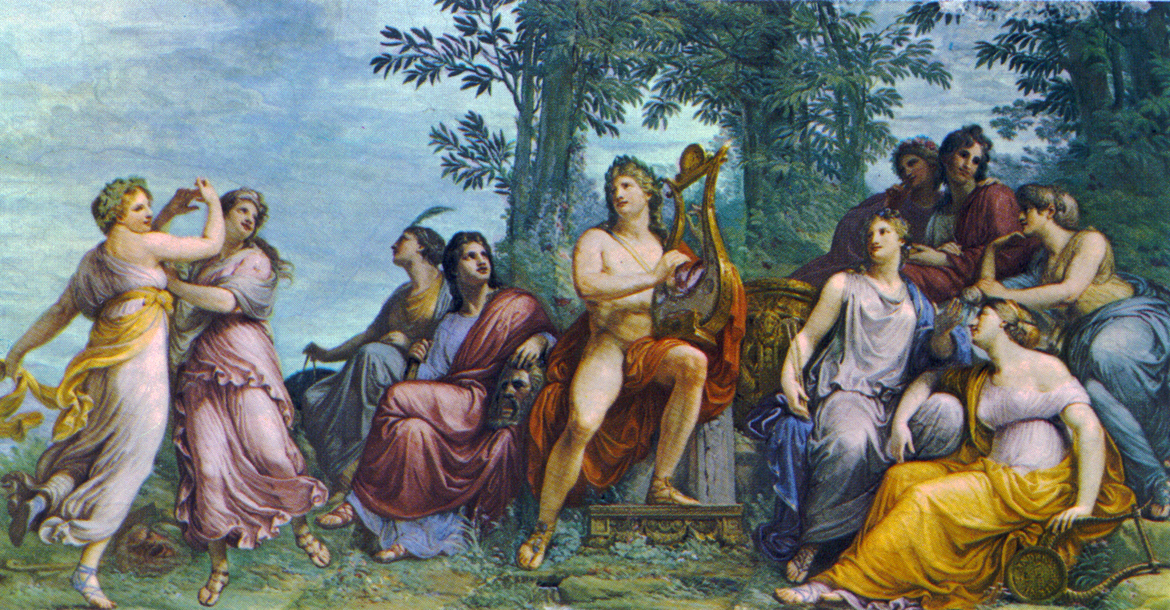
Many gods other than the twelve Olympians, like the Muses, would spend time on Olympus. Eros, the Latin Cupid, the little god of love, was the son of Venus. Eos was the goddess of the dawn. Iris was the messenger of Hera, and the road by which she traveled from heaven to earth was the rainbow, which vanished when her mission was done.
All of them came and went as they pleased, being sometimes in the sky, sometimes on the earth. They did not always do right, and they often argued and fought among themselves. Although they could not be killed, they could be wounded. Then ichor instead of blood flowed from their veins. They took much interest in human affairs; they had their favorites whom they helped, and their enemies whom they tried to harm.

CEFR Level: CEF Level B2
Comprehension Questions
Answer the questions below according to the reading using your own words. Make a note of where you found the answer in your reading.
- Who were the Olympians?
- How was Athena born?
- How was Dionysus born?
- Why does Hephaestus walk with a limp?
- How did Hephaestus and Dionysus join their father on Mount Olympus?
- What did the gods and goddesses eat on Mount Olympus?
Organizing Ideas: Fill in the Chart
Many characters were described in this introduction to mythology. Let’s organize the characters and who they are in the following chart. Fill in the missing information.
| Greek name | Latin name | God / goddess of… |
| Zeus | ||
| Hera | ||
| Poseidon | ||
| Hephaestus | ||
| Minerva | ||
| Mercury | ||
| Iris | X | |
| the Muses | X | |
| Mnemosyne | X | |
| Venus | ||
| Eros | ||
| Mars | ||
| Demeter | ||
| Phoebus | ||
| Diana | ||
| Bacchus | ||
| Pluto |
Comprehension and Critical Thinking Questions
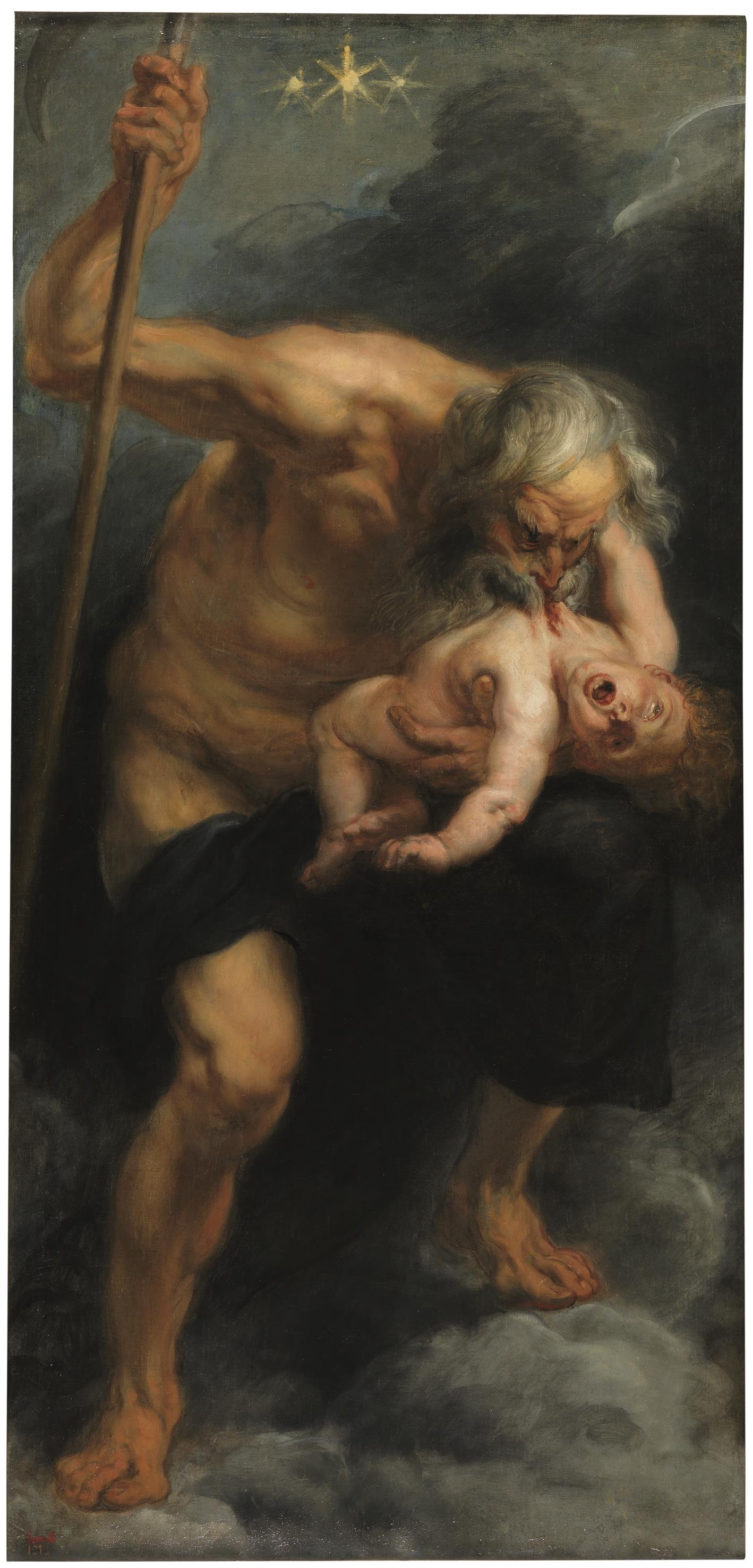
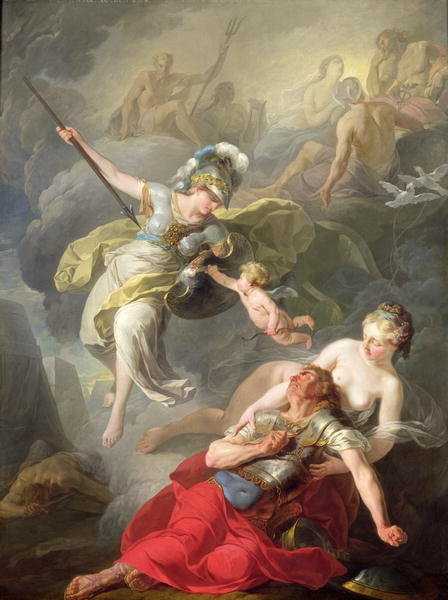
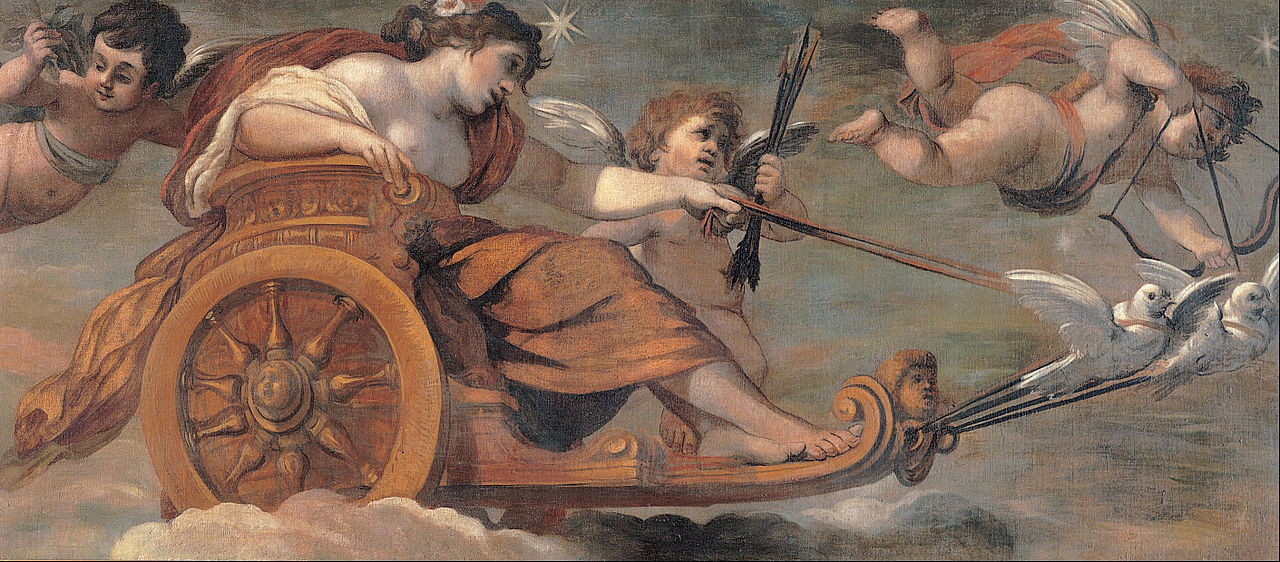
Here are very famous paintings of Greek gods. Based on what you have read so far, match the following pictures with their titles. Put the letter of the matching painting in the blank. Click here for an interactive version of this exercise.
____1. Saturn Devouring His Son by Peter Paul Rubens, 1636
____2. Chariot of Venus by Pietro da Cortona, 1622
____3. Bacchus by Caravaggio, 1597
____4. Hephaestus’s Workshop by Diego Rodriguez Silva Velázquez, 1660
____5. Artémis by Guillaume Seignac, 1870-1924
____6. Battle Between Minerva and Mars by Joseph-Benoit Suvée, 1771
|
|

|

|
E |
|
Vocabulary from the Stories
Many words and phrases in English come from the characters in Greek mythology. Fill in the following blanks with their corresponding god or goddess and definition. Discuss with a partner how the vocabulary is related to the god or goddess that the word comes from.
| Related Greek / Roman god / other |
English vocabulary and definition |
Relationship between vocabulary and story |
| iris (meaning 1) | ||
| X | iris (meaning 2) | |
| X | iridescent | |
| martial | ||
| Vulcan | volcano | |
| X | to vulcanize | |
| aphrodisiac | ||
| Venus | venereal | |
| X | venerate / veneration | |
| X | venom | |
| Mercury | mercurial | |
| X | merchant | |
| X | merchandise | |
| X | commerce | |
| Eros | erotic | |
| X | erogenous | |
| the Muses | to amuse | |
| X | to muse | |
| X | museum | |
| X | music | |
| X | amusement | |
| X | to be (someone’s) muse | |
| Mnemosyne | mnemonic | |
| X | memo | |
| X | remember | |
| X | memory | |
| Phobos | phobia |
Critical Thinking Questions
Below are critical thinking questions. “Critical thinking” means to think more deeply about a topic and connect it with old and new knowledge that you have. Often teachers will ask you for your opinion. These types of questions do not have a right or wrong answer, but you should support your answer with information from the reading. Discuss these questions with your classmates to see what their point of view is.
- Which of these characters is the most interesting to you? Explain why.
- Which of these characters do you dislike the most, and why?
- So far, how would you describe Zeus’ personality?
- How would you describe Hera?
- What do you think of the personalities of the gods? What do you think the people of ancient Greece thought of them?
- This is the caduceus, Hermes’ wand. What does it represent nowadays?

$\cczero$ - This is a picture of an ancient vase painting from Greece around 400 BC. What is happening in the picture?

$\ccpd$
8. Who are the characters in this cartoon? What is happening?

9. According to this reading, what does “Pantheon” mean? In the Merriam-Webster dictionary, the word “pantheon” can mean “a group of illustrious or notable persons or things”. Give an example of something that would be in a pantheon, and what kind of pantheon would it be? As an example, we can say that Mark Twain is in the pantheon of American writers.