

Humanities LibreTexts

1.03: Creating Discussion Questions

  • Page ID
    174573
  • \( \newcommand{\vecs}[1]{\overset { \scriptstyle \rightharpoonup} {\mathbf{#1}} } \)

    \( \newcommand{\vecd}[1]{\overset{-\!-\!\rightharpoonup}{\vphantom{a}\smash {#1}}} \)

    \( \newcommand{\dsum}{\displaystyle\sum\limits} \)

    \( \newcommand{\dint}{\displaystyle\int\limits} \)

    \( \newcommand{\dlim}{\displaystyle\lim\limits} \)

    \( \newcommand{\id}{\mathrm{id}}\) \( \newcommand{\Span}{\mathrm{span}}\)

    ( \newcommand{\kernel}{\mathrm{null}\,}\) \( \newcommand{\range}{\mathrm{range}\,}\)

    \( \newcommand{\RealPart}{\mathrm{Re}}\) \( \newcommand{\ImaginaryPart}{\mathrm{Im}}\)

    \( \newcommand{\Argument}{\mathrm{Arg}}\) \( \newcommand{\norm}[1]{\| #1 \|}\)

    \( \newcommand{\inner}[2]{\langle #1, #2 \rangle}\)

    \( \newcommand{\Span}{\mathrm{span}}\)

    \( \newcommand{\id}{\mathrm{id}}\)

    \( \newcommand{\Span}{\mathrm{span}}\)

    \( \newcommand{\kernel}{\mathrm{null}\,}\)

    \( \newcommand{\range}{\mathrm{range}\,}\)

    \( \newcommand{\RealPart}{\mathrm{Re}}\)

    \( \newcommand{\ImaginaryPart}{\mathrm{Im}}\)

    \( \newcommand{\Argument}{\mathrm{Arg}}\)

    \( \newcommand{\norm}[1]{\| #1 \|}\)

    \( \newcommand{\inner}[2]{\langle #1, #2 \rangle}\)

    \( \newcommand{\Span}{\mathrm{span}}\) \( \newcommand{\AA}{\unicode[.8,0]{x212B}}\)

    \( \newcommand{\vectorA}[1]{\vec{#1}}      % arrow\)

    \( \newcommand{\vectorAt}[1]{\vec{\text{#1}}}      % arrow\)

    \( \newcommand{\vectorB}[1]{\overset { \scriptstyle \rightharpoonup} {\mathbf{#1}} } \)

    \( \newcommand{\vectorC}[1]{\textbf{#1}} \)

    \( \newcommand{\vectorD}[1]{\overrightarrow{#1}} \)

    \( \newcommand{\vectorDt}[1]{\overrightarrow{\text{#1}}} \)

    \( \newcommand{\vectE}[1]{\overset{-\!-\!\rightharpoonup}{\vphantom{a}\smash{\mathbf {#1}}}} \)

    \( \newcommand{\vecs}[1]{\overset { \scriptstyle \rightharpoonup} {\mathbf{#1}} } \)

    \(\newcommand{\longvect}{\overrightarrow}\)

    \( \newcommand{\vecd}[1]{\overset{-\!-\!\rightharpoonup}{\vphantom{a}\smash {#1}}} \)

    \(\newcommand{\avec}{\mathbf a}\) \(\newcommand{\bvec}{\mathbf b}\) \(\newcommand{\cvec}{\mathbf c}\) \(\newcommand{\dvec}{\mathbf d}\) \(\newcommand{\dtil}{\widetilde{\mathbf d}}\) \(\newcommand{\evec}{\mathbf e}\) \(\newcommand{\fvec}{\mathbf f}\) \(\newcommand{\nvec}{\mathbf n}\) \(\newcommand{\pvec}{\mathbf p}\) \(\newcommand{\qvec}{\mathbf q}\) \(\newcommand{\svec}{\mathbf s}\) \(\newcommand{\tvec}{\mathbf t}\) \(\newcommand{\uvec}{\mathbf u}\) \(\newcommand{\vvec}{\mathbf v}\) \(\newcommand{\wvec}{\mathbf w}\) \(\newcommand{\xvec}{\mathbf x}\) \(\newcommand{\yvec}{\mathbf y}\) \(\newcommand{\zvec}{\mathbf z}\) \(\newcommand{\rvec}{\mathbf r}\) \(\newcommand{\mvec}{\mathbf m}\) \(\newcommand{\zerovec}{\mathbf 0}\) \(\newcommand{\onevec}{\mathbf 1}\) \(\newcommand{\real}{\mathbb R}\) \(\newcommand{\twovec}[2]{\left[\begin{array}{r}#1 \\ #2 \end{array}\right]}\) \(\newcommand{\ctwovec}[2]{\left[\begin{array}{c}#1 \\ #2 \end{array}\right]}\) \(\newcommand{\threevec}[3]{\left[\begin{array}{r}#1 \\ #2 \\ #3 \end{array}\right]}\) \(\newcommand{\cthreevec}[3]{\left[\begin{array}{c}#1 \\ #2 \\ #3 \end{array}\right]}\) \(\newcommand{\fourvec}[4]{\left[\begin{array}{r}#1 \\ #2 \\ #3 \\ #4 \end{array}\right]}\) \(\newcommand{\cfourvec}[4]{\left[\begin{array}{c}#1 \\ #2 \\ #3 \\ #4 \end{array}\right]}\) \(\newcommand{\fivevec}[5]{\left[\begin{array}{r}#1 \\ #2 \\ #3 \\ #4 \\ #5 \\ \end{array}\right]}\) \(\newcommand{\cfivevec}[5]{\left[\begin{array}{c}#1 \\ #2 \\ #3 \\ #4 \\ #5 \\ \end{array}\right]}\) \(\newcommand{\mattwo}[4]{\left[\begin{array}{rr}#1 \amp #2 \\ #3 \amp #4 \\ \end{array}\right]}\) \(\newcommand{\laspan}[1]{\text{Span}\{#1\}}\) \(\newcommand{\bcal}{\cal B}\) \(\newcommand{\ccal}{\cal C}\) \(\newcommand{\scal}{\cal S}\) \(\newcommand{\wcal}{\cal W}\) \(\newcommand{\ecal}{\cal E}\) \(\newcommand{\coords}[2]{\left\{#1\right\}_{#2}}\) \(\newcommand{\gray}[1]{\color{gray}{#1}}\) \(\newcommand{\lgray}[1]{\color{lightgray}{#1}}\) \(\newcommand{\rank}{\operatorname{rank}}\) \(\newcommand{\row}{\text{Row}}\) \(\newcommand{\col}{\text{Col}}\) \(\renewcommand{\row}{\text{Row}}\) \(\newcommand{\nul}{\text{Nul}}\) \(\newcommand{\var}{\text{Var}}\) \(\newcommand{\corr}{\text{corr}}\) \(\newcommand{\len}[1]{\left|#1\right|}\) \(\newcommand{\bbar}{\overline{\bvec}}\) \(\newcommand{\bhat}{\widehat{\bvec}}\) \(\newcommand{\bperp}{\bvec^\perp}\) \(\newcommand{\xhat}{\widehat{\xvec}}\) \(\newcommand{\vhat}{\widehat{\vvec}}\) \(\newcommand{\uhat}{\widehat{\uvec}}\) \(\newcommand{\what}{\widehat{\wvec}}\) \(\newcommand{\Sighat}{\widehat{\Sigma}}\) \(\newcommand{\lt}{<}\) \(\newcommand{\gt}{>}\) \(\newcommand{\amp}{&}\) \(\definecolor{fillinmathshade}{gray}{0.9}\)

    Students are used to being asked to answer questions, but one great way to check your comprehension and study for tests or dive deeper for essays is to have a study group and create discussion questions to discuss with your classmates. It’s a good way to study, but also to help your critical thinking skills. Creating discussion questions can help you in any course that you have, so it’s good while you are reading and after reading a text to make a list of questions to ask your study group. Below are the kinds of questions you should ask. They are in order from most basic to ones that require the most critical thinking.

    1. Level 1 questions are good to think about if you are going to have a multiple choice, fill in the blank, or true/false quiz or test. They will help you study the most basic pieces of information about the topic. They usually focus on the 5Ws: who, what, where, when, and sometimes why. These are also good questions to put on notecards to test yourself.
    2. Level 2 questions also check comprehension, but also require retelling events in your own words and explaining what happened in more detail. They can also focus on main ideas of the event or text.
    3. Level 3 questions ask for some application–how can the new information learned be used in other ways? Are there other examples? Is there a relationship to other texts?
    4. Level 4 questions categorize the new information from the text. Can this information be compared or contrasted to other texts? Can it be separated into parts or a process?
    5. Level 5 questions involve putting the new information with other information. What can be predicted from the information?
    6. Lastly, level 6 questions involve a lot of critical thinking. Do you agree with the information? What is your opinion of what happened? Go deeper–add “why”, think about how what you read can be applied in your life, how things could have been different if certain events didn’t happen in the stories or articles.

    All of these question types are important to help you study, but it’s important to have a good variety of them. Also if you are having trouble answering level 1-3 questions, it may make answering level 4-6 questions more difficult, so make sure you go through your discussion questions in order in your group. Use the chart below to help you make great questions for your group to discuss.


    Exercise \(\PageIndex{1}\): Practice Writing Discussion Questions 

    Using the following chart, generate 10 discussion questions for a story or article from the unit you are currently reading. Try to make 5 level 1-3 questions and 5 level 4-6 questions. Get into groups of at least three and discuss your answers.
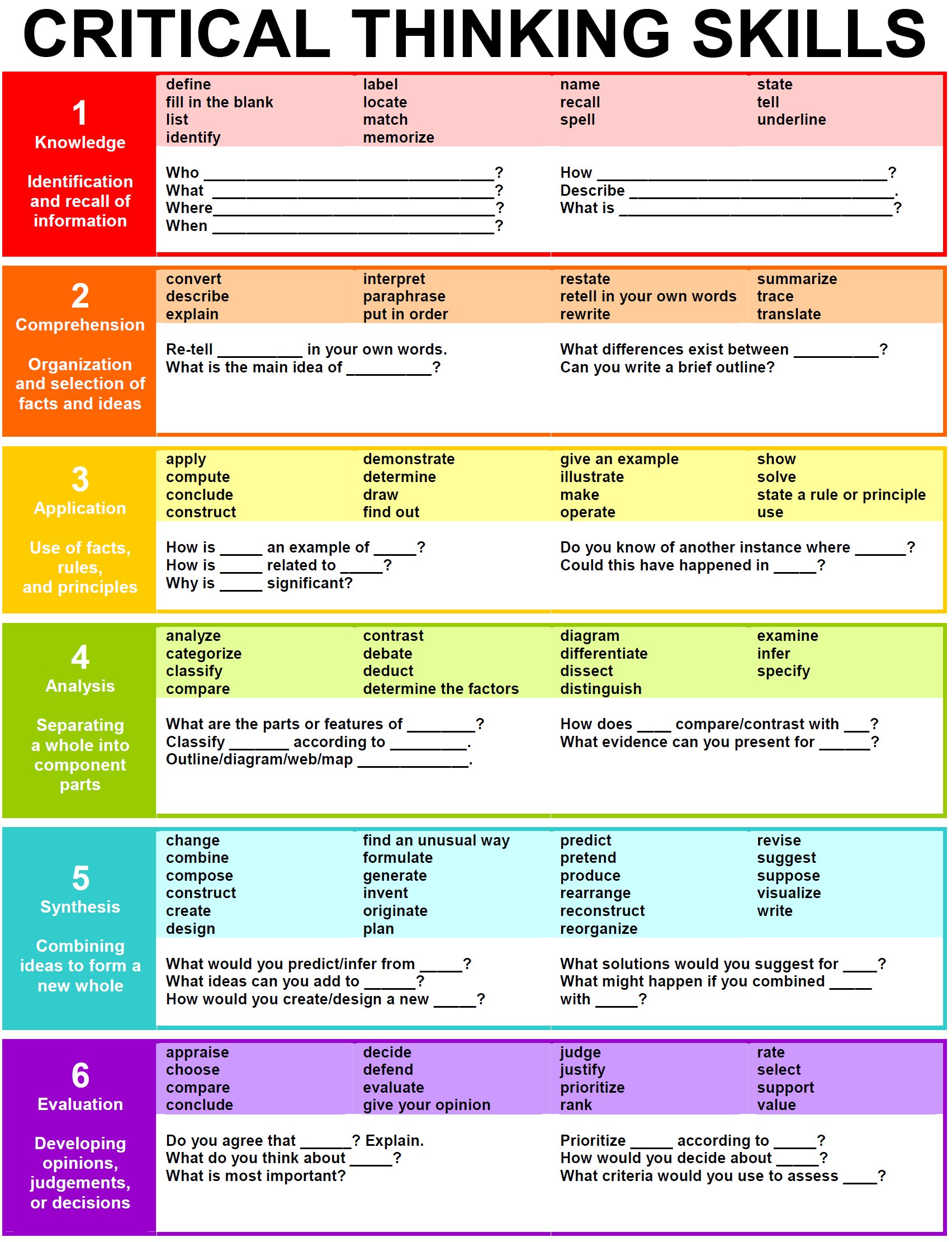
    Critical Thinking Skills: Levels, Definitions, Verbs, and Questions (chart from enokson, CC-BY-NC-ND)
    Level Definition Active Verbs Question Stems
    1. Knowledge Identification and recall of information define, fill in the blank, list, identify, label, locate, match, memorize, name, recall, spell, state, tell, underline
    • Who ______?
    • What ______?
    • Where ______?
    • When ______?
    • How ______?
    • Describe ______.
    • What is ______?
    2. Comprehension Organization and selection of facts and ideas convert, describe, explain, interpret, paraphrase, put in order, restate, retell in your own words, rewrite, summarize, trace, translate
    • Re-tell ______ in your own words.
    • What is the main idea of ______?
    • What differences exist between ______?
    • Can you write a brief outline?
    3. Application Use of facts, rules, and principles apply, compute, conclude, construct, demonstrate, determine, draw, find out, give an example, illustrate, make, operate, show, solve, state a rule or principle, use
    • How is ______ an example of ______?
    • How is ______ related to ______?
    • Why is ______ significant?
    • Do you know of another instance where ______?
    • Could this have happened in ______?
    4. Analysis Separating a whole into component parts analyze, categorize, classify, compare, contrast, debate, deduct, determine the factors, diagram, differentiate, dissect, distinguish, examine, infer, specify
    • What are the parts or features of ______?
    • Classify ______ according to ______.
    • Outline/diagram/web/map ______.
    • How does ______ compare/contrast with ______?
    • What evidence can you present for ______?
    5. Synthesis Combining ideas to form a new whole change, combine, compose, construct, create, design, find an unusual way, formulate, generate, invent, originate, plan, predict, pretend, produce, rearrange, reconstruct, reorganize, revise, suggest, suppose, visualize, write
    • What would you predict/infer from ______?
    • What ideas can you add to ______?
    • How would you create/design a new ______?
    • What solutions would you suggest for ______?
    • What might happen if you combined ______ with ______?
    6. Evaluation Developing opinions, judgments, or decisions appraise, choose, compare, conclude, decide, defend, evaluate, give your opinion, judge, justify, prioritize, rank, rate, select, support, value
    • Do you agree that ______? Explain.
    • What do you think about ______?
    • What is most important?
    • Prioritize ______ according to ______?
    • How would you decide about ______?
    • What criteria would you use to assess ______?

    This page titled 1.03: Creating Discussion Questions is shared under a CC BY-NC-SA license and was authored, remixed, and/or curated by Charity Davenport.

    • Was this article helpful?
