

4: Vocabulary
- Page ID
- 396587

\( \newcommand{\vecs}[1]{\overset { \scriptstyle \rightharpoonup} {\mathbf{#1}} } \)
\( \newcommand{\vecd}[1]{\overset{-\!-\!\rightharpoonup}{\vphantom{a}\smash {#1}}} \)
\( \newcommand{\dsum}{\displaystyle\sum\limits} \)
\( \newcommand{\dint}{\displaystyle\int\limits} \)
\( \newcommand{\dlim}{\displaystyle\lim\limits} \)
\( \newcommand{\id}{\mathrm{id}}\) \( \newcommand{\Span}{\mathrm{span}}\)
( \newcommand{\kernel}{\mathrm{null}\,}\) \( \newcommand{\range}{\mathrm{range}\,}\)
\( \newcommand{\RealPart}{\mathrm{Re}}\) \( \newcommand{\ImaginaryPart}{\mathrm{Im}}\)
\( \newcommand{\Argument}{\mathrm{Arg}}\) \( \newcommand{\norm}[1]{\| #1 \|}\)
\( \newcommand{\inner}[2]{\langle #1, #2 \rangle}\)
\( \newcommand{\Span}{\mathrm{span}}\)
\( \newcommand{\id}{\mathrm{id}}\)
\( \newcommand{\Span}{\mathrm{span}}\)
\( \newcommand{\kernel}{\mathrm{null}\,}\)
\( \newcommand{\range}{\mathrm{range}\,}\)
\( \newcommand{\RealPart}{\mathrm{Re}}\)
\( \newcommand{\ImaginaryPart}{\mathrm{Im}}\)
\( \newcommand{\Argument}{\mathrm{Arg}}\)
\( \newcommand{\norm}[1]{\| #1 \|}\)
\( \newcommand{\inner}[2]{\langle #1, #2 \rangle}\)
\( \newcommand{\Span}{\mathrm{span}}\) \( \newcommand{\AA}{\unicode[.8,0]{x212B}}\)
\( \newcommand{\vectorA}[1]{\vec{#1}} % arrow\)
\( \newcommand{\vectorAt}[1]{\vec{\text{#1}}} % arrow\)
\( \newcommand{\vectorB}[1]{\overset { \scriptstyle \rightharpoonup} {\mathbf{#1}} } \)
\( \newcommand{\vectorC}[1]{\textbf{#1}} \)
\( \newcommand{\vectorD}[1]{\overrightarrow{#1}} \)
\( \newcommand{\vectorDt}[1]{\overrightarrow{\text{#1}}} \)
\( \newcommand{\vectE}[1]{\overset{-\!-\!\rightharpoonup}{\vphantom{a}\smash{\mathbf {#1}}}} \)
\( \newcommand{\vecs}[1]{\overset { \scriptstyle \rightharpoonup} {\mathbf{#1}} } \)
\(\newcommand{\longvect}{\overrightarrow}\)
\( \newcommand{\vecd}[1]{\overset{-\!-\!\rightharpoonup}{\vphantom{a}\smash {#1}}} \)
\(\newcommand{\avec}{\mathbf a}\) \(\newcommand{\bvec}{\mathbf b}\) \(\newcommand{\cvec}{\mathbf c}\) \(\newcommand{\dvec}{\mathbf d}\) \(\newcommand{\dtil}{\widetilde{\mathbf d}}\) \(\newcommand{\evec}{\mathbf e}\) \(\newcommand{\fvec}{\mathbf f}\) \(\newcommand{\nvec}{\mathbf n}\) \(\newcommand{\pvec}{\mathbf p}\) \(\newcommand{\qvec}{\mathbf q}\) \(\newcommand{\svec}{\mathbf s}\) \(\newcommand{\tvec}{\mathbf t}\) \(\newcommand{\uvec}{\mathbf u}\) \(\newcommand{\vvec}{\mathbf v}\) \(\newcommand{\wvec}{\mathbf w}\) \(\newcommand{\xvec}{\mathbf x}\) \(\newcommand{\yvec}{\mathbf y}\) \(\newcommand{\zvec}{\mathbf z}\) \(\newcommand{\rvec}{\mathbf r}\) \(\newcommand{\mvec}{\mathbf m}\) \(\newcommand{\zerovec}{\mathbf 0}\) \(\newcommand{\onevec}{\mathbf 1}\) \(\newcommand{\real}{\mathbb R}\) \(\newcommand{\twovec}[2]{\left[\begin{array}{r}#1 \\ #2 \end{array}\right]}\) \(\newcommand{\ctwovec}[2]{\left[\begin{array}{c}#1 \\ #2 \end{array}\right]}\) \(\newcommand{\threevec}[3]{\left[\begin{array}{r}#1 \\ #2 \\ #3 \end{array}\right]}\) \(\newcommand{\cthreevec}[3]{\left[\begin{array}{c}#1 \\ #2 \\ #3 \end{array}\right]}\) \(\newcommand{\fourvec}[4]{\left[\begin{array}{r}#1 \\ #2 \\ #3 \\ #4 \end{array}\right]}\) \(\newcommand{\cfourvec}[4]{\left[\begin{array}{c}#1 \\ #2 \\ #3 \\ #4 \end{array}\right]}\) \(\newcommand{\fivevec}[5]{\left[\begin{array}{r}#1 \\ #2 \\ #3 \\ #4 \\ #5 \\ \end{array}\right]}\) \(\newcommand{\cfivevec}[5]{\left[\begin{array}{c}#1 \\ #2 \\ #3 \\ #4 \\ #5 \\ \end{array}\right]}\) \(\newcommand{\mattwo}[4]{\left[\begin{array}{rr}#1 \amp #2 \\ #3 \amp #4 \\ \end{array}\right]}\) \(\newcommand{\laspan}[1]{\text{Span}\{#1\}}\) \(\newcommand{\bcal}{\cal B}\) \(\newcommand{\ccal}{\cal C}\) \(\newcommand{\scal}{\cal S}\) \(\newcommand{\wcal}{\cal W}\) \(\newcommand{\ecal}{\cal E}\) \(\newcommand{\coords}[2]{\left\{#1\right\}_{#2}}\) \(\newcommand{\gray}[1]{\color{gray}{#1}}\) \(\newcommand{\lgray}[1]{\color{lightgray}{#1}}\) \(\newcommand{\rank}{\operatorname{rank}}\) \(\newcommand{\row}{\text{Row}}\) \(\newcommand{\col}{\text{Col}}\) \(\renewcommand{\row}{\text{Row}}\) \(\newcommand{\nul}{\text{Nul}}\) \(\newcommand{\var}{\text{Var}}\) \(\newcommand{\corr}{\text{corr}}\) \(\newcommand{\len}[1]{\left|#1\right|}\) \(\newcommand{\bbar}{\overline{\bvec}}\) \(\newcommand{\bhat}{\widehat{\bvec}}\) \(\newcommand{\bperp}{\bvec^\perp}\) \(\newcommand{\xhat}{\widehat{\xvec}}\) \(\newcommand{\vhat}{\widehat{\vvec}}\) \(\newcommand{\uhat}{\widehat{\uvec}}\) \(\newcommand{\what}{\widehat{\wvec}}\) \(\newcommand{\Sighat}{\widehat{\Sigma}}\) \(\newcommand{\lt}{<}\) \(\newcommand{\gt}{>}\) \(\newcommand{\amp}{&}\) \(\definecolor{fillinmathshade}{gray}{0.9}\)- Use the most effective strategy – context, word parts, or digital tools – to determine the meaning of an unknown word
The English language includes over 1,025,000 words. The average English-speaking adult has a working vocabulary of about 20,000 words. That means most of us have about a million words that we could potentially add to our vocabulary!
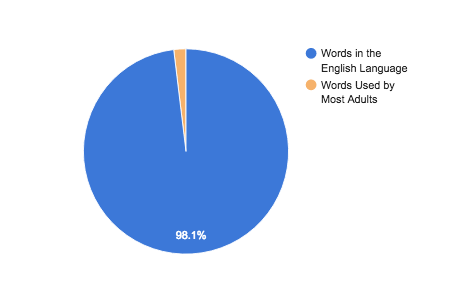
Figure \(\PageIndex{1}\)
Having a strong vocabulary makes reading more meaningful and enjoyable, and reading helps build a strong vocabulary. There are lots of other ways to pick up words, though. How do we know which tactics are best in any given situation for expanding your word power?
Stuck on a Word? Get Clues … Context Clues!
As we have already seen, sometimes we can try using the context clues, or words around the unfamiliar word, to help us figure out the meaning. When do we do that? When the surrounding sentences seem to give us hints in accordance with the context clues we have already learned, and when we don't have access to or don't want to interrupt the flow of our reading to access a dictionary.
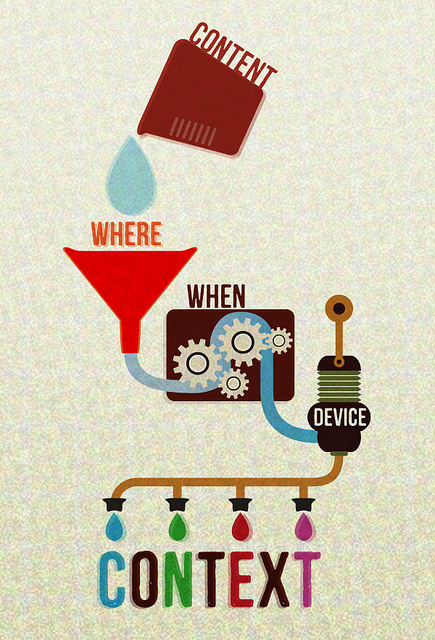
Figure \(\PageIndex{2}\)
Dictionaries
Should you stop reading to look words up?
It depends. Looking up words slows you down, and you may be able to make reasonable sense of their context without having to.
You have to decide how important a word seems to be. Do you feel you are missing something by not knowing it? Does it keep appearing? If you just carry on reading, the word may become clearer as you experience it being used (after all, that’s how we get to know the meaning of most words).
Sometimes it’s not one particular word that’s difficult, but a string of them. For example, when the phrase “clinical depression, assessed professionally through population surveys,” is likely to slow down many readers. If one word, like “depression” in this example, continues to occur, you may need to pay more attention to the recurring term.
Figure \(\PageIndex{3}\)
One way to tackle the challenge of unfamiliar words is to use a dictionary. You could use a traditional printed dictionary, or an online dictionary, or both. A printed dictionary is easy to keep beside you wherever you happen to be reading. But an online dictionary holds the advantage when it comes to looking up words quickly as you can look up a word in three or four online dictionaries simultaneously, to compare the definitions they offer.
You also have a choice between using a general dictionary, or a specialist dictionary for the subject that you are studying. How helpful you find either will depend on your subject, so it is worth doing a little exploring to find out. Note down a few “difficult” words from one of your main textbooks. Then visit a bookshop, or go online and find a few dictionaries. Look your words up to see if they are included and whether the definitions make sense to you.
Dictionaries are invaluable resources, but don’t expect them to be perfect. A general dictionary may not include key words or concepts from your subject area, or may give multiple definitions, in which case you still need to analyze a word in context to understand which meaning is correct in a particular situation. On the other hand, specialist dictionary definitions can be difficult to understand. Don't fear though--the more you read, and the more practice you gain navigating your resources, the more comfortable you will become.
Combining or Selecting Strategies
We have also discussed the value of using morphemes to expand our vocabularies. As you learn more word parts, you may find that you can guess the meaning of a word based on it's combination of prefixes, roots, affixes, and suffixes. Sometimes you can formulate a guess this way and verify your prediction by referring to the context to make sure the word makes sense. A third option is the dictionary. The more you find yourself making accurate inferences about word meanings with method 1 (morphemes) and method 2 (context clues), the less you may come to rely on the dictionary. Always consult a resource if you feel that morphemes and context are not enough for you to understand a new term that continues to occur in a reading. When time is of the essence, you are reasonably sure of your guess, and the meaning of an unknown word does not seem essential to your understanding of the bigger picture communicated by a group of sentences, it is probably not necessary to interrupt the flow of your reading to verify the definition.
Don't forget, you may want to add new words to your vocabulary notebook, which serves as a ready-made study tool for you to refer back to--great for discipline-specific vocabulary and keeping a record of your learning!