

19.5: Counting
- Page ID
- 258596

\( \newcommand{\vecs}[1]{\overset { \scriptstyle \rightharpoonup} {\mathbf{#1}} } \)
\( \newcommand{\vecd}[1]{\overset{-\!-\!\rightharpoonup}{\vphantom{a}\smash {#1}}} \)
\( \newcommand{\dsum}{\displaystyle\sum\limits} \)
\( \newcommand{\dint}{\displaystyle\int\limits} \)
\( \newcommand{\dlim}{\displaystyle\lim\limits} \)
\( \newcommand{\id}{\mathrm{id}}\) \( \newcommand{\Span}{\mathrm{span}}\)
( \newcommand{\kernel}{\mathrm{null}\,}\) \( \newcommand{\range}{\mathrm{range}\,}\)
\( \newcommand{\RealPart}{\mathrm{Re}}\) \( \newcommand{\ImaginaryPart}{\mathrm{Im}}\)
\( \newcommand{\Argument}{\mathrm{Arg}}\) \( \newcommand{\norm}[1]{\| #1 \|}\)
\( \newcommand{\inner}[2]{\langle #1, #2 \rangle}\)
\( \newcommand{\Span}{\mathrm{span}}\)
\( \newcommand{\id}{\mathrm{id}}\)
\( \newcommand{\Span}{\mathrm{span}}\)
\( \newcommand{\kernel}{\mathrm{null}\,}\)
\( \newcommand{\range}{\mathrm{range}\,}\)
\( \newcommand{\RealPart}{\mathrm{Re}}\)
\( \newcommand{\ImaginaryPart}{\mathrm{Im}}\)
\( \newcommand{\Argument}{\mathrm{Arg}}\)
\( \newcommand{\norm}[1]{\| #1 \|}\)
\( \newcommand{\inner}[2]{\langle #1, #2 \rangle}\)
\( \newcommand{\Span}{\mathrm{span}}\) \( \newcommand{\AA}{\unicode[.8,0]{x212B}}\)
\( \newcommand{\vectorA}[1]{\vec{#1}} % arrow\)
\( \newcommand{\vectorAt}[1]{\vec{\text{#1}}} % arrow\)
\( \newcommand{\vectorB}[1]{\overset { \scriptstyle \rightharpoonup} {\mathbf{#1}} } \)
\( \newcommand{\vectorC}[1]{\textbf{#1}} \)
\( \newcommand{\vectorD}[1]{\overrightarrow{#1}} \)
\( \newcommand{\vectorDt}[1]{\overrightarrow{\text{#1}}} \)
\( \newcommand{\vectE}[1]{\overset{-\!-\!\rightharpoonup}{\vphantom{a}\smash{\mathbf {#1}}}} \)
\( \newcommand{\vecs}[1]{\overset { \scriptstyle \rightharpoonup} {\mathbf{#1}} } \)
\(\newcommand{\longvect}{\overrightarrow}\)
\( \newcommand{\vecd}[1]{\overset{-\!-\!\rightharpoonup}{\vphantom{a}\smash {#1}}} \)
\(\newcommand{\ket}[1]{\left| #1 \right>}\)
\(\newcommand{\bra}[1]{\left< #1 \right|}\)
\(\newcommand{\braket}[2]{\left< #1 \vphantom{#2} \right| \left. #2 \vphantom{#1} \right>}\)
\(\newcommand{\braopket}[3]{\left< #1 \vphantom{#2}\vphantom{#3} \right| #2 \vphantom{#1}\vphantom{#3} \left| #3 \vphantom{#1}\vphantom{#2} \right>}\)
\(\newcommand{\qmvec}[1]{\mathbf{\vec{#1}}}\)
\(\newcommand{\op}[1]{\hat{\mathbf{#1}}}\)
\(\newcommand{\expect}[1]{\langle #1 \rangle}\)
\(\newcommand{\dfn}[1]{\emph{\textbf{#1}}}\)
Simple Meter
As you learn to feel the subdivision of the beat, it is helpful to count the smallest note value in the rhythm. In the case of the simple meter examples in this chapter, this will be the sixteenth note.
Numbers
If we are using the number system for counting, we fill in the sounds between our "1 and" with the syllables "e" and "a" (pronounced "uh").
For four sixteenth notes, there are notes sounding on all four parts: "1 e and a."

When counting a syncopated rhythm where there are some notes held and some notes sounding, either count the "1 e and a" continuously and clap the rhythm, or say out loud only the portions of the beat that will have sound.

In this example, we could count "1 e and a, 2 e and a" and clap on the "1" and the "a," the "2" and the "a." We could also think about the other subdivisions and then only say out loud, "1-a 2-a." If we choose the second option, it is important to still produce the correct rhythm and count in our head.
Takadimi
Takadimi breaks the four parts of a group of sixteenth notes into the syllables: ta-ka-di-mi
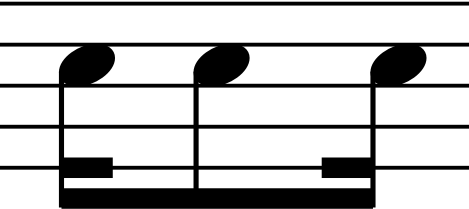 A sixteenth, an eighth, and a sixteenth would use the first two syllables and the last and we would say, "ta ka mi."
Though there are two different ways to count with the number system, we most often use the Takadimi system with the method to only say the syllables where there are sounds.
Compound Meter
When there is syncopation in a compound meter, it can be a challenge to keep track of the normal pulse. Counting out loud, or tapping your foot or hand, can help keep track of the beats as you perform a rhythm. In the case of compound duple meter, this will be the "1-la-li 2-la-li" that needs to stay consistent.
As with the previous coverage of counting in compound meter in 7.3.1: Sixteenth Notes, there are two versions of using numbers for counting and the option to use Takadimi.

Conducting
With any of these counting methods in various meters, unless clapping or tapping the rhythm, continue to practice conducting. When a conducting pattern becomes second nature, it can function as a metronome and keep the forward momentum and avoid pauses.