

13.7: Additional Classifications
- Page ID
- 258556

\( \newcommand{\vecs}[1]{\overset { \scriptstyle \rightharpoonup} {\mathbf{#1}} } \)
\( \newcommand{\vecd}[1]{\overset{-\!-\!\rightharpoonup}{\vphantom{a}\smash {#1}}} \)
\( \newcommand{\dsum}{\displaystyle\sum\limits} \)
\( \newcommand{\dint}{\displaystyle\int\limits} \)
\( \newcommand{\dlim}{\displaystyle\lim\limits} \)
\( \newcommand{\id}{\mathrm{id}}\) \( \newcommand{\Span}{\mathrm{span}}\)
( \newcommand{\kernel}{\mathrm{null}\,}\) \( \newcommand{\range}{\mathrm{range}\,}\)
\( \newcommand{\RealPart}{\mathrm{Re}}\) \( \newcommand{\ImaginaryPart}{\mathrm{Im}}\)
\( \newcommand{\Argument}{\mathrm{Arg}}\) \( \newcommand{\norm}[1]{\| #1 \|}\)
\( \newcommand{\inner}[2]{\langle #1, #2 \rangle}\)
\( \newcommand{\Span}{\mathrm{span}}\)
\( \newcommand{\id}{\mathrm{id}}\)
\( \newcommand{\Span}{\mathrm{span}}\)
\( \newcommand{\kernel}{\mathrm{null}\,}\)
\( \newcommand{\range}{\mathrm{range}\,}\)
\( \newcommand{\RealPart}{\mathrm{Re}}\)
\( \newcommand{\ImaginaryPart}{\mathrm{Im}}\)
\( \newcommand{\Argument}{\mathrm{Arg}}\)
\( \newcommand{\norm}[1]{\| #1 \|}\)
\( \newcommand{\inner}[2]{\langle #1, #2 \rangle}\)
\( \newcommand{\Span}{\mathrm{span}}\) \( \newcommand{\AA}{\unicode[.8,0]{x212B}}\)
\( \newcommand{\vectorA}[1]{\vec{#1}} % arrow\)
\( \newcommand{\vectorAt}[1]{\vec{\text{#1}}} % arrow\)
\( \newcommand{\vectorB}[1]{\overset { \scriptstyle \rightharpoonup} {\mathbf{#1}} } \)
\( \newcommand{\vectorC}[1]{\textbf{#1}} \)
\( \newcommand{\vectorD}[1]{\overrightarrow{#1}} \)
\( \newcommand{\vectorDt}[1]{\overrightarrow{\text{#1}}} \)
\( \newcommand{\vectE}[1]{\overset{-\!-\!\rightharpoonup}{\vphantom{a}\smash{\mathbf {#1}}}} \)
\( \newcommand{\vecs}[1]{\overset { \scriptstyle \rightharpoonup} {\mathbf{#1}} } \)
\(\newcommand{\longvect}{\overrightarrow}\)
\( \newcommand{\vecd}[1]{\overset{-\!-\!\rightharpoonup}{\vphantom{a}\smash {#1}}} \)
\(\newcommand{\ket}[1]{\left| #1 \right>}\)
\(\newcommand{\bra}[1]{\left< #1 \right|}\)
\(\newcommand{\braket}[2]{\left< #1 \vphantom{#2} \right| \left. #2 \vphantom{#1} \right>}\)
\(\newcommand{\braopket}[3]{\left< #1 \vphantom{#2}\vphantom{#3} \right| #2 \vphantom{#1}\vphantom{#3} \left| #3 \vphantom{#1}\vphantom{#2} \right>}\)
\(\newcommand{\qmvec}[1]{\mathbf{\vec{#1}}}\)
\(\newcommand{\op}[1]{\hat{\mathbf{#1}}}\)
\(\newcommand{\expect}[1]{\langle #1 \rangle}\)
\(\newcommand{\dfn}[1]{\emph{\textbf{#1}}}\)
Neighbor Group
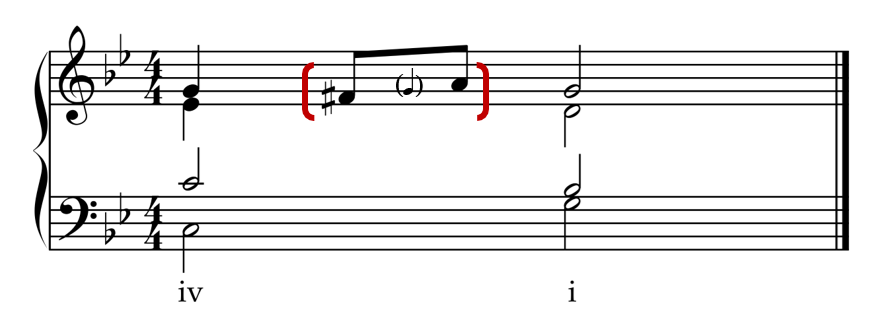
When we combine the escape tone and appoggiatura, we have a neighbor group. This can be abbreviated with "n" and "gr" in parenthesis and looks like: (n.gr). This looks like neighbor tones with the middle of the group being left out.
Key features
- The neighbor group is a combination of two different embellishments
- The first non-chord tone leaves the chord tone by a step
- There is a skip of a third in the opposite direction
- The second non-chord tone is resolved by coming up a step in the opposite direction of the skip
Example
In this example, we are in the key of G minor. Our first chord is a C minor chord, which is the minor four chord. It is made up of: C, E-flat, and G. On the second beat in this measure, we have a step down to the F-sharp and then a skip in the opposite direction to A. This group of two non-chord tones then resolves down a step to G. G belongs in our second chord because it is a minor tonic in this key and is made up of: G, B-flat, and D.
In small parenthesis, we can see the imaginary G that would make this look like a lower neighbor and then an upper neighbor with the middle chord tone missing.
Anticipation
An anticipation happens when a note from a chord shows up before the chord has happened. This is abbreviated by "ant" in parenthesis and looks like: (ant).
Key Features
- The note that is an anticipation cannot be present in the previous chord
- The anticipation note is heard and then the chord to which it belongs is heard
- The anticipation can be approached by either a step or a skip
- When an anticipation is approached and left by a leap, it is called a free anticipation
Example
For this example, we will stay with the same chord progression as we used above. Our first chord is C minor and is made up of: C, E-flat, and G. Our second chord is the minor tonic and is made up of: G, B-flat, and D. Since D is not present in the first chord, it can be used as an anticipation in the alto voice. The non-chord tone comes in on the second half of the second beat before the actual chord sounds on beat three.

Pedal Point
A note that is used as a pedal point starts as a chord tone, becomes a non-chord tone, and then returns to being a chord tone. This is abbreviated with lowercase "ped" and looks like: (ped).
Key Features
- The tonic or dominant note is usually used as a pedal point
- The pedal point is usually found in the bass
- When the tone is not in the bass, it is called an inverted pedal point
- If two pitches are held as a pedal point, it is called a double pedal point
Example
In this example in B-flat major, our B-flat in the bass becomes our pedal point and is held through the entire example. The first chord is a tonic chord and is made up of: B-flat, D, and F. The B-flat in the bass is a chord tone. The B-flat continues to be held, but the upper notes move and change the chord. The new chord is a dominant chord and is made up of: F, A, and C. The B-flat that is present in the bass is now a non-chord tone pedal point. The third chord returns to the tonic where the B-flat is again part of the chord.
