

7.4: Lab Activities
- Page ID
- 270113

\( \newcommand{\vecs}[1]{\overset { \scriptstyle \rightharpoonup} {\mathbf{#1}} } \)
\( \newcommand{\vecd}[1]{\overset{-\!-\!\rightharpoonup}{\vphantom{a}\smash {#1}}} \)
\( \newcommand{\dsum}{\displaystyle\sum\limits} \)
\( \newcommand{\dint}{\displaystyle\int\limits} \)
\( \newcommand{\dlim}{\displaystyle\lim\limits} \)
\( \newcommand{\id}{\mathrm{id}}\) \( \newcommand{\Span}{\mathrm{span}}\)
( \newcommand{\kernel}{\mathrm{null}\,}\) \( \newcommand{\range}{\mathrm{range}\,}\)
\( \newcommand{\RealPart}{\mathrm{Re}}\) \( \newcommand{\ImaginaryPart}{\mathrm{Im}}\)
\( \newcommand{\Argument}{\mathrm{Arg}}\) \( \newcommand{\norm}[1]{\| #1 \|}\)
\( \newcommand{\inner}[2]{\langle #1, #2 \rangle}\)
\( \newcommand{\Span}{\mathrm{span}}\)
\( \newcommand{\id}{\mathrm{id}}\)
\( \newcommand{\Span}{\mathrm{span}}\)
\( \newcommand{\kernel}{\mathrm{null}\,}\)
\( \newcommand{\range}{\mathrm{range}\,}\)
\( \newcommand{\RealPart}{\mathrm{Re}}\)
\( \newcommand{\ImaginaryPart}{\mathrm{Im}}\)
\( \newcommand{\Argument}{\mathrm{Arg}}\)
\( \newcommand{\norm}[1]{\| #1 \|}\)
\( \newcommand{\inner}[2]{\langle #1, #2 \rangle}\)
\( \newcommand{\Span}{\mathrm{span}}\) \( \newcommand{\AA}{\unicode[.8,0]{x212B}}\)
\( \newcommand{\vectorA}[1]{\vec{#1}} % arrow\)
\( \newcommand{\vectorAt}[1]{\vec{\text{#1}}} % arrow\)
\( \newcommand{\vectorB}[1]{\overset { \scriptstyle \rightharpoonup} {\mathbf{#1}} } \)
\( \newcommand{\vectorC}[1]{\textbf{#1}} \)
\( \newcommand{\vectorD}[1]{\overrightarrow{#1}} \)
\( \newcommand{\vectorDt}[1]{\overrightarrow{\text{#1}}} \)
\( \newcommand{\vectE}[1]{\overset{-\!-\!\rightharpoonup}{\vphantom{a}\smash{\mathbf {#1}}}} \)
\( \newcommand{\vecs}[1]{\overset { \scriptstyle \rightharpoonup} {\mathbf{#1}} } \)
\(\newcommand{\longvect}{\overrightarrow}\)
\( \newcommand{\vecd}[1]{\overset{-\!-\!\rightharpoonup}{\vphantom{a}\smash {#1}}} \)
\(\newcommand{\ket}[1]{\left| #1 \right>}\)
\(\newcommand{\bra}[1]{\left< #1 \right|}\)
\(\newcommand{\braket}[2]{\left< #1 \vphantom{#2} \right| \left. #2 \vphantom{#1} \right>}\)
\(\newcommand{\braopket}[3]{\left< #1 \vphantom{#2}\vphantom{#3} \right| #2 \vphantom{#1}\vphantom{#3} \left| #3 \vphantom{#1}\vphantom{#2} \right>}\)
\(\newcommand{\qmvec}[1]{\mathbf{\vec{#1}}}\)
\(\newcommand{\op}[1]{\hat{\mathbf{#1}}}\)
\(\newcommand{\expect}[1]{\langle #1 \rangle}\)
\(\newcommand{\dfn}[1]{\emph{\textbf{#1}}}\)
Warm Ups
These warm ups can be used for personal practice or in-class activities.
Activity 1
Go through this activity at least three times.
- At a very slow tempo, use the Curwen hand signs and solfège at the same time. Focus on the distances between the notes.
- Using the triple meter conducting pattern, conduct and sing solfège.
- Using the triple meter conducting pattern, conduct and sing scale degrees.

Activity 2
Go through this activity at least three times.
- At a very slow tempo, use the Curwen hand signs and solfège at the same time. Focus on the distances between the notes.
- Using the duple meter conducting pattern, conduct and sing solfège.
- Using the duple meter conducting pattern, conduct and sing scale degrees.

Intervals
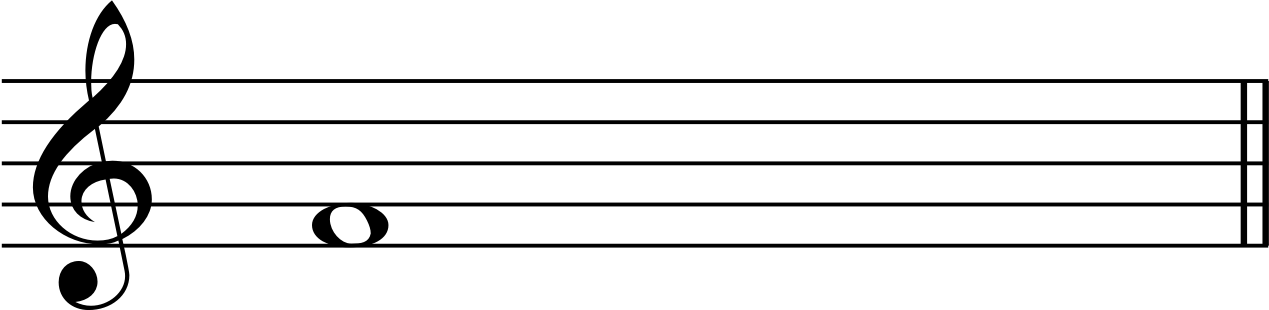
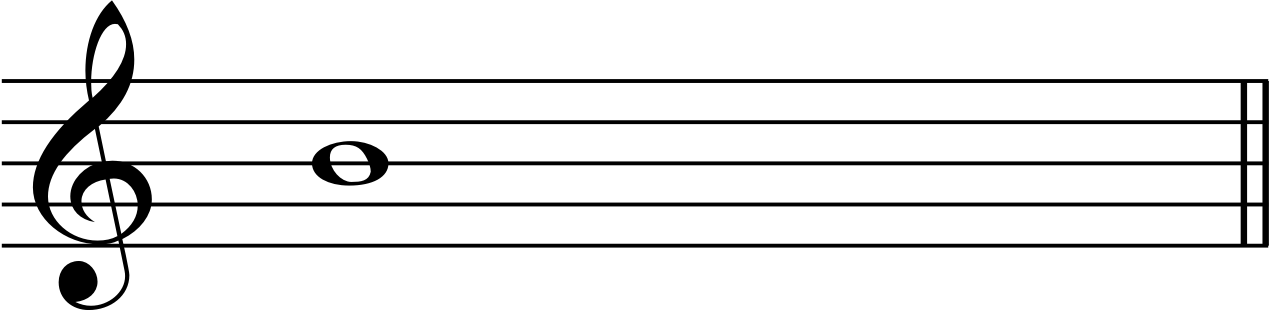
Listen to the interval played by your instructor. The first pitch is given for you. Notate the second pitch.




Sight Singing
Use these melodies to practice sight singing. True sight singing is your attempt the very first time you sing the melody. Our goal is to sing it perfectly the first time through. However, this is a new skill for many. As with any new skill, practicing is the key to improvement. If the melody is not perfect the first time through, discuss as a class or with your group and determine where errors were made. Why do you think that particular area was challenging? Practice a few parts and then attempt the melody again.
Melody 1

Melody 2

Melody 3

Melody 4

Rhythm Practice
Use these rhythm exercises to practice reading and performing rhythms with various subdivisions and patterns.
Rhythm 1

Rhythm 2

Rhythm 3

Rhythm 4

Rhythm 5

Rhythm Duet

Rhythmic Dictation
Use the staves provided to complete short rhythmic dictations with your instructor. As you listen to each example, conduct with your non-writing hand. Use the space provided to draw out your beat boxes.




Melodic Dictation

Discuss
How are you feeling about hearing the smaller note durations? Are the beat boxes or numbers working better for you?