

6.4: Consonant vs. Dissonant
- Page ID
- 258499

\( \newcommand{\vecs}[1]{\overset { \scriptstyle \rightharpoonup} {\mathbf{#1}} } \)
\( \newcommand{\vecd}[1]{\overset{-\!-\!\rightharpoonup}{\vphantom{a}\smash {#1}}} \)
\( \newcommand{\dsum}{\displaystyle\sum\limits} \)
\( \newcommand{\dint}{\displaystyle\int\limits} \)
\( \newcommand{\dlim}{\displaystyle\lim\limits} \)
\( \newcommand{\id}{\mathrm{id}}\) \( \newcommand{\Span}{\mathrm{span}}\)
( \newcommand{\kernel}{\mathrm{null}\,}\) \( \newcommand{\range}{\mathrm{range}\,}\)
\( \newcommand{\RealPart}{\mathrm{Re}}\) \( \newcommand{\ImaginaryPart}{\mathrm{Im}}\)
\( \newcommand{\Argument}{\mathrm{Arg}}\) \( \newcommand{\norm}[1]{\| #1 \|}\)
\( \newcommand{\inner}[2]{\langle #1, #2 \rangle}\)
\( \newcommand{\Span}{\mathrm{span}}\)
\( \newcommand{\id}{\mathrm{id}}\)
\( \newcommand{\Span}{\mathrm{span}}\)
\( \newcommand{\kernel}{\mathrm{null}\,}\)
\( \newcommand{\range}{\mathrm{range}\,}\)
\( \newcommand{\RealPart}{\mathrm{Re}}\)
\( \newcommand{\ImaginaryPart}{\mathrm{Im}}\)
\( \newcommand{\Argument}{\mathrm{Arg}}\)
\( \newcommand{\norm}[1]{\| #1 \|}\)
\( \newcommand{\inner}[2]{\langle #1, #2 \rangle}\)
\( \newcommand{\Span}{\mathrm{span}}\) \( \newcommand{\AA}{\unicode[.8,0]{x212B}}\)
\( \newcommand{\vectorA}[1]{\vec{#1}} % arrow\)
\( \newcommand{\vectorAt}[1]{\vec{\text{#1}}} % arrow\)
\( \newcommand{\vectorB}[1]{\overset { \scriptstyle \rightharpoonup} {\mathbf{#1}} } \)
\( \newcommand{\vectorC}[1]{\textbf{#1}} \)
\( \newcommand{\vectorD}[1]{\overrightarrow{#1}} \)
\( \newcommand{\vectorDt}[1]{\overrightarrow{\text{#1}}} \)
\( \newcommand{\vectE}[1]{\overset{-\!-\!\rightharpoonup}{\vphantom{a}\smash{\mathbf {#1}}}} \)
\( \newcommand{\vecs}[1]{\overset { \scriptstyle \rightharpoonup} {\mathbf{#1}} } \)
\(\newcommand{\longvect}{\overrightarrow}\)
\( \newcommand{\vecd}[1]{\overset{-\!-\!\rightharpoonup}{\vphantom{a}\smash {#1}}} \)
\(\newcommand{\ket}[1]{\left| #1 \right>}\)
\(\newcommand{\bra}[1]{\left< #1 \right|}\)
\(\newcommand{\braket}[2]{\left< #1 \vphantom{#2} \right| \left. #2 \vphantom{#1} \right>}\)
\(\newcommand{\braopket}[3]{\left< #1 \vphantom{#2}\vphantom{#3} \right| #2 \vphantom{#1}\vphantom{#3} \left| #3 \vphantom{#1}\vphantom{#2} \right>}\)
\(\newcommand{\qmvec}[1]{\mathbf{\vec{#1}}}\)
\(\newcommand{\op}[1]{\hat{\mathbf{#1}}}\)
\(\newcommand{\expect}[1]{\langle #1 \rangle}\)
\(\newcommand{\dfn}[1]{\emph{\textbf{#1}}}\)
Consonant Intervals
Consonant intervals are generally described as being pleasant and stable. This distinction and idea of a stable interval has been around since Pythagoras in the 5th century B.C.E. Although the intervals thought to be in this category have changed over time, we continue to classify intervals as either consonant or dissonant.
All perfect intervals are considered to be consonant from an ear training perspective, although the interval of the perfect fourth is often considered to be dissonant when dealing with counterpoint. Major thirds and sixths are slightly less consonant than perfect intervals, but are the stable backbone of triadic harmony and still very consonant.
Perfect Octave

The perfect octave is made up of two pitches from the same pitch class and is the most consonant of all of the intervals.



Perfect Fourth

Again, the perfect fourth is not fully a consonant interval, but for the sake of how it sounds on its own, we will consider it consonant for ear training purposes.

Minor Third

The minor third is do to me using solfège syllables. It is a consonant interval that is smaller than a perfect fifth.

Major Third
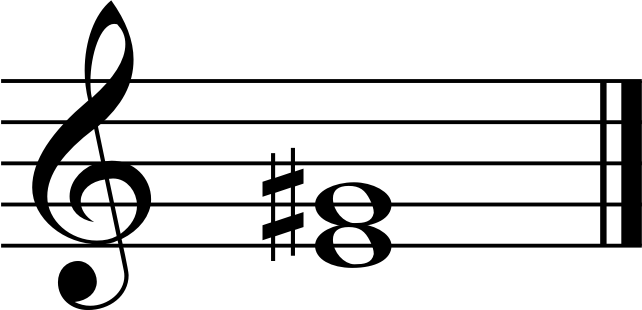
The major third is do to mi using solfège syllables. It has a brighter sound than the minor third and is another consonant interval smaller than a perfect fifth.

Minor Sixth

The minor sixth is a sweet sounding, consonant interval that is just slightly larger than a perfect fifth. You might also hear it as the outside notes of an inverted minor triad.

Major Sixth

The major sixth is a consonant interval larger than the perfect fifth. You might also hear it as outside notes of an inverted major triad.

Dissonant Intervals
Dissonant intervals are considered to be unstable and might give you that feeling of cringe. In this category, we find seconds, sevenths, and augmented or diminished intervals.
The idea of consonant and dissonant intervals is one of the very subjective areas of music. Our ideas of what is consonant and dissonant are culturally-specific and can change over time within the same music culture. Different genres and cultures have very different views on what constitutes a consonant or dissonant interval. In this book, the classifications of consonant and dissonant are discussed from an ear training perspective because the general quality and stability can be helpful when trying to determine the type of interval you are hearing.
Minor Second

The minor second is the smallest interval that we measure on the piano and possibly the most dissonant. One could argue that the major seventh is also quite dissonant, but the minor second is the smallest dissonant interval. This is the distance between ti and do in the major scale.

Major Second
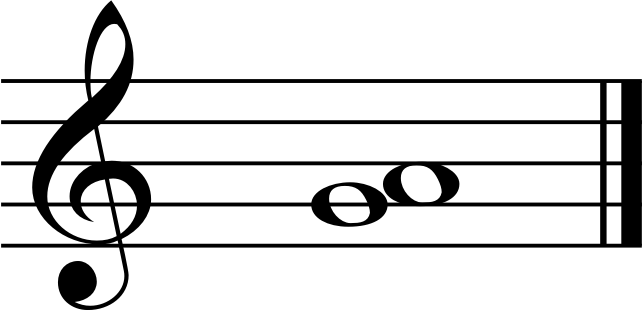
The major second is the same as a whole step. It is the distance between do and re if we think of the ascending major scale. It is the distance between mi and re if we think of a descending figure.

Minor Seventh

The minor seventh is the softer of the two seventh intervals. It often sounds as if it wants to resolve down by a step. Others hear it as the outside notes of a dominant seventh chord. It is dissonant, but a sweeter dissonance than the next interval.

Major Seventh

The major seventh is the most dissonant large interval within the octave. We can think of this interval as the distance between do and ti, or the tonic and the leading tone. A key feature of the major seventh is the tension created by the leading tone, which our ears want to hear resolved up to the octave.

Augmented Fourth/Diminished Fifth


The augmented fourth or diminished fifth is also known as the tritone. These two intervals sound the same even though they are written differently. This is a dissonant interval that is close to the size of the perfect fifth.
