

1.6: Marie De France
- Page ID
- 456342

\( \newcommand{\vecs}[1]{\overset { \scriptstyle \rightharpoonup} {\mathbf{#1}} } \)
\( \newcommand{\vecd}[1]{\overset{-\!-\!\rightharpoonup}{\vphantom{a}\smash {#1}}} \)
\( \newcommand{\dsum}{\displaystyle\sum\limits} \)
\( \newcommand{\dint}{\displaystyle\int\limits} \)
\( \newcommand{\dlim}{\displaystyle\lim\limits} \)
\( \newcommand{\id}{\mathrm{id}}\) \( \newcommand{\Span}{\mathrm{span}}\)
( \newcommand{\kernel}{\mathrm{null}\,}\) \( \newcommand{\range}{\mathrm{range}\,}\)
\( \newcommand{\RealPart}{\mathrm{Re}}\) \( \newcommand{\ImaginaryPart}{\mathrm{Im}}\)
\( \newcommand{\Argument}{\mathrm{Arg}}\) \( \newcommand{\norm}[1]{\| #1 \|}\)
\( \newcommand{\inner}[2]{\langle #1, #2 \rangle}\)
\( \newcommand{\Span}{\mathrm{span}}\)
\( \newcommand{\id}{\mathrm{id}}\)
\( \newcommand{\Span}{\mathrm{span}}\)
\( \newcommand{\kernel}{\mathrm{null}\,}\)
\( \newcommand{\range}{\mathrm{range}\,}\)
\( \newcommand{\RealPart}{\mathrm{Re}}\)
\( \newcommand{\ImaginaryPart}{\mathrm{Im}}\)
\( \newcommand{\Argument}{\mathrm{Arg}}\)
\( \newcommand{\norm}[1]{\| #1 \|}\)
\( \newcommand{\inner}[2]{\langle #1, #2 \rangle}\)
\( \newcommand{\Span}{\mathrm{span}}\) \( \newcommand{\AA}{\unicode[.8,0]{x212B}}\)
\( \newcommand{\vectorA}[1]{\vec{#1}} % arrow\)
\( \newcommand{\vectorAt}[1]{\vec{\text{#1}}} % arrow\)
\( \newcommand{\vectorB}[1]{\overset { \scriptstyle \rightharpoonup} {\mathbf{#1}} } \)
\( \newcommand{\vectorC}[1]{\textbf{#1}} \)
\( \newcommand{\vectorD}[1]{\overrightarrow{#1}} \)
\( \newcommand{\vectorDt}[1]{\overrightarrow{\text{#1}}} \)
\( \newcommand{\vectE}[1]{\overset{-\!-\!\rightharpoonup}{\vphantom{a}\smash{\mathbf {#1}}}} \)
\( \newcommand{\vecs}[1]{\overset { \scriptstyle \rightharpoonup} {\mathbf{#1}} } \)
\(\newcommand{\longvect}{\overrightarrow}\)
\( \newcommand{\vecd}[1]{\overset{-\!-\!\rightharpoonup}{\vphantom{a}\smash {#1}}} \)
\(\newcommand{\ket}[1]{\left| #1 \right>}\)
\(\newcommand{\bra}[1]{\left< #1 \right|}\)
\(\newcommand{\braket}[2]{\left< #1 \vphantom{#2} \right| \left. #2 \vphantom{#1} \right>}\)
\(\newcommand{\braopket}[3]{\left< #1 \vphantom{#2}\vphantom{#3} \right| #2 \vphantom{#1}\vphantom{#3} \left| #3 \vphantom{#1}\vphantom{#2} \right>}\)
\(\newcommand{\qmvec}[1]{\mathbf{\vec{#1}}}\)
\(\newcommand{\op}[1]{\hat{\mathbf{#1}}}\)
\(\newcommand{\expect}[1]{\langle #1 \rangle}\)
\(\newcommand{\dfn}[1]{\emph{\textbf{#1}}}\)
All we know about the author is that her name is Marie and she is from France. Since the English royal court at the time spoke French and had extensive ties to France, it is possible that she worked for an English king (some speculate Henry II). The very fact that she is “of France” could mean that she is not in France and is being identified that way in an English court. Unless more evidence is found, however, there is no way to know for certain. She is considered the first female French medieval poet.
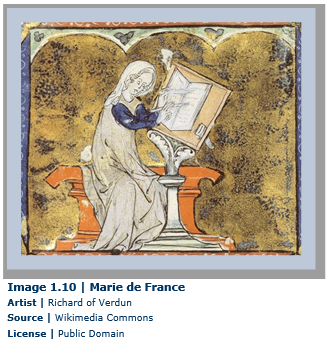
We do know that Marie’s works were popular. Denis Pyramus, in his Life of St . Edmund the King (written not too long after Marie’s works), praises “…Dame Marie, who turned into rhyme and made verses of ‘Lays’ which are not in the least true. For these she is much praised, and her rhyme is loved everywhere; for counts, barons, and knights greatly admire it, and hold it dear. And they love her writing so much, and take such pleasure in it, that they have it read, and often copied. These Lays are wont to please ladies, who listen to them with delight, for they are after their own hearts.” Sadly, he neglects to tell us any more about her, since he assumes that his audience knows exactly who she is. Marie states that her lais (lays) are versions of oral tales that she heard from Breton minstrels (from Brittany, on the French coast). Breton is a Brittonic (Celtic) language, brought by immigrants from southwestern England, especially Cornwall (possibly when the Angles and the Saxons were moving into Britain). Marie writes in Anglo-Norman, which is a version of medieval French, with the occasional English word thrown in. Not surprising- ly, several of the lais (lays) deal with British stories, including the two presented in the anthology. In Launfal, the titular knight is a neglected member of King Arthur’s court, until he encounters a fairy lady who will grant him any wish, as long as he keeps their love a secret. In The Lay of the Honeysuckle, the knight Tristan has a brief meeting with his true love, Queen Isolde (who is the wife of his uncle, King Mark of Cornwall).