

1.5: Sección 1 - Verbos como gustar
- Page ID
- 209684
\( \newcommand{\vecs}[1]{\overset { \scriptstyle \rightharpoonup} {\mathbf{#1}} } \)
\( \newcommand{\vecd}[1]{\overset{-\!-\!\rightharpoonup}{\vphantom{a}\smash {#1}}} \)
\( \newcommand{\id}{\mathrm{id}}\) \( \newcommand{\Span}{\mathrm{span}}\)
( \newcommand{\kernel}{\mathrm{null}\,}\) \( \newcommand{\range}{\mathrm{range}\,}\)
\( \newcommand{\RealPart}{\mathrm{Re}}\) \( \newcommand{\ImaginaryPart}{\mathrm{Im}}\)
\( \newcommand{\Argument}{\mathrm{Arg}}\) \( \newcommand{\norm}[1]{\| #1 \|}\)
\( \newcommand{\inner}[2]{\langle #1, #2 \rangle}\)
\( \newcommand{\Span}{\mathrm{span}}\)
\( \newcommand{\id}{\mathrm{id}}\)
\( \newcommand{\Span}{\mathrm{span}}\)
\( \newcommand{\kernel}{\mathrm{null}\,}\)
\( \newcommand{\range}{\mathrm{range}\,}\)
\( \newcommand{\RealPart}{\mathrm{Re}}\)
\( \newcommand{\ImaginaryPart}{\mathrm{Im}}\)
\( \newcommand{\Argument}{\mathrm{Arg}}\)
\( \newcommand{\norm}[1]{\| #1 \|}\)
\( \newcommand{\inner}[2]{\langle #1, #2 \rangle}\)
\( \newcommand{\Span}{\mathrm{span}}\) \( \newcommand{\AA}{\unicode[.8,0]{x212B}}\)
\( \newcommand{\vectorA}[1]{\vec{#1}} % arrow\)
\( \newcommand{\vectorAt}[1]{\vec{\text{#1}}} % arrow\)
\( \newcommand{\vectorB}[1]{\overset { \scriptstyle \rightharpoonup} {\mathbf{#1}} } \)
\( \newcommand{\vectorC}[1]{\textbf{#1}} \)
\( \newcommand{\vectorD}[1]{\overrightarrow{#1}} \)
\( \newcommand{\vectorDt}[1]{\overrightarrow{\text{#1}}} \)
\( \newcommand{\vectE}[1]{\overset{-\!-\!\rightharpoonup}{\vphantom{a}\smash{\mathbf {#1}}}} \)
\( \newcommand{\vecs}[1]{\overset { \scriptstyle \rightharpoonup} {\mathbf{#1}} } \)
\( \newcommand{\vecd}[1]{\overset{-\!-\!\rightharpoonup}{\vphantom{a}\smash {#1}}} \)
¿Recuerdas?
A Nate y a Marina les encanta viajar y les fascinan los sitios arqueológicos. Por eso, les pareció buena idea hacer el camino Inca entre Cusco y Machu Picchu durante sus últimas vacaciones. Les encantaron las ruinas de los monumentos y les interesó mucho aprender más de la historia del imperio Inca.
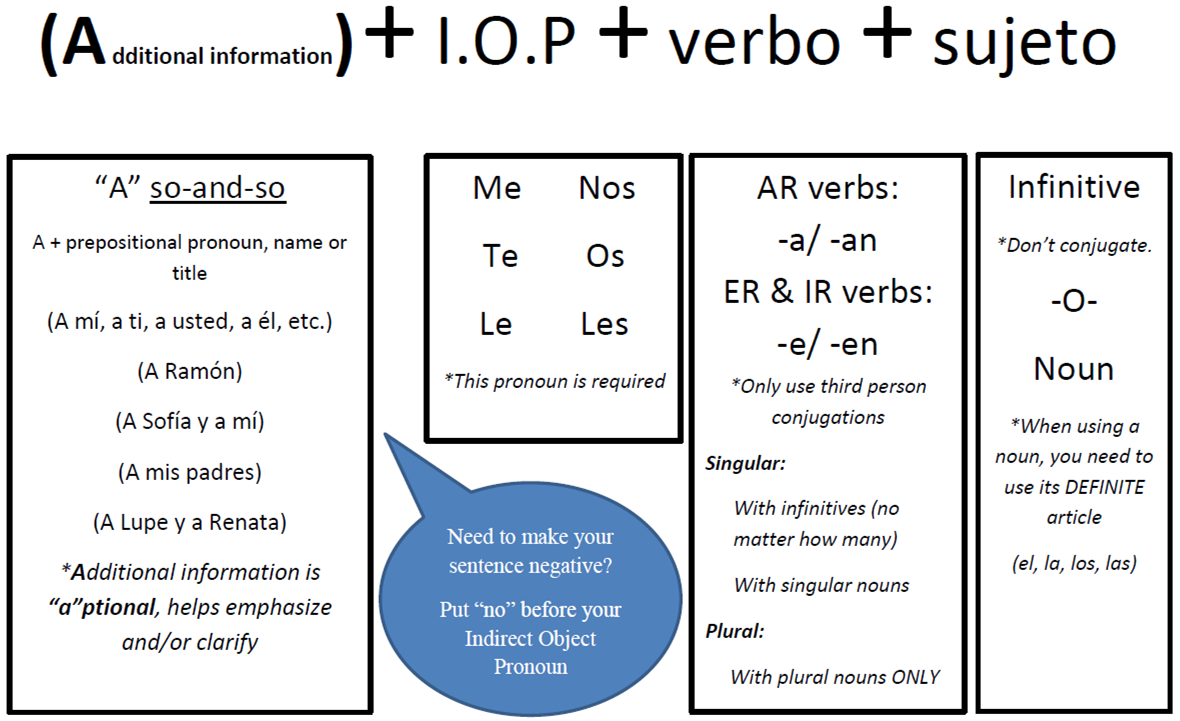
The verbs in the example above behave just like gustar:
- They require an indirect object pronoun (me, te, le, nos, os, les)
- The verb is conjugated based on the word that follows, so it is most often in the third person singular or plural
- If followed by a verb, the third person singular is used.
- The preposition "a" provides additional information for clarification of emphasis
| aburrir (to be bored) | encantar ( to love) | faltar (to lack) | fascinar (to fascinate/love) |
| importar (to be important) | interesar (to interest) | hacer falta (to lack) | molestar (to bother/annoy) |
| parecer (to seem) | preocupar (to be worried) | quedar (to remain/to fit well) | sorprender (to surprise) |
Ejemplos:
- (A mí) me preocupa hacer tantos preparativos para el viaje.
- ¿(A ti) te aburre la lección?
- (A Jorge y a mí) nos falta dinero para hacer el viaje.
Explicación adicional
Puedes ver una lección en linea y ver más ejemplos haciendo click en el dibjuo a continuación:

(Verbs like Gustar created by Adriana Díaz-Ross)
Para resumir
(The material below is from Erin Huebener)
¡A practicar!
Actividad 1 ¿Cuánto te gusta?
Con un compañero/a decide cuánto te gusta hacer usando las expresiones siguientes.
· No me interesa nada.
· Me gusta.
· ¡Me encanta!
1. Leer novelas gráficas: __________________________________________________________
2. Jugar videojuegos: _____________________________________________________________
3. Limpiar la casa: _______________________________________________________________
4. Viajar: ______________________________________________________________________
5. Ir al cine: ____________________________________________________________________
6. Salir con mis amigos: ___________________________________________________________
7. Cocinar: _____________________________________________________________________
8. Trabajar como voluntario/a: ______________________________________________________
(Actividad por Erin Huebener)
Actividad 2
Actividad 3
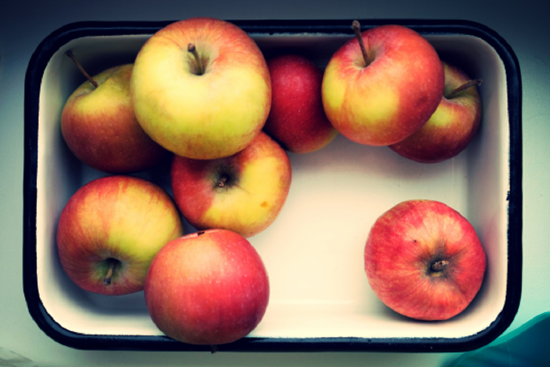
Problemas de razonamiento. Word problems— Use “Me queda” or “Me quedan” to say how much/ how many items you have left.
1.Si tienes nueve manzanas y comes tres, ¿cuántas manzanas te quedan? _____ _______________
2.Si tienes dos zapatos y arruinas uno, ¿cuántos zapatos te quedan? _____ ___________________

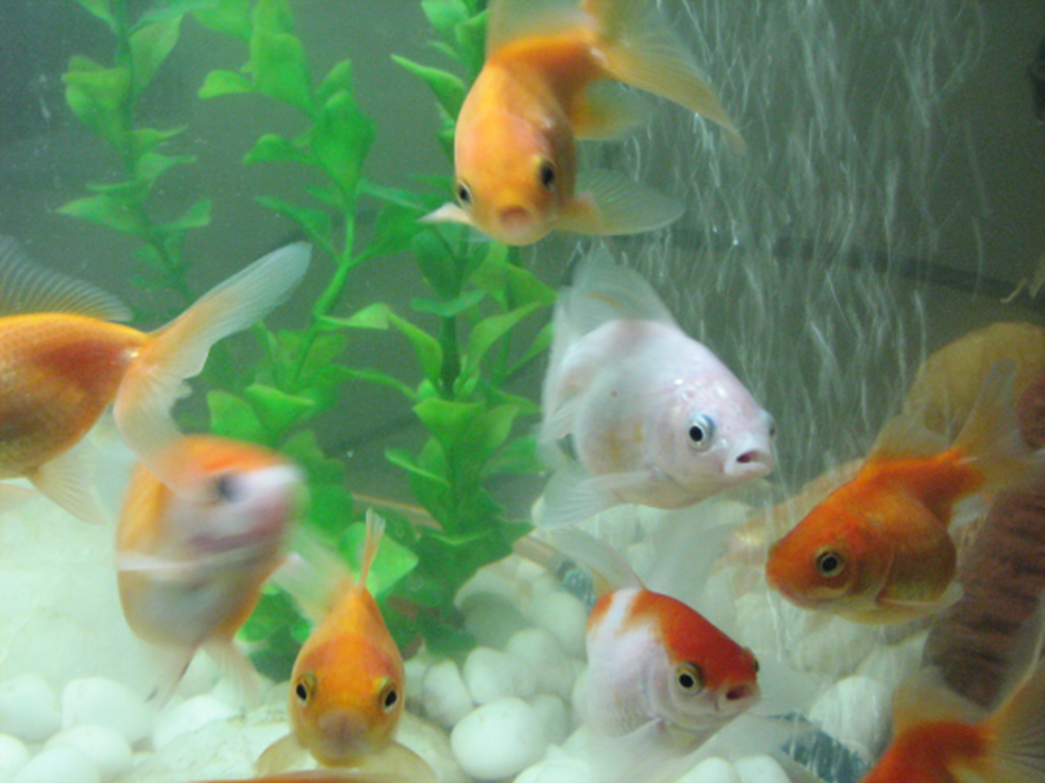
3.Si tienes veinticuatro peces y mueren once, ¿cuántos peces te quedan? _______ ___________
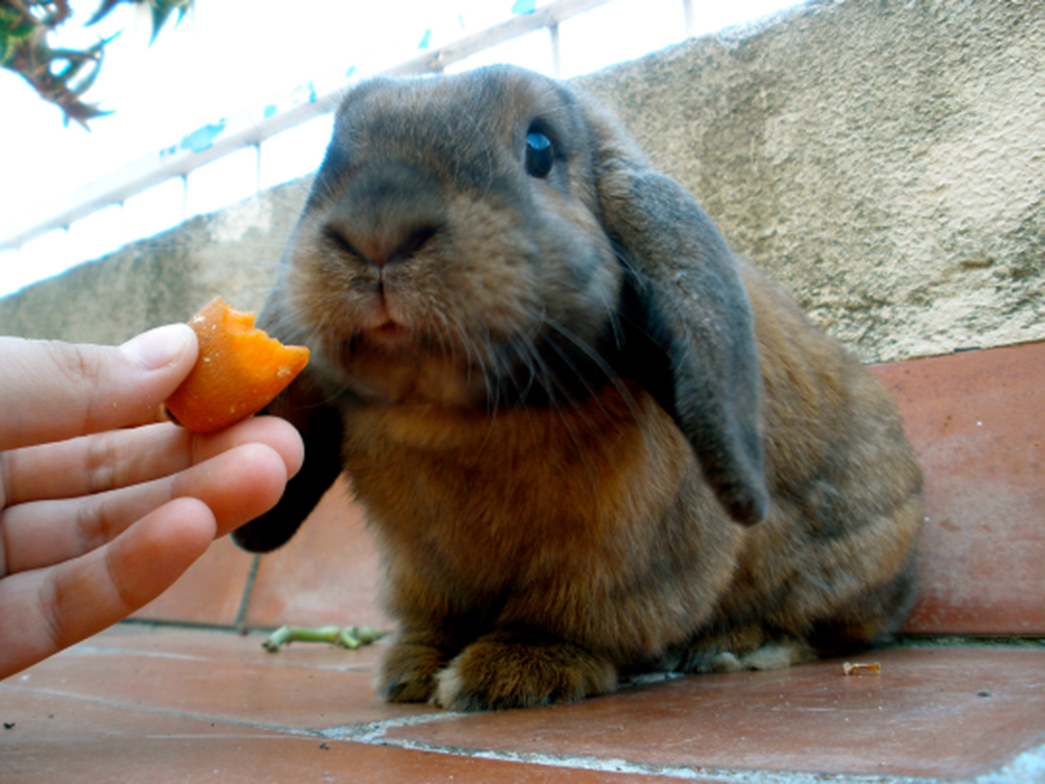
4.Si tienes dos zanahorias y le das una a tu conejito, ¿cuántas zanahorias te quedan? ______ _____________
(Activity by Erin Huebener)
Actividad 4
Mi restaurante favorito. Fill in the blanks using verbs like gustar to complete the paragraph and learn more about narrator's favorite restaurant
A mi esposa y a mí _______ ________________________ (encantar) el restaurante limeño de nuestro barrio.
A mí ______ _______________ (gustar) el ceviche y el aguadito.
A mi esposa ________ _______________ (molestar) los platos sin mucho sabor (flavor), y todo lo que sirven es muy sabroso.
Al chef _______ _____________ (importar) usar ingredientes frescos.
A nosotros __________ ________________(interesar) saber cuáles son los ingredientes de cada plato, y el chef comparte (shares) sus secretos con nosotros.
A mi esposa ________ ______________ (molestar) los precios altos en otros restaurantes. Este es muy barato.
¡Y hay tanta comida que a nosotros siempre _______ ____________ (quedar) muchas sobras!
Actividad 5. Me gustas tú
(This activity is adapted from one created by Normal Corrales-Martin in ¡Qué viva la música! CC-By-NC-4)
Paso 1: Escucha la canción de "Me gustas tú" por Manu Chao (0:00-1:25)
OJO: We've mostly seen gustar in the third person singular or plural (gusta/gustan). In this case, "tú" is what the singer likes, and therefore,
me gustas tú (I like you)
Paso 2: Escucha otra vez pensando en esta preguntas.
a. ¿Qué cosas le gustan a Manu Chao?
b. ¿Qué le gusta hacer a Manu Chao?
Paso 3: Con otra persona de la clase, escriban unas letras para la canción describiendo lo que a ustedes les gusta.