

10.7: Cultura- Perú
- Page ID
- 492135

\( \newcommand{\vecs}[1]{\overset { \scriptstyle \rightharpoonup} {\mathbf{#1}} } \)
\( \newcommand{\vecd}[1]{\overset{-\!-\!\rightharpoonup}{\vphantom{a}\smash {#1}}} \)
\( \newcommand{\dsum}{\displaystyle\sum\limits} \)
\( \newcommand{\dint}{\displaystyle\int\limits} \)
\( \newcommand{\dlim}{\displaystyle\lim\limits} \)
\( \newcommand{\id}{\mathrm{id}}\) \( \newcommand{\Span}{\mathrm{span}}\)
( \newcommand{\kernel}{\mathrm{null}\,}\) \( \newcommand{\range}{\mathrm{range}\,}\)
\( \newcommand{\RealPart}{\mathrm{Re}}\) \( \newcommand{\ImaginaryPart}{\mathrm{Im}}\)
\( \newcommand{\Argument}{\mathrm{Arg}}\) \( \newcommand{\norm}[1]{\| #1 \|}\)
\( \newcommand{\inner}[2]{\langle #1, #2 \rangle}\)
\( \newcommand{\Span}{\mathrm{span}}\)
\( \newcommand{\id}{\mathrm{id}}\)
\( \newcommand{\Span}{\mathrm{span}}\)
\( \newcommand{\kernel}{\mathrm{null}\,}\)
\( \newcommand{\range}{\mathrm{range}\,}\)
\( \newcommand{\RealPart}{\mathrm{Re}}\)
\( \newcommand{\ImaginaryPart}{\mathrm{Im}}\)
\( \newcommand{\Argument}{\mathrm{Arg}}\)
\( \newcommand{\norm}[1]{\| #1 \|}\)
\( \newcommand{\inner}[2]{\langle #1, #2 \rangle}\)
\( \newcommand{\Span}{\mathrm{span}}\) \( \newcommand{\AA}{\unicode[.8,0]{x212B}}\)
\( \newcommand{\vectorA}[1]{\vec{#1}} % arrow\)
\( \newcommand{\vectorAt}[1]{\vec{\text{#1}}} % arrow\)
\( \newcommand{\vectorB}[1]{\overset { \scriptstyle \rightharpoonup} {\mathbf{#1}} } \)
\( \newcommand{\vectorC}[1]{\textbf{#1}} \)
\( \newcommand{\vectorD}[1]{\overrightarrow{#1}} \)
\( \newcommand{\vectorDt}[1]{\overrightarrow{\text{#1}}} \)
\( \newcommand{\vectE}[1]{\overset{-\!-\!\rightharpoonup}{\vphantom{a}\smash{\mathbf {#1}}}} \)
\( \newcommand{\vecs}[1]{\overset { \scriptstyle \rightharpoonup} {\mathbf{#1}} } \)
\(\newcommand{\longvect}{\overrightarrow}\)
\( \newcommand{\vecd}[1]{\overset{-\!-\!\rightharpoonup}{\vphantom{a}\smash {#1}}} \)
\(\newcommand{\ket}[1]{\left| #1 \right>}\)
\(\newcommand{\bra}[1]{\left< #1 \right|}\)
\(\newcommand{\braket}[2]{\left< #1 \vphantom{#2} \right| \left. #2 \vphantom{#1} \right>}\)
\(\newcommand{\braopket}[3]{\left< #1 \vphantom{#2}\vphantom{#3} \right| #2 \vphantom{#1}\vphantom{#3} \left| #3 \vphantom{#1}\vphantom{#2} \right>}\)
\(\newcommand{\qmvec}[1]{\mathbf{\vec{#1}}}\)
\(\newcommand{\op}[1]{\hat{\mathbf{#1}}}\)
\(\newcommand{\expect}[1]{\langle #1 \rangle}\)
\(\newcommand{\dfn}[1]{\emph{\textbf{#1}}}\)
Cultura: Perú

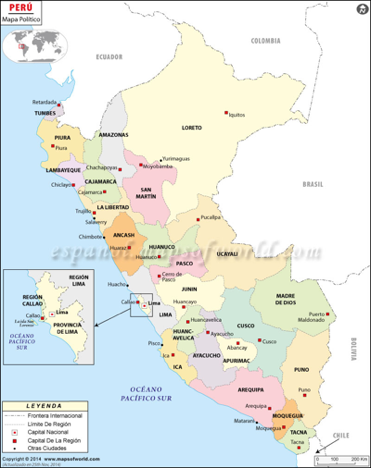
Capital: Lima
Extensión territorial: 1.285.216 km² (496,225 millas cuadradas)
Analogía con territorio en los Estados Unidos: aproximadamente el territorio de California
Población: 33 millones 726 mil habitantes
Idiomas: español, quechua y aymara
Ciudades importantes:
- Cuzco
- Arequipa
- Trujillo
Datos curiosos:
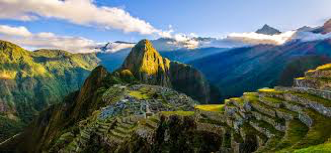
- Una de las 7 nuevas maravillas del mundo, Machu Picchu, está ubicada en Cuzco.
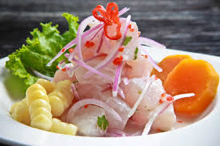
- La comida peruana es una de las mejores del mundo. El ceviche es un plato típico.
Música: Gian Marco
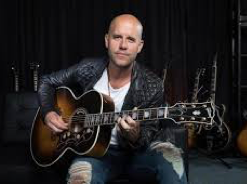
Cantante: Gian Marco
Canción: Sácala a bailar
Letra: Sácala a bailar
Llegó la noche, todo comienza
La que te gusta, tiene un vestido color melón
Cabello suelto, zapatos rojos
Vino sólita, todos la vieron cuando llegó
Coro
Sácala a bailar, que ella baila bonito
Sácala que quiere bailar pegadito
Sácala a bailar, sácala a bailar
Sácala a bailar, que no tiene pareja
Sácala que ahorita, comienza la fiesta
Sácala a bailar, sácala a bailar
Sácala, sacude las caderas
Sácala, la música que esta buena
Sácala, me estoy enamorando
Contigo voy cantando
Sácala, un paso y media vuelta
Sácala, tu mano no me suelta
Sácala, me estoy enamorando
Y sácala a bailar o la saco yo
Llegó la noche, se pone buena
Poquito a poco, se va acercando a mi corazón
Ojitos negros, manos de seda
Chica bonita, todos la vieron cuando llegó
Coro
Sácala bailar, que ella baila bonito
Sácala que quiere bailar pegadito
Sácala a bailar, sácala a bailar
Sácala a bailar, que no tiene pareja
Sácala que ahorita, comienza la fiesta
Sácala a bailar, sácala a bailar
Sácala, sacude las caderas
Sácala, la música que está buena…
Personalidad: Mario Vargas Llosa

Escritor y político. Nació en Arequipa el 28 de marzo de 1936. Recibió el Premio Nobel de Literatura en 2010 y el Premio Cervantes en 1994. Es reconocido novelista y ensayista.Participó como candidato a la presidencia del Perú en las elecciones de 1990. Mario Vargas Llosa es uno de los escritores hispanoamericanos de mayor fama mundial. Sus obras más características son La ciudad y los perros (1962) y La casa verde (1965).
Preguntas de comprensión. After reading the short biography of Mario Vargas Llosa, answer the following questions.
1. ¿Dónde y cuándo nació Mario Vargas LLosa?
___________________________________________________________________.
2. ¿Qué evento importante pasó en el 2010?
___________________________________________________________________.
3. Mencione una de sus novelas más importantes y en qué año se publica.
___________________________________________________________________.