

6.9: Cultura- Colombia
- Page ID
- 492091

\( \newcommand{\vecs}[1]{\overset { \scriptstyle \rightharpoonup} {\mathbf{#1}} } \)
\( \newcommand{\vecd}[1]{\overset{-\!-\!\rightharpoonup}{\vphantom{a}\smash {#1}}} \)
\( \newcommand{\dsum}{\displaystyle\sum\limits} \)
\( \newcommand{\dint}{\displaystyle\int\limits} \)
\( \newcommand{\dlim}{\displaystyle\lim\limits} \)
\( \newcommand{\id}{\mathrm{id}}\) \( \newcommand{\Span}{\mathrm{span}}\)
( \newcommand{\kernel}{\mathrm{null}\,}\) \( \newcommand{\range}{\mathrm{range}\,}\)
\( \newcommand{\RealPart}{\mathrm{Re}}\) \( \newcommand{\ImaginaryPart}{\mathrm{Im}}\)
\( \newcommand{\Argument}{\mathrm{Arg}}\) \( \newcommand{\norm}[1]{\| #1 \|}\)
\( \newcommand{\inner}[2]{\langle #1, #2 \rangle}\)
\( \newcommand{\Span}{\mathrm{span}}\)
\( \newcommand{\id}{\mathrm{id}}\)
\( \newcommand{\Span}{\mathrm{span}}\)
\( \newcommand{\kernel}{\mathrm{null}\,}\)
\( \newcommand{\range}{\mathrm{range}\,}\)
\( \newcommand{\RealPart}{\mathrm{Re}}\)
\( \newcommand{\ImaginaryPart}{\mathrm{Im}}\)
\( \newcommand{\Argument}{\mathrm{Arg}}\)
\( \newcommand{\norm}[1]{\| #1 \|}\)
\( \newcommand{\inner}[2]{\langle #1, #2 \rangle}\)
\( \newcommand{\Span}{\mathrm{span}}\) \( \newcommand{\AA}{\unicode[.8,0]{x212B}}\)
\( \newcommand{\vectorA}[1]{\vec{#1}} % arrow\)
\( \newcommand{\vectorAt}[1]{\vec{\text{#1}}} % arrow\)
\( \newcommand{\vectorB}[1]{\overset { \scriptstyle \rightharpoonup} {\mathbf{#1}} } \)
\( \newcommand{\vectorC}[1]{\textbf{#1}} \)
\( \newcommand{\vectorD}[1]{\overrightarrow{#1}} \)
\( \newcommand{\vectorDt}[1]{\overrightarrow{\text{#1}}} \)
\( \newcommand{\vectE}[1]{\overset{-\!-\!\rightharpoonup}{\vphantom{a}\smash{\mathbf {#1}}}} \)
\( \newcommand{\vecs}[1]{\overset { \scriptstyle \rightharpoonup} {\mathbf{#1}} } \)
\(\newcommand{\longvect}{\overrightarrow}\)
\( \newcommand{\vecd}[1]{\overset{-\!-\!\rightharpoonup}{\vphantom{a}\smash {#1}}} \)
\(\newcommand{\ket}[1]{\left| #1 \right>}\)
\(\newcommand{\bra}[1]{\left< #1 \right|}\)
\(\newcommand{\braket}[2]{\left< #1 \vphantom{#2} \right| \left. #2 \vphantom{#1} \right>}\)
\(\newcommand{\braopket}[3]{\left< #1 \vphantom{#2}\vphantom{#3} \right| #2 \vphantom{#1}\vphantom{#3} \left| #3 \vphantom{#1}\vphantom{#2} \right>}\)
\(\newcommand{\qmvec}[1]{\mathbf{\vec{#1}}}\)
\(\newcommand{\op}[1]{\hat{\mathbf{#1}}}\)
\(\newcommand{\expect}[1]{\langle #1 \rangle}\)
\(\newcommand{\dfn}[1]{\emph{\textbf{#1}}}\)
Cultura: Colombia
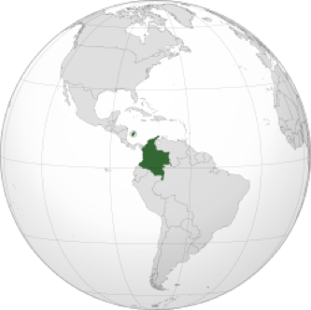
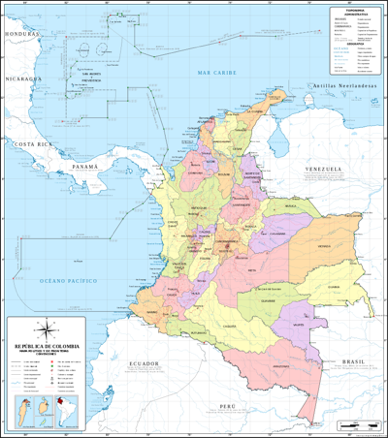
Capital: Bogotá
Extensión territorial: 1,141,748 km² (440,831 millas cuadradas)
Analogía con territorio en los Estados Unidos: dos veces el territorio de Texas
Población: 51.609.000 habitantes
Idiomas: español (oficial) y 65 lenguas nativas
Ciudades importantes:
- Cartagena
- Medellín
- Cali
- Barranquilla
Datos curiosos:
- El único país de Sudamérica que tiene costa en el mar Caribe y en el océano Pacífico.
- Principal productor mundial de esmeraldas.
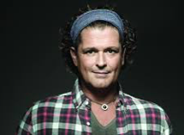
Música: Carlos Vives
Canción: La tierra del olvido
Letra de la Canción:
Como la luna que alumbra
Por la noche los caminos
Como las hojas al viento
Como el sol que espanta el frío
Como la tierra a la lluvia
Como el mar que espera al rio
Así espero tu regreso
A la tierra del olvido
Como naufragan mis miedos
Si navego en tu mirada
Como alertas mis sentidos
Con tu voz enamorada
Con tu sonrisa de niña
Como me mueves el alma
Como me quitas el sueño
Como me robas la calma
Tú tienes la llave de mi corazón
Yo te quiero
Más que mi vida porque sin tu amor
Yo me muero
Tú tienes la llave de mi corazón
Yo te quiero
Más que mi vida porque sin tu amor
Yo me muero
Como la luna que alumbra
Por la noche los caminos
Como las hojas al viento
Como el sol que espanta el frío
Como la tierra a la lluvia
Como el mar que espera al río
Así espero tu regreso…
Biografía: Carlos Vives es un cantante, actor y compositor colombiano. Nació el 7 de agosto de 1961 en Santa Marta. Ha ganado (has won) dos premios Grammy y quince premios Grammy Latinos.
Answer the following questions after you have viewed the video and read the biography.
- ¿Cuántos años tiene Carlos Vives ahora?
- En la canción, cuando cantan: “Yo te quiero” (I love you), en tu opinión, ¿A quién se refiere?
- ¿Te gustó la canción? ¿Por qué? (el ritmo, la letra (lyrics), los cantantes…etc.)
- ¿Cuál de todos los cantantes (singers) en esta canción te gustó más y por qué?
Personalidad: Gabriel García Márquez
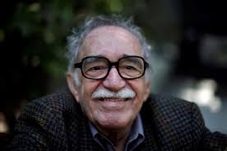
Escritor, periodista, guionista y editor.
Nació en Aracataca, Magdalena, el 6 de marzo de 1927 y murió en la Ciudad de México el 17 de abril de 2014.
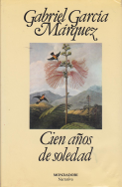
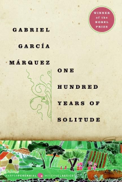
Recibió el Premio Nobel de Literatura en 1982. Es considerado el representante del movimiento literario Realismo Mágico de los años 1960 en Latinoamérica. Su obra más conocida es la novela ‘Cien años de soledad’ (1967). Este libro narra la historia de la familia Buendía y está traducido a 37 lenguas.
Preguntas de comprensión. After reading the short biography of Gabriel García Márquez, answer the following questions.
- ¿Dónde y cuándo nació García Márquez?
- ¿Qué pasó en el año 1982?
- ¿Cuál es el tema (theme) de Cien años de soledad?
- ¿Te gusta leer? ¿Estás leyendo un libro en este momento? ¿Cuál es el título y quién es el autor (autora)?