

About the Author
- Page ID
- 472734
\( \newcommand{\vecs}[1]{\overset { \scriptstyle \rightharpoonup} {\mathbf{#1}} } \)
\( \newcommand{\vecd}[1]{\overset{-\!-\!\rightharpoonup}{\vphantom{a}\smash {#1}}} \)
\( \newcommand{\dsum}{\displaystyle\sum\limits} \)
\( \newcommand{\dint}{\displaystyle\int\limits} \)
\( \newcommand{\dlim}{\displaystyle\lim\limits} \)
\( \newcommand{\id}{\mathrm{id}}\) \( \newcommand{\Span}{\mathrm{span}}\)
( \newcommand{\kernel}{\mathrm{null}\,}\) \( \newcommand{\range}{\mathrm{range}\,}\)
\( \newcommand{\RealPart}{\mathrm{Re}}\) \( \newcommand{\ImaginaryPart}{\mathrm{Im}}\)
\( \newcommand{\Argument}{\mathrm{Arg}}\) \( \newcommand{\norm}[1]{\| #1 \|}\)
\( \newcommand{\inner}[2]{\langle #1, #2 \rangle}\)
\( \newcommand{\Span}{\mathrm{span}}\)
\( \newcommand{\id}{\mathrm{id}}\)
\( \newcommand{\Span}{\mathrm{span}}\)
\( \newcommand{\kernel}{\mathrm{null}\,}\)
\( \newcommand{\range}{\mathrm{range}\,}\)
\( \newcommand{\RealPart}{\mathrm{Re}}\)
\( \newcommand{\ImaginaryPart}{\mathrm{Im}}\)
\( \newcommand{\Argument}{\mathrm{Arg}}\)
\( \newcommand{\norm}[1]{\| #1 \|}\)
\( \newcommand{\inner}[2]{\langle #1, #2 \rangle}\)
\( \newcommand{\Span}{\mathrm{span}}\) \( \newcommand{\AA}{\unicode[.8,0]{x212B}}\)
\( \newcommand{\vectorA}[1]{\vec{#1}} % arrow\)
\( \newcommand{\vectorAt}[1]{\vec{\text{#1}}} % arrow\)
\( \newcommand{\vectorB}[1]{\overset { \scriptstyle \rightharpoonup} {\mathbf{#1}} } \)
\( \newcommand{\vectorC}[1]{\textbf{#1}} \)
\( \newcommand{\vectorD}[1]{\overrightarrow{#1}} \)
\( \newcommand{\vectorDt}[1]{\overrightarrow{\text{#1}}} \)
\( \newcommand{\vectE}[1]{\overset{-\!-\!\rightharpoonup}{\vphantom{a}\smash{\mathbf {#1}}}} \)
\( \newcommand{\vecs}[1]{\overset { \scriptstyle \rightharpoonup} {\mathbf{#1}} } \)
\(\newcommand{\longvect}{\overrightarrow}\)
\( \newcommand{\vecd}[1]{\overset{-\!-\!\rightharpoonup}{\vphantom{a}\smash {#1}}} \)
\(\newcommand{\ket}[1]{\left| #1 \right>}\)
\(\newcommand{\bra}[1]{\left< #1 \right|}\)
\(\newcommand{\braket}[2]{\left< #1 \vphantom{#2} \right| \left. #2 \vphantom{#1} \right>}\)
\(\newcommand{\braopket}[3]{\left< #1 \vphantom{#2}\vphantom{#3} \right| #2 \vphantom{#1}\vphantom{#3} \left| #3 \vphantom{#1}\vphantom{#2} \right>}\)
\(\newcommand{\qmvec}[1]{\mathbf{\vec{#1}}}\)
\(\newcommand{\op}[1]{\hat{\mathbf{#1}}}\)
\(\newcommand{\expect}[1]{\langle #1 \rangle}\)
\(\newcommand{\dfn}[1]{\emph{\textbf{#1}}}\)
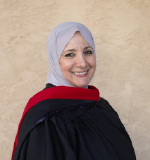
About the Author
Hana Kassas
My name is Hana Kassas, and I am an Arabic and English as a Second Language (ESL) educator, OER author, and curriculum developer. I have been teaching Arabic at the college and university level in the San Diego area for more than two decades, working with students from diverse linguistic, cultural, and educational backgrounds.
My teaching experience has included San Diego State University and Cuyamaca College, where I began teaching in 2015. I also teach English as a Second Language (ESL) within the San Diego Community College District. Teaching both Arabic and ESL has given me a broader perspective on language education and on the different ways students develop confidence, proficiency, and a sense of belonging through language.
Throughout my teaching career, I have come to believe that language education should go beyond vocabulary lists and grammatical rules. Learning a language gives students access to cultures, histories, perspectives, communities, and new ways of understanding the world. For that reason, I strive to create learning experiences that encourage students not only to understand Arabic, but also to use Arabic to communicate, explore, question, analyze, and express their own ideas.
My Journey with Open Educational Resources
My work with Open Educational Resources (OER) began in 2022 and has become one of the most meaningful parts of my professional journey.
Through grant-supported OER projects, I began developing materials for Arabic 1 and Arabic 2 with the goal of providing students with high-quality learning resources without the financial burden of traditional textbooks. That work continued with Arabic 3 and ultimately led to the development of Arabic Level 4.
Together, these four books form an Arabic OER series designed to support students as they progress from beginning language study toward increasingly advanced communication and cultural exploration.
Arabic Level 4 is the fourth and final book in this OER series.
Developing these resources has involved years of writing, research, revision, activity development, instructional design, and exploration of educational technologies. With each level, I have also had an opportunity to reconsider what an Arabic textbook can be and how an open textbook can respond to the changing needs of students and instructors.
My Approach to Arabic Language Learning
A central principle behind these materials is that language skills should reinforce one another.
Rather than treating reading, writing, listening, speaking, vocabulary, grammar, and culture as completely separate areas of study, the OER integrates them within meaningful thematic units. Students encounter language in context and then have opportunities to apply what they learn through communication.
As students progress through the series, they are encouraged to become increasingly independent users of Arabic. Activities gradually move beyond structured language practice toward more complex tasks involving discussion, analysis, research, writing, presentations, collaboration, critical thinking, and creative expression.
Grammar and vocabulary remain important, but they serve a larger purpose: helping students communicate more effectively and express increasingly sophisticated ideas.
Culture at the Center of Language Learning
Culture is an essential part of my approach to teaching Arabic.
Students learning Arabic are not simply learning a linguistic system. They are also encountering the histories, traditions, experiences, perspectives, and contemporary realities of a diverse region.
For this reason, the OER series incorporates cultural content throughout the curriculum rather than treating culture as an occasional addition to language instruction.
Students explore topics connected to different parts of the Arab world and consider both traditional and contemporary perspectives. They are encouraged to make cultural comparisons, conduct research, ask questions, and reflect on the relationship between language, culture, identity, and society.
My goal is to help students see the Arab world in its richness and diversity while developing the linguistic skills they need to engage with it thoughtfully.
Why OER Matters to Me
Creating OER has become a professional passion for me because I strongly believe that access to high-quality educational materials should not depend on a student's ability to purchase an expensive textbook.
Our students already manage tuition, transportation, work, family responsibilities, and many other financial pressures. When educators can remove the cost of a textbook while still providing rigorous, engaging, and meaningful learning materials, we remove one more barrier between students and their education.
But for me, OER is about more than affordability.
Open educational resources give educators the freedom to adapt, revise, expand, reorganize, and improve instructional materials. Language changes. Technology changes. Our classrooms change. Most importantly, our students and their needs change.
Our educational materials should be able to evolve with them.
OER also creates opportunities for educators to share their work and contribute to a larger community. A resource developed for one classroom can be adapted by another instructor, used by students at another institution, or inspire a new approach to teaching.
That ability to share and build upon educational work is one of the reasons I have become so committed to open education.
About Arabic Level 4
Arabic Level 4 represents the culmination of my work on this four-book OER sequence.
At this level, students are asked to engage with Arabic in increasingly sophisticated ways. They read and listen for meaning, analyze ideas, express and defend opinions, participate in discussions, conduct research, collaborate with classmates, give presentations, and produce both analytical and creative work.
The materials also connect Arabic language learning with meaningful topics relevant to students and to the contemporary Arab world. Language becomes the means through which students investigate ideas rather than simply the subject they are studying.
This final level reflects an important goal of the entire series: helping students move from learning Arabic toward using Arabic.
A Personal Note
Creating these four OER books has been a long and deeply rewarding journey. Behind every level are countless hours of writing, revising, researching, designing activities, exploring new approaches, and thinking carefully about what will best support students in their language-learning journey.
At the center of all of this work has always been one purpose: supporting our students.
If these resources help remove a financial barrier for a student, encourage someone to continue studying Arabic, help a learner become more confident communicating in the language, introduce students to perspectives and traditions they had not encountered before, or provide another educator with materials that support their classroom, then the work behind them has accomplished something meaningful.
I am grateful for the opportunity to contribute these materials to the Open Educational Resources community and to share them with Arabic students and educators beyond my own classroom.
I hope this series continues to be used, adapted, expanded, and improved—and, most importantly, that it helps students discover both the Arabic language and the diverse cultures and communities connected to it.
Hana Kassas
Arabic and ESL Educator
OER Author and Curriculum Developer