

3.5: Logical Fallacies - How to Spot Them and Avoid Making Them
- Page ID
- 306446

\( \newcommand{\vecs}[1]{\overset { \scriptstyle \rightharpoonup} {\mathbf{#1}} } \)
\( \newcommand{\vecd}[1]{\overset{-\!-\!\rightharpoonup}{\vphantom{a}\smash {#1}}} \)
\( \newcommand{\dsum}{\displaystyle\sum\limits} \)
\( \newcommand{\dint}{\displaystyle\int\limits} \)
\( \newcommand{\dlim}{\displaystyle\lim\limits} \)
\( \newcommand{\id}{\mathrm{id}}\) \( \newcommand{\Span}{\mathrm{span}}\)
( \newcommand{\kernel}{\mathrm{null}\,}\) \( \newcommand{\range}{\mathrm{range}\,}\)
\( \newcommand{\RealPart}{\mathrm{Re}}\) \( \newcommand{\ImaginaryPart}{\mathrm{Im}}\)
\( \newcommand{\Argument}{\mathrm{Arg}}\) \( \newcommand{\norm}[1]{\| #1 \|}\)
\( \newcommand{\inner}[2]{\langle #1, #2 \rangle}\)
\( \newcommand{\Span}{\mathrm{span}}\)
\( \newcommand{\id}{\mathrm{id}}\)
\( \newcommand{\Span}{\mathrm{span}}\)
\( \newcommand{\kernel}{\mathrm{null}\,}\)
\( \newcommand{\range}{\mathrm{range}\,}\)
\( \newcommand{\RealPart}{\mathrm{Re}}\)
\( \newcommand{\ImaginaryPart}{\mathrm{Im}}\)
\( \newcommand{\Argument}{\mathrm{Arg}}\)
\( \newcommand{\norm}[1]{\| #1 \|}\)
\( \newcommand{\inner}[2]{\langle #1, #2 \rangle}\)
\( \newcommand{\Span}{\mathrm{span}}\) \( \newcommand{\AA}{\unicode[.8,0]{x212B}}\)
\( \newcommand{\vectorA}[1]{\vec{#1}} % arrow\)
\( \newcommand{\vectorAt}[1]{\vec{\text{#1}}} % arrow\)
\( \newcommand{\vectorB}[1]{\overset { \scriptstyle \rightharpoonup} {\mathbf{#1}} } \)
\( \newcommand{\vectorC}[1]{\textbf{#1}} \)
\( \newcommand{\vectorD}[1]{\overrightarrow{#1}} \)
\( \newcommand{\vectorDt}[1]{\overrightarrow{\text{#1}}} \)
\( \newcommand{\vectE}[1]{\overset{-\!-\!\rightharpoonup}{\vphantom{a}\smash{\mathbf {#1}}}} \)
\( \newcommand{\vecs}[1]{\overset { \scriptstyle \rightharpoonup} {\mathbf{#1}} } \)
\(\newcommand{\longvect}{\overrightarrow}\)
\( \newcommand{\vecd}[1]{\overset{-\!-\!\rightharpoonup}{\vphantom{a}\smash {#1}}} \)
\(\newcommand{\ket}[1]{\left| #1 \right>}\)
\(\newcommand{\bra}[1]{\left< #1 \right|}\)
\(\newcommand{\braket}[2]{\left< #1 \vphantom{#2} \right| \left. #2 \vphantom{#1} \right>}\)
\(\newcommand{\braopket}[3]{\left< #1 \vphantom{#2}\vphantom{#3} \right| #2 \vphantom{#1}\vphantom{#3} \left| #3 \vphantom{#1}\vphantom{#2} \right>}\)
\(\newcommand{\qmvec}[1]{\mathbf{\vec{#1}}}\)
\(\newcommand{\op}[1]{\hat{\mathbf{#1}}}\)
\(\newcommand{\expect}[1]{\langle #1 \rangle}\)
\(\newcommand{\dfn}[1]{\emph{\textbf{#1}}}\)
Logical Fallacies -- Definition
As you rewrite, review, and revise your logical argument, be aware of logical fallacies, or common errors in thinking that can weaken a logical argument.
Fallacies are errors or tricks of reasoning. We can call a fallacy an error of reasoning if it occurs accidentally; we call it a trick of reasoning if a speaker or writer uses it in order to deceive or manipulate the audience. Fallacies can be either formal or informal.

(Decorative image of a traffic sign that says "Oops!") Image authored by Cripi on Pixabay. CC0: No Rights Reserved
Most formal fallacies are errors of logic: the conclusion doesn’t really follow from, or is not supported by, the premises. Either the premises are untrue or the argument is invalid. For example, the following argument contains an error in assuming that one thing and only that one thing causes a particular outcome: “Nora feeds Johnny eggplant every day, and Johnny is really healthy; therefore, we should feed our Sally more eggplant.” While it may be true that eggplant is a healthy food, Johnny’s eggplant consumption is assuredly not the only factor contributing to his health. So it does not necessarily follow that Sally should also eat eggplant every day. Formal fallacies are created when the relationship between premise and conclusion does not hold up, or when premises are unsound.
Informal fallacies take many forms and are widespread in everyday discourse. Very often they involve bringing irrelevant information into an argument, or are based on assumptions that, when examined, prove to be incorrect. For example, the following statement plays inaccurately to authority by assuming that one person only knows best, without bringing facts, multiple informed expert opinions, or relevant research into the argument: “Our governor supports a single-payer health care system for the state, so we should, too.” While the governor may have information about health care that the average citizen does not have access to, merely the fact that the governor supports a particular cause is not a reason to agree. Informal fallacies often result from the misuse of language and/or evidence.
Whether a fallacy is an error or a trick, whether it is formal or informal, its use undercuts the validity and soundness of any argument. For example, if someone defines a key term in her argument in an ambiguous, vague, or circular way, her argument will appear very weak to a critical audience.
In addition, when listeners or readers spot questionable reasoning or unfair attempts at audience manipulation, more than the author’s argument (logos) may be compromised. Their evaluation of the credibility of the speaker/writer (ethos), and perhaps their ability to connect with that speaker on the level of shared values (pathos), also may be compromised. At the very least, the presence of fallacies will suggest to an audience that the speaker or writer lacks argumentative skill.
Evaluating an Argument for Logical Fallacies

One way to go about evaluating an argument for fallacies is to return to the concept of the three types of support for claims: ethos, logos, and pathos.
As a quick reminder,
- Ethos is an argument that appeals to ethics, authority, and/or credibility.
- Logos is an argument that appeals to logic.
- Pathos is an argument that appeals to emotion.
Classifying fallacies as fallacies of ethos, logos, or pathos will help you both to understand their nature and to recognize them when you encounter them. Please keep in mind, however, that some fallacies may fit into multiple categories.
- Fallacies of ethos relate to credibility. These fallacies may unfairly build up the credibility of the author (or the author's allies) or unfairly attack the credibility of the author’s opponent (or allies).
- Fallacies of logos give an unfair advantage to the claims of the speaker or writer or an unfair disadvantage to his opponent’s claims.
- Fallacies of pathos rely excessively upon emotional appeals, attaching positive associations to the author’s argument and negative ones to his opponent’s position.
Evaluating an Appeal to Ethos
When you evaluate an appeal to ethos, you examine how successfully a speaker or writer establishes authority or credibility with her intended audience. You are asking yourself what elements of the essay or speech would cause an audience to feel that the author is (or is not) trustworthy and credible.
A good speaker or writer leads the audience to feel comfortable with her knowledge of a topic. The audience sees her as someone worth listening to—a clear or insightful thinker, or at least someone who is well-informed and genuinely interested in the topic.
Some of the questions you can ask yourself as you evaluate an author’s ethos may include the following:
- Has the writer or speaker cited her sources or in some way made it possible for the audience to access further information about the issue?
- Does she demonstrate familiarity with different opinions and perspectives?
- Does she provide complete and accurate information about the issue?
- Does she use the evidence fairly? Does she avoid selective use of evidence or other types of manipulation of data?
- Does she speak respectfully about people who may have opinions and perspectives different from her own?
- Does she use unbiased language?
- Does she avoid excessive reliance on emotional appeals?
- Does she accurately convey the positions of people with whom she disagrees?
- Does she acknowledge that an issue may be complex or multifaceted?
- Does her education or experience give her credibility as someone who should be listened to on this issue?
Some of the above questions may strike you as relevant to an evaluation of logos as well as ethos—questions about the completeness and accuracy of information and whether it is used fairly. In fact, illogical thinking and the misuse of evidence may lead an audience to draw conclusions not only about the person making the argument but also about the logic of an argument.
Recognizing a Manipulative Appeal to Ethos
In a perfect world, everyone would tell the truth and we could depend upon the credibility of speakers and authors. Unfortunately, that is not always the case. You would expect that news reporters would be objective and tell new stories based upon the facts. Janet Cooke, Stephen Glass, Jayson Blair, and Brian Williams all lost their jobs for plagiarizing or fabricating parts of their news stories. Janet Cooke’s Pulitzer Prize was revoked after it was discovered that she made up “Jimmy,” an eight-year old heroin addict. Brian Williams was fired as anchor of the NBC Nightly News for exaggerating his role in the Iraq War.
Others have become infamous for claiming academic degrees that they didn’t earn, as in the case of Marilee Jones. At the time of discovery, she was Dean of Admissions at Massachusetts Institute of Technology (MIT). After 28 years of employment, it was determined that she never graduated from college. However, on her website she is still promoting herself as “a sought after speaker, consultant and author” and “one of the nation’s most experienced College Admissions Deans."
Beyond lying about their own credentials, authors may employ a number of tricks or fallacies to lure you to their point of view. Some of the more common techniques are described below. When you recognize these fallacies being committed, you should question the credibility of the speaker and the legitimacy of the argument. If you use these when making your own arguments, be aware that they may undermine or destroy your credibility.
Fallacies that Misuse an Appeal to Ethos
Ad hominem: attacking the person making an argument rather than the argument itself. Latin for “argument against the person” or “argument toward the person.” Basically, an ad hominem argument goes like this: Person 1 makes claim X. There is something objectionable about Person 1. Therefore claim X is false.

False authority: relying on claims of expertise when the claimed expert (a) lacks adequate background/credentials in the relevant field, (b) departs in major ways from the consensus in the field, or (c) is biased, e.g., has a financial stake in the outcome.
Example: “Dr. X is an engineer, and he doesn’t believe in global warming.”
Guilt by association: linking the person making an argument to an unpopular person or group.
Example: “My opponent is a card-carrying member of the Communist Party.”
Poisoning the well: undermining an opponent’s credibility before they get a chance to speak.
Example: “The prosecution is going to bring up a series or so-called experts who are getting a lot of money to testify here today.”
Transfer fallacy: associating the argument with someone or something popular or respected; hoping that the positive associations will “rub off” onto the argument.
Examples: In politics, decorating a stage with red, white, and blue flags and bunting; in advertising, using pleasant or wholesome settings as the backdrop for print or video ads.
Name-calling: labeling an opponent with words that have negative connotations in an effort to undermine the opponent’s credibility.
Example: “These rabble-rousers are nothing but feminazis.”
Plain folk: presenting yourself as (or associating your position with) ordinary people with whom you hope your audience will identify; arguers imply that they or their supporters are trustworthy because they are "common people" rather than members of the elite.
Example: “Who would you vote for—someone raised in a working-class neighborhood who has the support of Joe the Plumber or some elitist whose daddy sent him to a fancy school?”
Testimonial fallacy (argument from authority): inserting an endorsement of the argument by someone who is popular or respected but who lacks expertise or authority in the area under discussion.
Example: “I’m not a doctor, but I play one on TV”—a famous example of a celebrity endorsement for a cough syrup (Deis, 2011, n.p.).
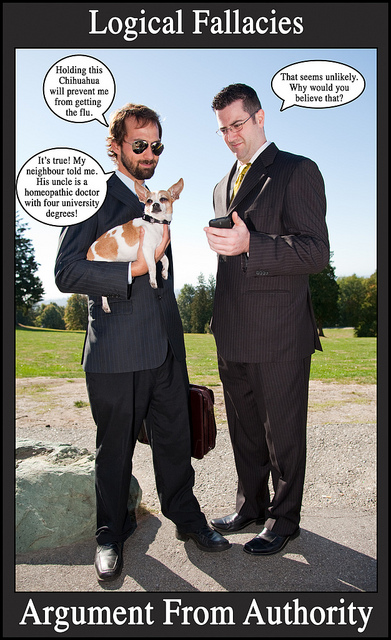
The most general structure of this argument runs something like the following: Person A claims that Person A is a respected scientist or other authority; therefore, the claim they make is true.
Evaluating an Appeal to Logos
When you evaluate an appeal to logos, you consider how logical the argument is and how well-supported it is in terms of evidence. You are asking yourself what elements of the essay or speech would cause an audience to believe that the argument is (or is not) logical and supported by appropriate evidence.
To evaluate whether the evidence is appropriate, apply the STAR criteria: how Sufficient,Typical;Accurate, and Relevant is the evidence?
Recognizing a Manipulative Appeal
Diagramming the argument – identifying the main claim and the main supporting points or premises – can help you determine if an appeal to logos is manipulative. Write out the main claim or conclusion. Then identify the supporting claims or premises. Are the premises true? Does the conclusion follow logically from the premises? Is there sufficient, typical, accurate, and relevant evidence to support the reasoning? Is the speaker or author attempting to divert your attention from the real issues? These are some of the elements you might consider while evaluating an argument for the use of logos.
Pay particular attention to numbers, statistics, findings, and quotes used to support an argument. Be critical of the source and do your own investigation of the “facts.” Maybe you’ve heard or read that half of all marriages in America will end in divorce. It is so often discussed that we assume it must be true. Careful research will show that the original marriage study was flawed, and divorce rates in America have steadily declined since 1985 (Peck, 1993). If there is no scientific evidence, why do we continue to believe it? Part of the reason might be that it supports the commonly held idea of the dissolution of the American family.
Deductive Logic
An argument using deductive logic is one that works from the top to the bottom. It begins with what is known as a "major premise," adds a "minor premise," and attempts to reach a conclusion. A major premise is a statement that comments about a large group, a minor premise refers to a single member, and the conclusion attempts to prove that because this single member is a part of the larger group, it must, therefore, also have the trait named in the major premise.
For example:
Now, if it is true that men are tall, and that Bob is a man, then we can safely infer that Bob must be tall. However, beware the logical fallacy. Though it may be true that in certain cultures men are, on average, taller than women, certainly this is not always the case. Being that our major premise is not altogether true, we can now say that this argument is flawed. Further, we might ask what our definition of "tall" is. Tall is different if we are talking about the average population, different for basketball players. Also, what is a man? Are transgendered individuals included? We see that the problem becomes far more complex the more we look into it.
Inductive Logic
While some would argue that a deductive argument works from the top down, toward a conclusion, and that an inductive argument works from the bottom up. This is mildly misleading. What is meant by this is that an inductive logical argument begins with a firm affirmation of truth, a conclusive statement. By getting the audience to agree with this statement, the argument moves to the next "logical" step. It proceeds in this manner until the argument has led you from one seemingly reasonable conclusion to another that you may not have originally agreed with. Take the following as an example. (Move through the argument slowly, making sure you understand and agree with each step in the process -- and please forgive the religious content, you'll come to see it is irrelevant anyway).
The human soul is inherently free. This is its very nature. We are confined to our mortal, earthly bodies, but our souls must be kept free, or the nature of the soul is entirely negated. If one chooses to believe in a soul, they can only believe that it embraces this (vague idea of) freedom.
At conception, a child is given a soul. Some may argue that that happens after birth, but if those very same persons are pro-life, they confuse their arguments. Thus, if someone is pro-life, and believes in a soul, they must believe in the freedom of that soul, and also accept that the soul is granted upon conception.
A soul cannot die. By the same means by which it is free over the body, a soul claims immortality while the body decomposes and is ended. To deny that a soul is immortal is again to deny the very essence of a soul. Thus, if someone is pro-life, and believes in a soul, they must believe in the freedom of that soul, the immortality of the soul, and also accept that the soul is granted upon conception.
A soul cannot be born. It is immortal and cannot die, it is not earthly, it forever exists, and cannot be born. There are tales in Greek mythology of Athena’s birth, yet she is born from her father’s head a fully decorated woman. She was not born. She existed previously, as Milton writes the Son in Paradise Lost. If one accepts the Bible’s teachings, there can be no reincarnation, no other form of birth, or rebirth. Thus, if someone is pro-life, and believes in a soul, and does not accept reincarnation, they must believe in the freedom of that soul, the immortality of the soul that is always and forever (which cannot be born and cannot die), and also accept that the soul is granted upon conception.
A soul being always an essence, and not being able to be reincarnated, can only exist outside of the body, somewhere, until the act of conception occurs. That soul must then be placed in the body that was forever intended to receive it, as it belongs nowhere else. The soul is fated to that one body. Thus, if someone is pro-life, and believes in a soul, and does not accept reincarnation, namely a practicing Catholic, they must also believe in the freedom of the soul, and in the concept of fate. Fate, however, completely opposes the idea of freedom. One cannot then believe in a soul, for it immediately enforces a belief in fate which directly negates the belief in the soul. If our actions are written in a Divine plan, we are not free to make our own choices. Every action has been scripted.
Don't worry, it must be that you were meant to read this.
Here's a sample inductive argument by Ben Doberstein.
Having seen this, some might say that the argument defeats Catholicism from an atheist standpoint. Others might find that it argues for the secularization of religion. Still, there are ways in which it supports Catholicism at the same time.
Though the argument might seem as if it is disagreeing with the Catholic religion, and some would agree that it is, we must always be looking for the logical fallacy. Upon closer inspection, you may notice that all this argument truly does, in one reading of the text, is to explain the complexity of God through the mind of a human. Catholicism has argued since the beginning that God is impossible to fully explain using the conceptions of man. In that way, this argument only supports that conclusion.
Be aware that there will be logic fallacies hidden in almost every argument. If there is more than one side to an argument, such as in religious or political debates, it is most likely because the argument is impossible to prove. Hence, there is a logical fallacy in the argument.
Fallacies that misuse appeals to logos or attempt to manipulate the logic of an argument are discussed below.
Fallacies that Misuse an Appeal to Logos
Hasty generalization: jumping to conclusions based upon an unrepresentative sample or insufficient evidence.
Example: “10 of the last 14 National Spelling Bee Champions have been Indian American. Indian Americans must all be great spellers!”
Appeal to ignorance—true believer’s form: arguing along the lines that if an opponent can’t prove something isn’t the case, then it is reasonable to believe that it is the case; transfers the burden of proof away from the person making the claim (the proponent).
Example: “You can’t prove that extraterrestrials haven’t visited earth, so it is reasonable to believe that they have visited earth.”
Appeal to ignorance—skeptic’s form: confusing absence of evidence with evidence of absence; assumes that if you cannot now prove something exists, then it is shown that it doesn’t exist.
Example: “There’s no proof that starting classes later in the day will improve the performance of our high school students; therefore, this change in schedule will not work.”
Begging the question: circular argument because the premise is the same as the claim that you are trying to prove.
Example: “This legislation is sinful because it is the wrong thing to do.”
False dilemma: misuse of the either/or argument; presenting only two options when other choices exist
Example: “Either we pass this ordinance or there will be rioting in the streets.”
Post hoc ergo propter hoc: Latin phrase meaning “after this, therefore because of this”; confuses correlation with causation by concluding that an event preceding a second event must be the cause of that second event.
Example: “My child was diagnosed with autism after receiving vaccinations. That is proof that vaccines are to blame.”
Non-sequitur: Latin for “does not follow”; the conclusion cannot be inferred from the premises because there is a break in the logical connection between a claim and the premises that are meant to support it, either because a premise is untrue (or missing) or because the relationship between premises does not support the deduction stated in the claim.
Example (untrue premise): “If she is a Radford student, she is a member of a sorority. She is a Radford student. Therefore she is a member of a sorority.”
Smoke screen: avoiding the real issue or a tough question by introducing an unrelated topic as a distraction; sometimes called a red herring.
Example: “My opponent says I am weak on crime, but I have been one of the most reliable participants in city council meetings.”

Image by Mark Klotz on flickr CC BY-NC: Attribution-NonCommercial
The red herring is as much a debate tactic as it is a logical fallacy. It is a fallacy of distraction and is committed when a listener attempts to divert an arguer from his argument by introducing another topic. This can be one of the most frustrating, and effective, fallacies to observe.The fallacy gets its name from fox hunting, specifically from the practice of using smoked herrings, which are red, to distract hounds from the scent of their quarry. Just as a hound may be prevented from catching a fox by distracting it with a red herring, so an arguer may be prevented from proving his point by distracting him with a tangential issue.
Straw man: pretending to criticize an opponent’s position but actually misrepresenting his or her view as simpler and/or more extreme than it is and therefore easier to refute than the original or actual position; unfairly undermines credibility of claim if not source of claim.
Example: “Senator Smith says we should cut back the Defense budget. His position is that we should let down our defenses and just trust our enemies not to attack us!”
Evaluating an Appeal to Pathos
People may be uninterested in an issue unless they can find a personal connection to it, so a communicator may try to connect to her audience by evoking emotions or by suggesting that author and audience share attitudes, beliefs, and values—in other words, by making an appeal to pathos. Even in formal writing, such as academic books or journals, an author often will try to present an issue in such a way as to connect to the feelings or attitudes of his audience.
When you evaluate pathos, you are asking whether a speech or essay arouses the audience’s interest and sympathy. You are looking for the elements of the essay or speech that might cause the audience to feel (or not feel) an emotional connection to the content.
An author may use an audience’s attitudes, beliefs, or values as a kind of foundation for his argument—a layer that the writer knows is already in place at the outset of the argument. So one of the questions you can ask yourself as you evaluate an author’s use of pathos is whether there are points at which the writer or speaker makes statements assuming that the audience shares his feelings or attitudes. For example, in an argument about the First Amendment, does the author seem to take it for granted that the audience is religious?
Recognizing a Manipulative Appeal to Pathos
Up to a certain point, an appeal to pathos can be a legitimate part of an argument. For example, a writer or speaker may begin with an anecdote showing the effect of a law on an individual. This anecdote will be a means of the author gaining an audience’s attention for an argument in which they use evidence and reason to present their full case as to why the law should/should not be repealed or amended. In such a context, engaging the emotions, values, or beliefs of the audience is a legitimate tool, the effective use of which should lead you to give the author high marks.
An appropriate appeal to pathos is different than trying to unfairly play upon the audience’s feelings and emotions through fallacious, misleading, or excessively emotional appeals. Such a manipulative use of pathos may alienate the audience or cause them to “tune out”. An example would be the American Society for the Prevention of Cruelty to Animals (ASPCA) commercials featuring the song “In the Arms on an Angel” and footage of abused animals. Even Sarah McLachlan, the singer and spokesperson featured in the commercials, admits that she changes the channel because they are too depressing (Brekke, 2014).
Even if an appeal to pathos is not manipulative, such an appeal should complement rather than replace reason and evidence-based argument. In addition to making use of pathos, authors must establish their credibility (ethos) and must supply reasons and evidence (logos) in support of their position. An author who essentially replaces logos and ethos with pathos alone should be given low marks.
See below for the most common fallacies that misuse appeals to pathos.
Fallacies that Misuse an Appeal to Pathos
Appeal to fear: using scare tactics; emphasizing threats or exaggerating possible dangers.
Example: “Without this additional insurance, you could find yourself broke and homeless.”
Appeal to guilt and appeal to pity: trying to evoke an emotional reaction that will cause the audience to behave sympathetically even if it means disregarding the issue at hand.
Example: “I know I missed assignments, but if you fail me, I will lose my financial aid and have to drop out.”
Appeal to popularity (bandwagon): urging tthe audience to follow a course of action because “everyone does it.”
Example: “Nine out of ten shoppers have switched to Blindingly-Bright-Smile Toothpaste.”
Slippery Slope: making an unsupported or inadequately supported claim that “One thing inevitably leads to another.” This may be considered a fallacy of logos as well as pathos but is placed in this section because it often is used to evoke the emotion of fear.
Example: “We can’t legalize marijuana; if we do, then the next thing you know people will be strung out on heroin.”
Appeal to the people: also called stirring symbols fallacy; the communicator distracts the readers or listeners with symbols that are very meaningful to them, with strong associations or connotations.
Example: This fallacy is referred to in the sentence “That politician always wraps himself in the flag.”
Appeal to tradition: people have done it a certain way for a long time; assumes that what has been customary in the past is correct and proper.
Example: “A boy always serves as student-body president; a girl always serves as secretary.”
Loaded-Language and other emotionally charged uses of language: using slanted or biased language, including Goodness terms, devil terms, euphemisms, and dysphemisms.
Example: In the sentence “Cutting access to food stamps would encourage personal responsibility,” the "goodness" term is “personal responsibility.” It might seem as if it would be hard to argue against “personal responsibility” or related "goodness" terms such as “independence” and “self-reliance.” However, it would require a definition of “personal responsibility,” combined with evidence from studies of people’s behavior in the face of food stamp or other benefit reductions, to argue that cutting access to food stamps would lead to the intended results.
Conclusion
Fallacies can crop up whenever definitions, inferences, and facts are at issue. Once we become familiar with fallacies we may start to see them everywhere. That can be good and bad. Since persuasion is ever-present, it is good to be on guard against various hidden persuaders. But whether a persuasive strategy is considered fallacious may be dependent on context. For example, we expect advertisements, political speeches, and editorials on public policy or ethical issues to try to sway us emotionally.
However, as a writer of logical argument, your task is to evaluate your draft in order to identify and eliminate inappropriate logical fallacies, which often try to argue through emotional means, personal attack, or inappropriate evidence and conclusions. Your purpose, as a writer of logical argument, is to get your reader to see the value in what you’re asserting, to get that person to say “I understand and accept the validity of your point of view,” even though he may still not agree.
Identifying Hasty Generalizations
A generalization is a reasonably true statement based on statistically valid data. A hasty generalization is a statement that is true in general but may not be true in any particular case. A generalization becomes a hasty generalization when the statement is assumed to be true about an individual or when the generalization is statistically invalid. Hasty generalizations are one of the most common logical fallacies.
Decide whether the following statements are generalizations or hasty generalizations:
A. Dogs developed from wolves.
B. You’ll be a victim of a crime if you are out between 1 a.m. and 3 a.m.
C. Crime happens more often in cities than in suburbs.
D. Women are more neurotic than men (according to a fired Google employee manifesto).
E. Pit bulls are killers.
F. Billionaires are greedy.
Identifying Logical Fallacies and Appeals
Individually or in groups, identify the logical fallacies (by name) or appeals in the following statements.
1. Pilots claim to have seen unidentified flying objects (spacecraft from other planets). Pilots are trained in observation and are reliable, so UFOs must exist.
2. The universe has all the properties to support life; therefore, it was designed specifically to support life.
3. What are skeptics of alternative medicines afraid of?
4. There is no evidence to show ghosts exist, so ghosts do not exist.
5. Mammals live on land. Whales are mammals. Therefore, whales must live on land.
6. The number of transistors in a dense integrated circuit doubles approximately every two years.
7. More people in the world smoke than in the past. The rate of people dying from lung cancer is declining. Smoking does not cause lung cancer.
8. Drinking alcohol increases one’s risk for breast cancer. Katie drinks four glasses of wine per week. She will develop breast cancer.
9. Computers are the brains of machines, so people should not need much sleep for their brains to work properly.
10. The earliest remains of Homo erectus are in Africa and Asia, so the species originated in one of those places.
11. The extinction of large mammals will inevitably lead to the extinction of humans.
12. Humans are destroying Earth, so we should colonize Mars so we can survive.
13. We don’t know how placebos work, so they must not work.
Logical Fallacies Review
The following video, while relatively lengthy, clearly explains many common logical fallacies such as hasty generalization, slippery slope, and more. As such, it provides a good review of the fallacies that you should be identifying and editing out of your logical argument essay drafts.
Video: Logical Fallacies by US Represented. All Rights Reserved. Standard YouTube license.
Contributors:
- Adapted from College Writing, authored by Susan Oaks, provided by Empire State College, SUNY OER Services. License: CC BY-NC-SA:
This page last updated on June 5, 2020.