5.2.10: Self-Portrait with her Daughter
- Page ID
- 374990

\( \newcommand{\vecs}[1]{\overset { \scriptstyle \rightharpoonup} {\mathbf{#1}} } \)
\( \newcommand{\vecd}[1]{\overset{-\!-\!\rightharpoonup}{\vphantom{a}\smash {#1}}} \)
\( \newcommand{\dsum}{\displaystyle\sum\limits} \)
\( \newcommand{\dint}{\displaystyle\int\limits} \)
\( \newcommand{\dlim}{\displaystyle\lim\limits} \)
\( \newcommand{\id}{\mathrm{id}}\) \( \newcommand{\Span}{\mathrm{span}}\)
( \newcommand{\kernel}{\mathrm{null}\,}\) \( \newcommand{\range}{\mathrm{range}\,}\)
\( \newcommand{\RealPart}{\mathrm{Re}}\) \( \newcommand{\ImaginaryPart}{\mathrm{Im}}\)
\( \newcommand{\Argument}{\mathrm{Arg}}\) \( \newcommand{\norm}[1]{\| #1 \|}\)
\( \newcommand{\inner}[2]{\langle #1, #2 \rangle}\)
\( \newcommand{\Span}{\mathrm{span}}\)
\( \newcommand{\id}{\mathrm{id}}\)
\( \newcommand{\Span}{\mathrm{span}}\)
\( \newcommand{\kernel}{\mathrm{null}\,}\)
\( \newcommand{\range}{\mathrm{range}\,}\)
\( \newcommand{\RealPart}{\mathrm{Re}}\)
\( \newcommand{\ImaginaryPart}{\mathrm{Im}}\)
\( \newcommand{\Argument}{\mathrm{Arg}}\)
\( \newcommand{\norm}[1]{\| #1 \|}\)
\( \newcommand{\inner}[2]{\langle #1, #2 \rangle}\)
\( \newcommand{\Span}{\mathrm{span}}\) \( \newcommand{\AA}{\unicode[.8,0]{x212B}}\)
\( \newcommand{\vectorA}[1]{\vec{#1}} % arrow\)
\( \newcommand{\vectorAt}[1]{\vec{\text{#1}}} % arrow\)
\( \newcommand{\vectorB}[1]{\overset { \scriptstyle \rightharpoonup} {\mathbf{#1}} } \)
\( \newcommand{\vectorC}[1]{\textbf{#1}} \)
\( \newcommand{\vectorD}[1]{\overrightarrow{#1}} \)
\( \newcommand{\vectorDt}[1]{\overrightarrow{\text{#1}}} \)
\( \newcommand{\vectE}[1]{\overset{-\!-\!\rightharpoonup}{\vphantom{a}\smash{\mathbf {#1}}}} \)
\( \newcommand{\vecs}[1]{\overset { \scriptstyle \rightharpoonup} {\mathbf{#1}} } \)
\(\newcommand{\longvect}{\overrightarrow}\)
\( \newcommand{\vecd}[1]{\overset{-\!-\!\rightharpoonup}{\vphantom{a}\smash {#1}}} \)
\(\newcommand{\ket}[1]{\left| #1 \right>}\)
\(\newcommand{\bra}[1]{\left< #1 \right|}\)
\(\newcommand{\braket}[2]{\left< #1 \vphantom{#2} \right| \left. #2 \vphantom{#1} \right>}\)
\(\newcommand{\braopket}[3]{\left< #1 \vphantom{#2}\vphantom{#3} \right| #2 \vphantom{#1}\vphantom{#3} \left| #3 \vphantom{#1}\vphantom{#2} \right>}\)
\(\newcommand{\qmvec}[1]{\mathbf{\vec{#1}}}\)
\(\newcommand{\op}[1]{\hat{\mathbf{#1}}}\)
\(\newcommand{\expect}[1]{\langle #1 \rangle}\)
\(\newcommand{\dfn}[1]{\emph{\textbf{#1}}}\)
Élisabeth-Louise Vigée Le Brun
Vigée Le Brun, Self-Portrait with her Daughter
Video \(\PageIndex{3}\): Élisabeth Louise Vigée Le Brun, Self-Portrait with her Daughter, Julie, 1789, oil on canvas, 130 x 94 cm (Musée du Louvre). Speakers: Dr. Beth Harris and Dr. Steven Zucker

During the course of her lifetime, Elisabeth Vigée Le Brun painted many self-portraits, including her 1789 Self-Portrait with Her Daughter Julie (à l’Antique). In this intimate painting, she is seated on a bench as her daughter Julie leans into her body, and the arms of mother and daughter circle around each other. What differentiates this work from other self-portraits is her choice of attire. In this work, she appears to be wearing a one-shouldered dress that resembles the ancient Greek chiton, a garment not worn since antiquity. Why would the artist dress this way?
What is she wearing?

While other self-portraits by Vigée Le Brun show her wearing fashionable but modest dress (see for example her self-portrait from 1790), this garment exposes one shoulder and the upper chest area of her body. Although Vigée Le Brun wrote in her memoirs that she often “wore white dresses in muslin or linen lawn,” [1] she is not wearing an actual dress in this self-portrait, but one that has been formed from a length of white cloth wrapped over one shoulder and around her body. The cloth is held in place with a red scarf that is bound twice around her torso and fastened underneath her bust. A length of green silk is draped across her legs and a red ribbon is tied around her unpowdered hair. The artist’s considerable skill in rendering cloth is evident but there is another message intended by her choice of dress in this work.
Why would she dress this way for her self-portrait?
As a woman artist in eighteenth century France, Elisabeth Vigée Le Brun had to work harder to gain access to the profession than a man with comparable skills, especially since women were not permitted access to life drawing classes. At the time, the Académie Royale de Peinture et de Sculpture (Royal Academy of Painting and Sculpture) governed the profession of art in France, such that only members of the Academy had the right to publicly exhibit their work in the official salons. Although Vigée Le Brun was initially denied membership to the Academy, in 1783 the king of France ordered an exception be made and the artist became one of four female members.

An artist’s self-portrait is a form of calling card that not only demonstrates skills in achieving a likeness but may also be designed to convey messages about the artist’s identity and inner life. Elisabeth Vigée Le Brun’s design of her 1789 self-portrait with her daughter echoes that of the Renaissance painter Raphael, a much-admired artist in eighteenth century France. Vigée Le Brun’s pose with her daughter creates a triangular composition that is reminiscent of Raphael’s Madonna and Child in The Small Cowper Madonna. In Raphael’s work, the arms of baby Jesus encircle his mother’s neck and the colours red, blue and green predominate. In addition, the manner in which the drapery falls across the lap in Le Brun’s work also seems to emulate Raphael.

Aside from the reference to Raphael, the draped cloth worn by Vigée Le Brun also creates a timeless quality that harkens back to the classical period. Although a more informal and lightweight type of long-sleeved dress was worn in the 1780s by women including the artist and her clients, the dress worn by the artist in this particular self-portrait is quite different from the the chemise á la reine. The garment worn by Vigée Le Brun in this work bares one shoulder and, in this way, closely resembles a chiton, a sleeveless and form-fitting dress created from draped cloth. Many examples of the chiton can be seen ancient Greek sculpture, including a marble statue of Aphrodite from the collection of the Metropolitan Museum of Art.

In creating a visual link to the classical era (ancient Greece and Rome) through her choice of dress, Elizabeth Vigée Le Brun may have wanted to reference legendary figures from that time. According to a Greek myth recounted by Pliny the Elder, the Corinthian maiden Dibutadis created the first drawing when she traced the shadow of her lover on a wall; this tale, in which the origin of drawing was linked to a desire to remember, was well known to artists in the eighteenth century. By wearing a form of dress linked to that time, Elizabeth Vigée Le Brun suggests that she is equally worthy of being remembered. Or she may have wanted the viewer to link her to the renowned painter Apelles of Kos from the fourth century B.C.E who Pliny the Elder considered superior to all other artists of the time. Either way, in dressing herself in a manner that is suggestive of classical antiquity, the artist invites viewers to equate her artwork to that of the artistic legends of the past.
Reading the clues of dress in a self-portrait

When an artist creates a self-portrait, they can choose to wear whatever they feel best reflects their identity. In reading such works, it is important to consider the fact that the artist’s choice of attire may or may not reflect what was actually worn at the time but instead be a deliberate reference to another artist and/or another time period. Such is the case in Elisabeth Vigée Le Brun’s Self-Portrait with Her Daughter Julie (à l’Antique) in which she references the classical period in her manner of dress in order to cast herself as equal to legendary masters from the past.
Notes:
- Elisabeth Louise Vigée-Lebrun, Memoirs of Madame Vigée-Lebrun, translated by Lionel Strachey, 1903 (London: Dodo Press, 2017), p. 42
Additional resources:
Élisabeth Louise Vigée Le Brun on The Metropolitan Museum of Art’s Heilbrunn Timeline of Art History
Joseph Baillio, Katharine Baetjer, Paul Lang, Vigée Le Brun (New Haven: Yale University Press in association with The Metropolitan Museum of Art, New York, 2016).
Ingrid E. Mida, Reading Fashion in Art (London: Bloomsbury Academic, 2020).
Mary D. Sheriff, The Exceptional Woman: Elisabeth Vigée Le Brun and the Cultural Politics of Art (Chicago and London: The University of Chicago Press, 1996).
Elisabeth Louise Vigée-Lebrun, Memoirs of Madame Vigée-Lebrun, Translated by Lionel Strachey, 1903. (London: Dodo Press, 2017).
Élisabeth Louise Vigée Le Brun, Self-Portrait
by DR. APRIL RENÉE LYNCH

There is an oft-quoted saying misattributed to Marie-Antoinette, Queen of France, during a famine suffered by her subjects: If they have no bread, “then let them eat cake.”
In fact, this statement (which showed flagrant disregard for the suffering of the people) was never uttered by the Queen that we know from so many sumptuous portraits. These portraits are largely the work of Élisabeth Louise Vigée-LeBrun, a celebrated French artist known especially for her lavish portraits of Marie-Antoinette and other European monarchs and nobles as well as for her many self-portraits.

Patron Queen
Vigée-LeBrun first met Queen Marie-Antoinette at the royal palace at Versailles in 1778. The Queen had heard of the young painter’s successes and had her own likeness painted en robe a paniers (in a hoopskirt). The painting is a majestic full-length display of power. Marie-Antoinette stands facing the viewer, with the exception of her head, which is turned slightly to the viewer’s left so that she looks past us.The Queen is dressed in an elaborate golden white dress. Her hair is piled high and she wears a feathery headdress. All around her are the accoutrements of her station: huge columns, a marble bust of her husband, Louis XVI, displayed high atop a pedestal and behind a table on which sits a crown. The painting was originally meant for the queen’s brother, Emperor Joseph II of Austria, but Marie-Antoinette was so pleased with it that she ordered copies made for Catherine the Great of Russia and her own apartments at Versailles.
Élisabeth Louise Vigée-LeBrun, painter

The artist who created this opulent showpiece became famous and wealthy as Queen Marie-Antoinette’s official court painter. She was born to Louis Vigée and Jeanne Maissin in a bustling section of Paris. In her autobiography Souvenirs written towards the end of her life, Vigée-LeBrun wrote that her father, a minor portraitist, doted on her, wishing his daughter fame and good fortune; and that he cherished her early efforts at drawing. Vigée-LeBrun wrote that her mother thought her awkward and ugly. Nevertheless, she grew up to be intelligent, beautiful, rich, and talented, characteristics on display in her Self-Portrait of 1790.
Created soon after her swift departure from France at the onset of the French Revolution, Vigée-LeBrun’s Self-Portrait in the Galleria degli Uffizi in Florence, is one of her best-known pictures. It is a late example of the Rococo style. Rococo epitomized a fashionable ideal, wherein perpetual youth was libertine and pleasure-loving, its sexual gratification taken without guilt or consequence. Despite this, the artist, like her royal patron, was extremely conservative in her politics.

This self-portrait was painted in Rome; one of the first cities in which Vigée-LeBrun stayed during her decade-long exile from France. The artist sits in a relaxed pose at her easel and is positioned slightly off center. She wears a white turban and a dark dress—in the free-flowing style that Marie-Antoinette had made popular at the French court—with a soft, white, ruffled collar of the same material as her headdress. Her belt is a wide red ribbon. Vigée-LeBrun holds a brush to a partially finished work; the subject is probably Marie-Antoinette—perhaps intended as a tribute to her favorite sitter. Slightly used brushes are at the ready along with a palette, she has everything cradled in her arm close to the viewer.
The painting expresses an alert intelligence, vibrancy, and freedom from care. This, despite the fact that Vigée-LeBrun had been forced to flee France in disguise and under cover of darkness during the early stages of the Revolution. As she painted this portrait, her Queen was being driven from power by revolutionaries who hated the profligate lifestyle of the nobility and would later execute both Marie-Antoinette and her husband, King Louis XVI. Given these circumstances, Vigée-LeBrun—a working painter, wife, and mother—displays an extraordinarily sanguine persona.

Additional resources:
Gita May, Elisabeth Vigée-LeBrun: The Odyssey of an Artist in an Age of Revolution (New Haven: Yale University Press, 2005).
Élisabeth-Louise Vigée Le Brun, Madame Perregaux
by DR. BETH HARRIS and DR. STEVEN ZUCKER
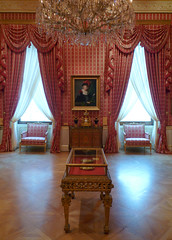
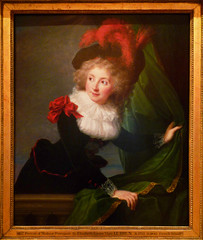
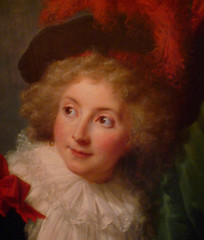
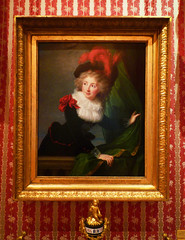
Video \(\PageIndex{4}\): Élisabeth-Louise Vigée Le Brun, Madame Perregaux, 1789, oil on oak panel, 99.6 x 78.5 cm (Wallace Collection, London)
Smarthistory images for teaching and learning: